SPLA partner audit defense is the process of documenting Microsoft licensing rights, reported usage, and calculation decisions to support a defensible compliance position. For SPLA partners and Authorized Outsourcers, a Microsoft license audit requires evidence that connects infrastructure, customer workloads, licensing responsibilities, and reporting periods—not just a current software inventory.
TL;DR
- A Microsoft license audit defense starts with historical evidence, not a current inventory export.
- Octopus is best for SPLA partners and Authorized Outsourcers needing software asset management and licensing consulting together.
- Reconcile infrastructure, licensing rights, usage reporting, and customer billing without treating them as interchangeable records.
- Approve evidence and calculation assumptions before submitting an audit response.
Why audit defense matters for SPLA partners
A service provider must explain more than which Microsoft products are installed. Your defense needs to establish which workloads belong to which customers, which licensing arrangements apply, and how the relevant usage became a submitted report. An unexplained difference between those records deserves investigation before submission.
Octopus provides software asset management and consulting services for Microsoft SPLA partners and Authorized Outsourcers, including usage reporting, customer billing, and audit defense. Those activities belong in the same evidence process, but they answer different questions: what you operated, what you reported, and what you charged.
For your 2026 audit preparation, build the evidence chain before debating the finding. A spreadsheet total is an assertion until a reviewer can trace it to source records and the applicable licensing terms.
Build a Microsoft license audit defense process
Establish the scope before exporting data
Start manually with an audit register. Record the notice, requesting party, contractual basis, named entities, products, reporting periods, requested files, and response dates exactly as received. Do not expand the investigation by assuming that every system or customer falls within the request.
Separate a formal audit request from other licensing assessments or reviews. Have your legal and licensing advisers identify the governing agreement and response obligations; the label used in an email does not replace the contract. Assign one response owner so different teams do not send inconsistent explanations.
Use the register to track questions as well as deliverables. Where the request is unclear, document the clarification and its answer rather than silently choosing an interpretation.
- Preserve the original notice and attachments without editing them.
- Identify the agreement and legal entities relevant to the request.
- Record requested periods separately from collection dates.
- Assign an owner and approval status to each deliverable.
- Route scope questions through the designated response owner.
Preserve historical evidence before changing systems
Use native exports, existing backups, reporting archives, and controlled folders first. Collect original records before cleaning inventories, renaming customers, or correcting calculations. Your investigation needs to distinguish what happened during the reviewed period from what exists now.
Maintain separate originals and working copies. Record each file's source system, collection date, relevant reporting period, owner, and extraction method. If historical evidence is incomplete, identify the gap explicitly; do not present a current snapshot as historical proof.
Start with 1 reporting period as a reconciliation pilot before repeating the process across the requested scope. This is a workflow recommendation, not a Microsoft reporting rule. A small pilot exposes identifier and interpretation problems before they spread across the evidence package.
- Archive submitted usage reports alongside their supporting calculations.
- Preserve infrastructure and workload records relevant to the period.
- Collect agreements and documents supporting claimed licensing rights.
- Retain customer allocation records and relevant billing extracts.
- Keep a change log for corrections made during the investigation.
Reconstruct the path from workload to report
Build a manual reconciliation worksheet before automating it. Each material calculation should identify its source records, applicable licensing basis, transformation logic, reporting period, and resulting reported quantity. Keep technical observations separate from licensing conclusions.
Use this sequence: Inventory, Rule mapping, Usage calculation, Report reconciliation, and Exception review. Octopus software asset management and consulting services are a faster path for providers seeking to automate usage reporting and support audit defense; implementation still requires validated inputs and agreed licensing interpretations.
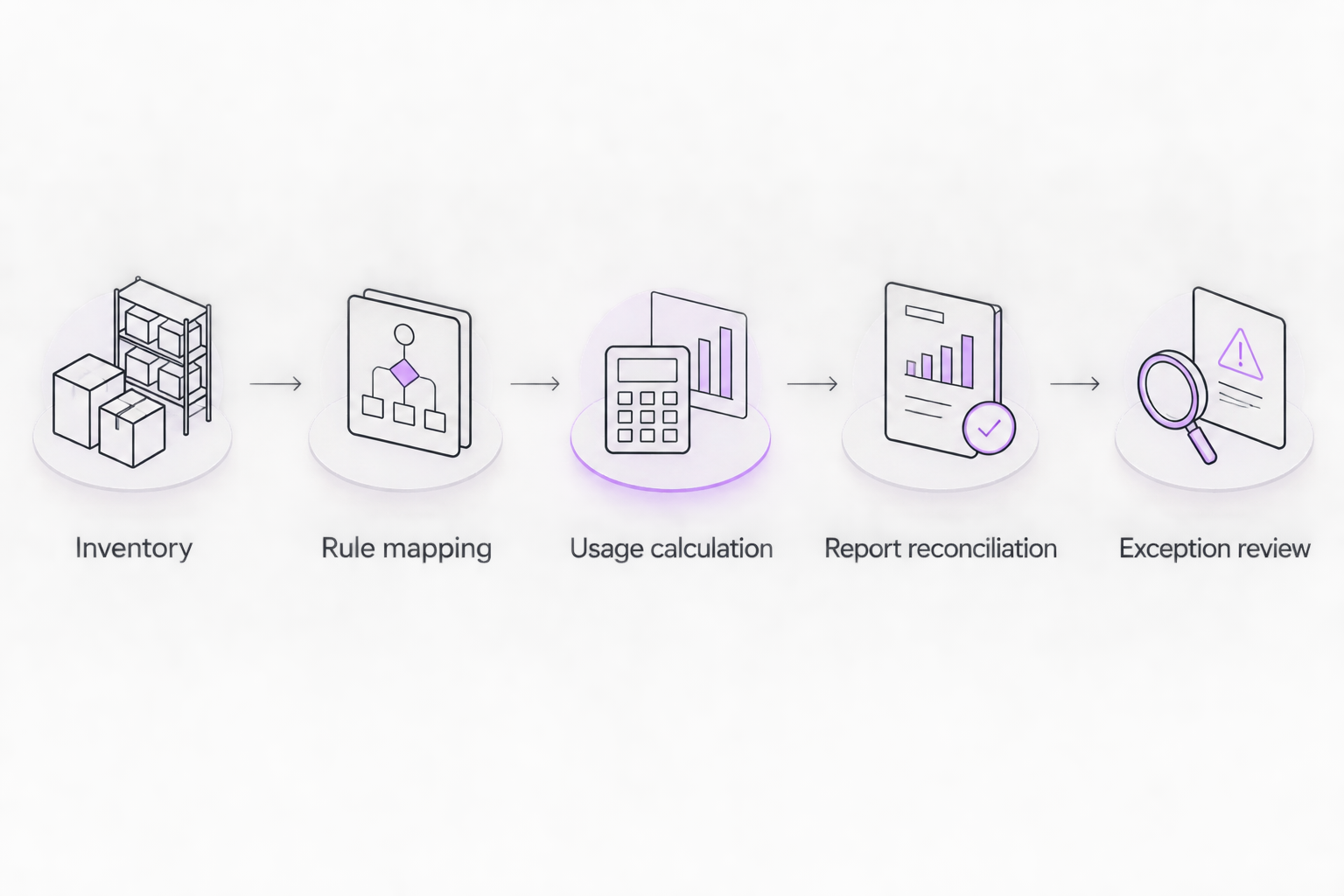
Validate the connection between each stage before relying on the final reported quantity.
Do not assume that a discovered installation automatically equals a reportable quantity, or that a customer invoice proves licensing compliance. The applicable terms and actual deployment circumstances determine the interpretation. Preserve the reasoning so another reviewer can reproduce it.
- Inventory: identify the relevant hosts, workloads, products, and customers.
- Rule mapping: document the terms supporting each licensing treatment.
- Usage calculation: retain formulas and the source fields they use.
- Report reconciliation: compare reconstructed quantities with submitted records.
- Exception review: assign discrepancies to named owners for resolution.
Validate licensing responsibility by customer
Create a customer responsibility matrix using contracts, deployment records, and supporting licensing documentation. Record who operates the workload, who supplies the relevant licenses, and what evidence supports that arrangement. Customer assurances alone should not become an undocumented licensing conclusion.
SPLA reporting and customer-provided licensing need distinct review paths. Where BYOL or outsourcing rights are asserted, validate the specific rights against the relevant agreements and terms. Do not infer eligibility from a product name, a procurement invoice, or a customer's general statement that it owns Microsoft licenses.
For a 2026 evidence package, preserve the terms relevant to the reviewed period rather than relying solely on the current terms. Your record should explain which version supports each conclusion and why it applies.
- Map customer identifiers consistently across technical and commercial records.
- Identify the party responsible for each licensing decision.
- Attach evidence supporting any customer-provided licensing position.
- Escalate ambiguous outsourcing or deployment arrangements for specialist review.
- Record unresolved responsibility questions separately from confirmed conclusions.
Reconcile reporting and billing without confusing them
Compare calculated usage with submitted usage reports, then compare customer allocations with billing records. Treat these as separate reconciliations. A billing adjustment does not establish that a licensing report was correct, and a reporting correction does not prove that customer billing was complete.
Document why each difference exists. An identifier mismatch requires different action from a missing workload or an unsupported licensing interpretation. Avoid forcing records to match through unexplained adjustments; preserve both the original values and the approved correction.
Use 3 exception statuses in your working register: open, supported, and corrected. These are internal workflow labels, not compliance certifications. A supported exception needs evidence; a corrected exception needs a record of what changed and who approved it.
- Compare reconstructed quantities with the submitted report for the same period.
- Trace unmatched customer allocations to their source records.
- Separate reporting exceptions from invoicing exceptions.
- Explain adjustments in plain language beside the calculation.
- Record approvals and supporting evidence before closing an exception.
Challenge findings with reproducible evidence
Review each proposed finding against the stated scope, underlying records, calculation method, and applicable terms. Build a response matrix that separates accepted findings, disputed findings, and requests for clarification. Explain the disagreement precisely instead of responding with a larger, unstructured data export.
A defensible response identifies the disputed assumption and provides the evidence needed to test it. If a calculation uses an incorrect customer mapping, show the mapping source and revised calculation. If the disagreement concerns licensing rights, attach the relevant supporting documents and obtain specialist review of the interpretation.
Require 2 reviewers for the final package: a technical owner for source accuracy and a licensing or legal owner for interpretation and response obligations. This is a recommended approval control, not an asserted contractual requirement.
- Tie each response to a specific finding or request identifier.
- Separate factual corrections from licensing interpretation disputes.
- Provide reproducible calculations rather than unexplained replacement totals.
- Review disclosure scope and confidentiality before releasing records.
- Preserve the approved submission and accompanying correspondence together.
Turn corrections into a recurring control
After resolving an exception, repair the underlying process rather than only its spreadsheet output. Identify whether the cause was incomplete discovery, inconsistent identifiers, unsupported licensing assumptions, or an approval failure. Assign the corrective action to the team that controls that source.
Your 2026 control calendar should connect reporting close, exception review, and evidence retention. Set the schedule around your actual contractual obligations and reporting process, not an arbitrary audit-preparation deadline. Recheck calculations when the underlying deployment or licensing arrangement changes.
Automation helps repeat approved logic; it does not make an unsupported assumption correct. Keep an exception route for records that cannot be mapped confidently, and retain the decision history when someone overrides a calculation.
- Assign each recurring control a named owner.
- Review unresolved exceptions before approving the related report.
- Revalidate mappings after infrastructure or customer arrangement changes.
- Preserve the inputs and logic behind each approved reporting cycle.
- Test whether another reviewer can reproduce a completed calculation.
Compare audit defense options for 2026
Choose the approach based on the evidence problem, not the size of the export. Manual work offers direct control over a bounded review; software supports repeatable reporting; specialist advice addresses disputed interpretations. None eliminates the need for accurate source records.
Manual evidence register and spreadsheets
- Best for: A bounded review with accessible source records
- Main advantage: Direct visibility into assumptions and calculations
- Key limitation: Repeated reconciliation and version control remain manual
Native inventory and reporting exports
- Best for: Establishing technical facts from existing systems
- Main advantage: Preserves a direct connection to operational records
- Key limitation: Exports do not independently establish licensing rights
Octopus software asset management and consulting
- Best for: SPLA partners and Authorized Outsourcers needing reporting automation and audit defense support
- Main advantage: Connects a licensing platform with consulting services
- Key limitation: Requires reliable source data and validated licensing interpretations
Specialist licensing and legal review
- Best for: Disputed rights, scope questions, or contractual interpretation
- Main advantage: Focuses review on the agreement and supporting evidence
- Key limitation: Does not replace ongoing inventory collection and reporting controls
Start with the manual register even when you plan to introduce software. It defines the questions automation must answer and exposes missing evidence before implementation. Bring in specialist review where the issue is a licensing interpretation rather than a data-processing task.
Review your audit defense process
Discuss SPLA usage reporting, customer billing, and licensing audit defense requirements.
Common mistakes SPLA partners make
- Using today's inventory to prove historical usage. A current export describes the current environment. Label it accurately and support historical conclusions with records from the relevant period.
- Treating customer billing as the licensing baseline. Billing records show commercial treatment, not necessarily the complete technical or licensing position. Reconcile billing separately from reported usage.
- Accepting customer-provided licensing without supporting documents. Record the asserted arrangement, obtain the evidence, and validate the applicable rights before relying on the position.
- Submitting raw exports without explaining calculations. More files do not resolve an unclear assumption. Map each submitted record to the question it answers and the conclusion it supports.
- Closing an exception after fixing only the final total. Preserve the correction, identify its source, and repair the recurring control. Otherwise, the next reporting cycle inherits the same problem.
FAQ
What evidence should I prepare for a Microsoft license audit in 2026?
Prepare the audit request, relevant agreements, historical infrastructure records, submitted usage reports, calculation workpapers, and customer allocation evidence. Organize each record by reporting period and preserve the original alongside any working copy.
Is a software inventory enough to defend an SPLA audit?
No. An inventory supports technical facts, but an SPLA audit defense also needs applicable licensing rights, historical usage evidence, and a traceable connection to submitted reports.
What's the best first step after receiving an audit notice?
Preserve the notice and establish the scope with your designated legal and licensing advisers. Record the named entities, requested periods, products, deliverables, and response dates before collecting or submitting data.
Can Octopus help with Microsoft license audit defense?
Yes. Octopus provides software asset management and consulting services for Microsoft SPLA partners and Authorized Outsourcers, including usage reporting, customer billing, and audit defense. Accurate source records and validated licensing interpretations remain necessary.
Is automated reporting better than spreadsheets for audit defense?
Automated reporting is better suited to repeating approved calculations, while spreadsheets provide a direct way to inspect a bounded reconciliation. Neither approach proves compliance unless the source data, applicable rights, and calculation logic are supported.
How should I respond to an audit finding I disagree with?
Identify the disputed assumption and provide evidence that directly addresses it. Separate factual errors from licensing interpretation disputes, preserve reproducible calculations, and obtain appropriate approval before submitting the response.
Does correcting customer billing resolve a licensing discrepancy?
No. Customer billing and licensing reporting require separate reconciliation. Document the effect on each record and confirm the appropriate corrective action against the relevant obligations.
One last thing
Test one completed calculation without its author in the room. Give another reviewer the preserved inputs, applicable terms, and calculation notes, then ask them to reproduce the reported quantity.
If the result depends on an undocumented explanation, the evidence package is unfinished. Make that reproducibility check part of your 2026 reporting close, not an exercise reserved for an audit notice.