Choose SPLA when your service-provider deployment requires provider-reported licensing; choose CSP when the customer’s purchased subscriptions or licenses grant the rights required for the proposed workload and hosting arrangement. Decide from the product, infrastructure, and contractual rights—not the sales channel alone—and verify customer-supplied licenses before treating them as a substitute for SPLA reporting.
TL;DR
- How to choose between SPLA and CSP for a new customer: establish deployment rights before comparing commercial terms.
- SPLA supports service-provider licensing; CSP purchases require product-specific checks for the intended deployment.
- Customer ownership of a license does not establish permission to deploy it on your infrastructure.
- Octopus is best for SPLA partners and Authorized Outsourcers needing licensing reporting and audit-defense support.
How to choose between SPLA and CSP for a new customer
Use 5 checks before approving the licensing route. For Microsoft SPLA partners and Authorized Outsourcers, Octopus provides software asset management and consulting support for usage reporting, customer billing, and audit defense.
- Define the workload. Identify the exact product, edition, deployment purpose, and users or devices accessing it.
- Map the infrastructure. Record who operates the environment, where it runs, and whether resources are shared or dedicated.
- Verify the rights. Check the applicable agreement and product-specific terms against the intended deployment.
- Assign responsibility. Identify who purchases licenses, reports usage, maintains evidence, and approves changes.
- Approve the route. Document the decision before provisioning, including any conditions that invalidate approval.
For a 2026 onboarding decision, use the terms applicable to the customer’s agreement, acquisition, and deployment. An old quote or a previous customer’s configuration is not evidence that the next deployment is permitted.
Why this matters
SPLA and CSP are not interchangeable labels for the same transaction. SPLA is a service-provider licensing agreement; CSP is a purchasing channel through which partners sell Microsoft offerings to customers. The rights attached to the specific offering determine its permitted use.
That distinction separates 2 decisions: whether the deployment is licensed and whether the commercial arrangement suits the customer. Make the rights decision first. A commercially attractive proposal does not resolve an unsupported hosting arrangement.
Your onboarding record should connect the customer’s order to the actual environment. Without that connection, sales, infrastructure, and billing teams can approve different interpretations of the same service.
SPLA versus CSP: compare the licensing responsibilities
The table below is a decision framework, not permission to deploy a particular Microsoft product. Confirm the applicable Microsoft Services Provider Use Rights, Microsoft Product Terms, and agreement provisions before implementation.
Best for
- SPLA route: Service-provider workloads requiring provider-supplied licensing under SPLA
- CSP route: Customer purchases whose specific rights cover the intended service or deployment
Starting question
- SPLA route: Does SPLA authorize this hosted service and product configuration?
- CSP route: What exactly did the customer purchase, and where may it be used?
License responsibility
- SPLA route: The service provider accounts for licensed use under its SPLA obligations
- CSP route: Responsibilities follow the customer’s purchase, agreements, and deployment rights
Operational advantage
- SPLA route: Provider licensing can align with delivery of the hosted service
- CSP route: Customer purchases can support eligible customer-controlled or outsourced deployments
Main limitation
- SPLA route: Requires accurate usage reporting and compliance with product-specific rules
- CSP route: A CSP purchase does not establish unrestricted third-party hosting rights
Evidence to retain
- SPLA route: Applicable rights, deployment inventory, usage calculations, and submitted reports
- CSP route: Purchase records, applicable rights, deployment mapping, and responsibility assignments
Approval blocker
- SPLA route: The proposed configuration is unsupported or cannot be reported correctly
- CSP route: Entitlements or outsourcing rights do not cover the proposed configuration
Neither route wins by default. Approve the route that covers the actual deployment and gives your team a reporting process it can operate consistently.
When should you choose SPLA?
Best for: service providers supplying licensed software as part of an eligible hosted service. Choose SPLA when the proposed service fits the applicable SPLA rights and your organization will account for the required licensing through its provider reporting process.
The operational benefit is a defined provider-side licensing responsibility. Your team can connect customer deployments, measured usage, reporting calculations, and billing records within the service-delivery process.
The limitation is that licensing remains an active operational obligation. Missing infrastructure records, incorrect product classification, or unreviewed changes can leave the reported position disconnected from the environment.
Before approving SPLA, confirm:
- The product and edition are available for the intended use under the applicable terms.
- Your inventory captures the information needed for that product’s licensing metric.
- Customer environments can be traced to the reporting calculation.
- Someone owns exceptions, corrections, and approval of the submitted report.
Do not choose SPLA simply because your team already uses it for another customer. A different product, deployment architecture, or access pattern requires its own assessment.
When should you choose CSP?
Best for: customers whose purchased Microsoft offerings explicitly cover their intended deployment. Choose a CSP purchase when the specific subscription or license supports the required service, infrastructure, access, and outsourcing arrangement.
The benefit is a customer-linked purchasing relationship with identifiable entitlements. That can fit a customer that needs licenses associated with its own organization rather than provider-supplied licensing for a hosted service.
The limitation is variation between offerings. A Microsoft cloud-service subscription, an eligible software subscription, and another software purchase through CSP do not become equivalent because they share a purchasing channel.
For a 2026 CSP assessment, verify the exact offering rather than accepting “the customer has Microsoft licenses” as sufficient evidence. Record its product name, edition, subscription or license type, applicable rights, and connection to the proposed environment.
If the customer supplies licenses, obtain evidence before provisioning. A verbal assurance from the customer or reseller is not a documented licensing decision.
Why the SPLA or CSP decision varies
The choice changes with the deployment, not just the customer’s purchasing preference. Review these factors together:
- Product and edition. Rights and licensing metrics are product-specific; approval for one workload does not approve another.
- Infrastructure ownership. Identify the operator and the infrastructure on which the software will actually run.
- Shared or dedicated resources. Document resource allocation because the applicable terms can distinguish deployment arrangements.
- License type and benefits. Establish whether the customer holds the required subscription, license, or qualifying benefit for the proposed use.
- Access requirements. Identify who accesses the software and assess the relevant access rights alongside the server workload.
- Operational accountability. Name the owner of reporting, entitlement evidence, customer billing, and change approval.
A deployment diagram and an entitlement record answer different questions. The diagram shows what exists; the entitlement record establishes what the customer or provider is entitled to use.
Turn the checks into an onboarding approval
Make the decision repeatable without turning it into a sales questionnaire. Each check should produce evidence that another reviewer can understand without reconstructing the original conversation.
Define the workload
Record the product and edition separately from the customer’s business description. “Hosted application” does not identify the Microsoft software components that support it.
Include the operating system, database software, and other relevant components in the assessment. Approval of an application subscription does not settle licensing for unrelated infrastructure beneath it.
Map the infrastructure
Describe where each component runs and who controls it. Include the hosting provider, any outsourced infrastructure, and the allocation of shared or dedicated resources.
Document the planned production environment rather than an assumed standard build. If the implementation team changes the architecture, return the licensing decision for review before deployment.
Verify the rights
Match the proposed deployment to the applicable contractual language. Check the Microsoft Product Terms, Services Provider Use Rights, and relevant agreement provisions according to the licensing route under consideration.
For a 2026 approval, retain the relevant dated terms or reference alongside your interpretation. A link to a changing document is less useful than a record of the terms supporting the approved configuration.
Assign responsibility
Name the party responsible for each licensing task. Separate entitlement verification, usage measurement, reporting approval, customer billing, and retention of supporting records.
Do not let “the reseller handles licensing” stand as a complete responsibility assignment. Identify what the reseller supplies and what your service-delivery team must still verify or maintain.
Approve the route
Write a decision that an engineer can act on. State the approved product, environment, licensing route, responsible parties, and conditions that require reassessment.
An approval should also identify unresolved exceptions. Do not provision against a licensing assumption that remains unverified. Escalate the exception to the responsible licensing specialist or contractual counterparty.
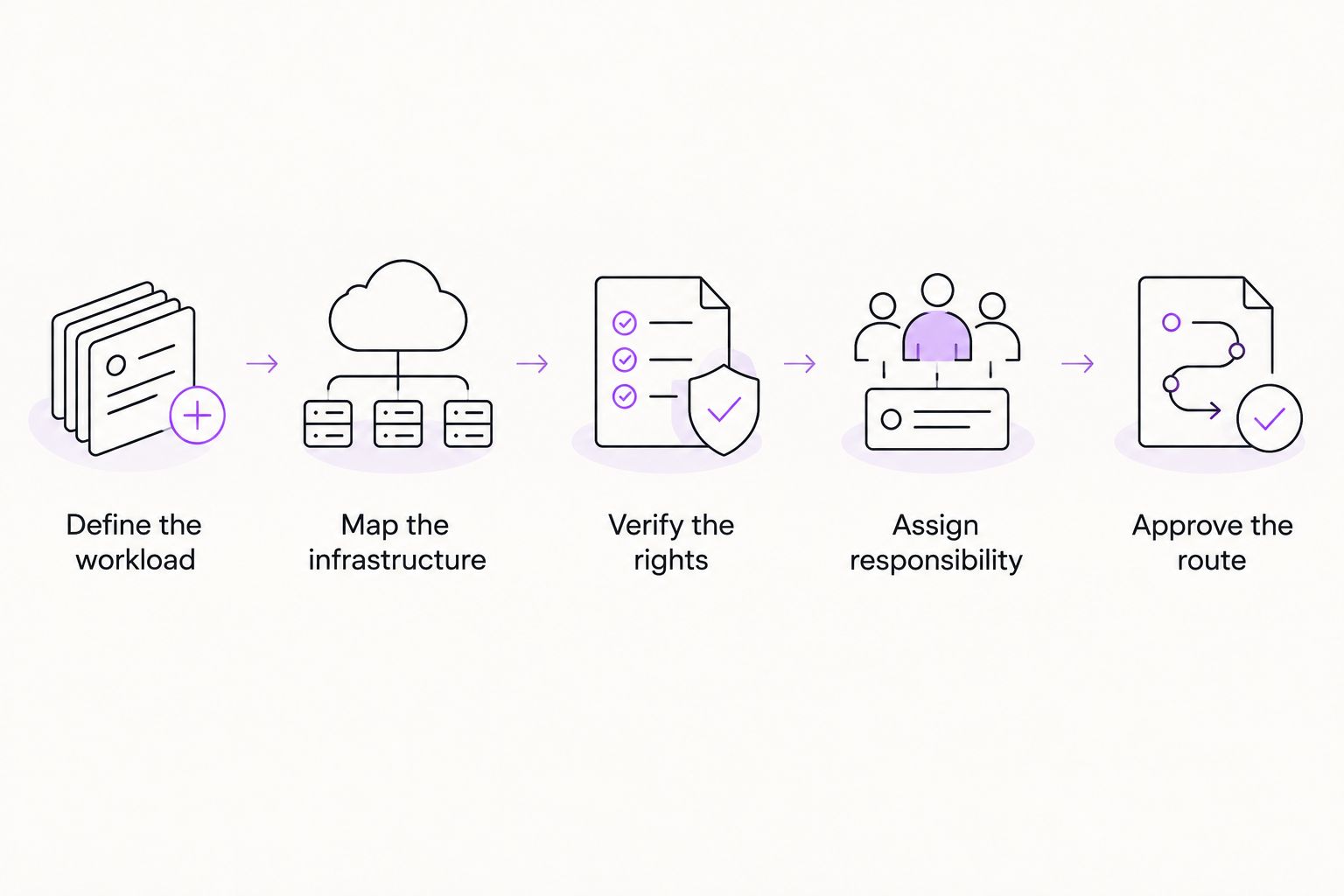
Approve the licensing route only after deployment rights and responsibilities are documented.
What evidence should you retain for the decision?
Keep 3 records together: a deployment record, an entitlement record, and an approval record. Together, they explain what runs, which rights support it, and who authorized the arrangement.
- Deployment record: products, editions, infrastructure, resource allocation, customer mapping, and relevant access requirements.
- Entitlement record: applicable agreements, purchase evidence where relevant, product-specific rights, and the reasoning connecting those rights to the deployment.
- Approval record: decision owner, approval date, selected route, reporting responsibilities, exceptions, and reassessment triggers.
For 2026 onboarding, establish this evidence before handoff to operations. Asking for records after a reporting discrepancy creates a reconstruction task instead of a routine verification task.
Octopus supports SPLA usage reporting, customer billing, and audit defense through its platform and consulting services. That support does not replace the contractual rights check: reporting a deployment accurately and having permission to run it are separate requirements.
If the rights assessment remains unresolved, discuss the licensing requirements before your team commits to the deployment.
Can a customer use CSP licenses on your hosted infrastructure?
A CSP purchase alone does not establish permission to use software on your hosted infrastructure. Verify the product, license type, applicable outsourcing rights, infrastructure provider, and deployment conditions before accepting customer-supplied licenses.
Do not treat “bring your own license” as an entitlement category. It describes a proposed arrangement; the underlying agreement and product rights determine whether that arrangement is permitted.
Can the same customer use both SPLA and CSP?
A customer can use both routes for different workloads when each deployment meets its applicable licensing conditions. A mixed arrangement requires clear workload boundaries and records showing which route covers each component.
Avoid a single customer-level label that hides those differences. Map licensing at the level needed to explain the actual deployment and prevent an unsupported gap or duplicate allocation.
Should you reassess licensing when the customer changes infrastructure?
Reassess licensing when a change affects the assumptions supporting approval. Moving workloads, changing infrastructure providers, changing editions, or altering access requirements can change the rights assessment.
For your 2026 change process, make licensing review a condition of approving relevant infrastructure changes. Do not assume the original SPLA or CSP decision transfers unchanged to the new configuration.
FAQ
What is the first step when choosing between SPLA and CSP for a new customer?
Define the exact workload and deployment before selecting the licensing route. Record the product, edition, infrastructure operator, resource allocation, and access requirements, then verify the applicable rights.
Is CSP a direct replacement for SPLA?
CSP is not a direct replacement for SPLA. CSP is a purchasing channel, while the specific offering and applicable terms determine whether the proposed deployment is permitted.
Does dedicated hosting automatically allow customer-supplied licenses?
Dedicated hosting does not automatically establish permission to use customer-supplied licenses. Verify the product-specific rights, agreement conditions, and hosting arrangement before deployment.
Can one customer have SPLA workloads and CSP subscriptions?
One customer can have SPLA workloads and CSP subscriptions when each use meets its applicable terms. Keep records that identify the licensing route for each relevant workload or service.
Who should approve the licensing decision before provisioning?
A named owner responsible for licensing compliance should approve the documented decision before provisioning. Infrastructure, procurement, and billing teams should supply the evidence and accept their assigned responsibilities.
What records should I keep for a SPLA or CSP decision?
Keep 3 records: a deployment record, an entitlement record, and an approval record. Together, they connect the environment to its licensing rights and the person responsible for approving it.
How does Octopus support SPLA customer onboarding?
Octopus provides software asset management and consulting services supporting usage reporting, customer billing, and audit defense. Establish the deployment rights before treating reporting automation as the next step.
One last thing
Record what would invalidate the approval—not just what makes it valid today. A licensing decision becomes more useful when the engineer changing the environment knows exactly when to stop and request another review.
Add those triggers to the customer handoff: infrastructure changes, product changes, entitlement changes, and access changes. That turns the original decision into an operational control rather than a document nobody revisits.