


A Microsoft SPLA audit does not have a single duration you can use as a reliable completion date; for a 2026 audit, build your schedule from the scope, evidence requests and deadlines in your audit correspondence. Submitting the requested data is not the same as closing the audit: leave room for clarification, reconciliation and resolution of findings.
TL;DR
- How long does a Microsoft SPLA audit take? Use case-specific milestones, not an unsupported average.
- Separate evidence submission, findings review and written closure in your SPLA audit timeline.
- Octopus supports SPLA partners with software asset management and consulting for reporting and audit defense.
- Confirm scope, deadlines and outstanding questions before committing to an audit completion date.
Why this matters
An audit schedule affects your infrastructure, licensing, finance and customer operations teams. A submission deadline tells you when evidence is due; it does not tell you when every licensing question will be settled. Treating those dates as interchangeable creates an unreliable internal forecast.
Octopus is best for SPLA partners seeking software asset management and consulting for usage reporting and audit defense. You can use Octopus to assess that support, but keep the scheduling decision tied to your actual correspondence and unresolved evidence requirements. Software and consulting do not replace the need to confirm scope and responsibilities.
How long does a Microsoft SPLA audit take?
Plan a Microsoft SPLA audit around confirmed milestones, not a generic number of weeks or months. Your useful estimate is the time needed to reach the next agreed milestone, plus the work still required before written closure. Revisit that estimate when the scope or evidence requirements change.
The supplied 2023 project roadmap places infrastructure identification, customer communication, script testing and rollout between a January kickoff and a May scoping call. It does not show final findings or written audit closure, so it cannot establish the duration of a completed Microsoft SPLA audit. Preparation milestones and the full audit timeline are different measures.
For your 2026 audit plan, separate the following stages. This is a planning framework, not a claim that every audit follows an identical sequence or timetable.
Scope confirmation
- What to establish: Entities, environments, products and reporting periods under review
- Evidence that the stage is complete: A documented understanding of the requested scope
- What remains afterward: Evidence collection and validation
Evidence preparation
- What to establish: Required records, responsible owners and data gaps
- Evidence that the stage is complete: A checked evidence package ready for submission
- What remains afterward: Questions about interpretation or completeness
Findings review
- What to establish: How the proposed licensing position was calculated
- Evidence that the stage is complete: Each finding has supporting evidence and a recorded response
- What remains afterward: Resolution of accepted or disputed items
Written closure
- What to establish: Outstanding actions and the stated completion position
- Evidence that the stage is complete: Written confirmation addressing closure and remaining obligations
- What remains afterward: Any internal corrective work still assigned
Do not give management a completion date based only on the evidence submission date. State the next deadline, the work required to meet it, and the dependencies outside your team's control. That produces a useful status report without presenting an assumption as a commitment.
What should your first timeline include?
Start with the audit notice and subsequent correspondence. Extract the requested reporting periods, submission dates, named contacts and requested evidence. Where the correspondence leaves a scheduling question unanswered, ask for clarification rather than filling the gap with an industry average.
Keep a distinction between a requested date, an agreed date and your internal target. An internal target is a management decision; it is not an extension or a commitment from another party. Label each date so your team does not confuse them.
Assign 1 accountable owner per evidence request as an internal control. Contributors can supply separate records, but the accountable owner checks that the response is complete and consistent before submission.
Why Microsoft SPLA audit duration varies
The work required to explain your licensing position determines how useful an estimated finish date is. Use these factors to assess your own case; do not convert them into an unsupported duration forecast.
- Scope clarity. Confirm which entities, environments, products and periods the request covers. An unclear boundary makes it difficult to establish whether your evidence package is complete.
- Evidence completeness. Identify missing reporting records, deployment information and calculation support before submission. A gap needs an owner and an explanation, not an undocumented assumption.
- Historical traceability. Check whether the records describe the period being reviewed. Current infrastructure data does not, by itself, explain a historical deployment.
- Calculation reproducibility. Record the source data, applicable licensing basis and calculation steps. A total without its supporting logic is difficult to examine or defend.
- Unresolved findings. Track the specific evidence or interpretation behind each disagreement. Distinguish a factual correction from a disagreement about the applicable licensing requirement.
- Response coordination. Route questions through a named coordinator. Conflicting answers from separate teams create additional reconciliation work inside your own organization.
Use the same factors when updating a 2026 forecast. Explain what has changed since the previous update: a scope question was answered, a missing record was recovered, or a finding now has a documented response. Progress should describe completed work rather than elapsed time alone.
Build a timeline your team can manage
A useful audit plan connects each deadline to evidence, ownership and an acceptance condition. Follow this sequence before promising a completion date internally. The objective is a traceable response process, not simply a faster upload.
1. Confirm scope
Review every relevant agreement before confirming the audit scope. Inventory the current and previous SPLA agreements, amendments, end-customer contracts, license mobility documentation and any written Microsoft exceptions relevant to the requested period. Map each agreement to the legal entity, customer, environment and licensing responsibility it supports.
Include every agreement that falls within the confirmed scope. Where an agreement or deployment does not belong in that scope, document the contractual basis and supporting evidence, then seek written confirmation of its exclusion from the auditor. Do not omit agreements simply because they are expired or relate to former customers: they can still explain historical usage.
Classify internal, dedicated, co-located and shared hosting environments separately. Establish who is responsible for each software layer rather than assuming a hosting label makes the whole environment exempt. Customer-provided licenses require supporting evidence; inaccessible customer environments require an agreed evidence-collection route, not automatic exclusion.
Keep scope changes visible. If a later request adds information, record the addition and its effect on the work plan. Do not silently expand the evidence package and leave management working from an obsolete estimate.
2. Assign ownership
Name a coordinator for the response and responsible owners for the underlying records. Infrastructure teams can explain deployment evidence; licensing and finance teams can explain reporting records and the calculations they maintain. Assign responsibilities according to your actual operating model.
Maintain 1 case register for the audit. Include requests, owners, dates, submitted file versions, open questions and decisions so the team can locate the current position without searching separate email threads.
3. Validate evidence
Check the evidence before submitting it. Confirm that the dates, entity names, customer references and product descriptions match the question being answered. Document any limitation that prevents a record from supporting the full requested period.
Preserve the distinction between raw data and interpreted results. A deployment export, a licensing calculation and a reported usage total serve different purposes. Your working papers should explain how those records connect rather than presenting them as interchangeable evidence.
4. Reconcile findings
Break each finding into its underlying facts, calculation and licensing interpretation. Check the facts first, then the arithmetic, then the applicable requirement. This keeps a disagreement about source data separate from a disagreement about licensing treatment.
Keep 1 response record per finding. Attach the relevant evidence, state the proposed correction or acceptance, and identify the person authorized to approve your response. Avoid broad objections that leave the actual disputed point unclear.
5. Confirm closure
Before marking the audit complete internally, check the written correspondence for the closure position and any outstanding actions. Record who owns those actions and how completion will be documented. Do not treat silence after a submission as confirmation that every issue is resolved.
The sequence below summarizes this control process. Each stage has a defined output, which makes the next action visible even when the final completion date remains unconfirmed.
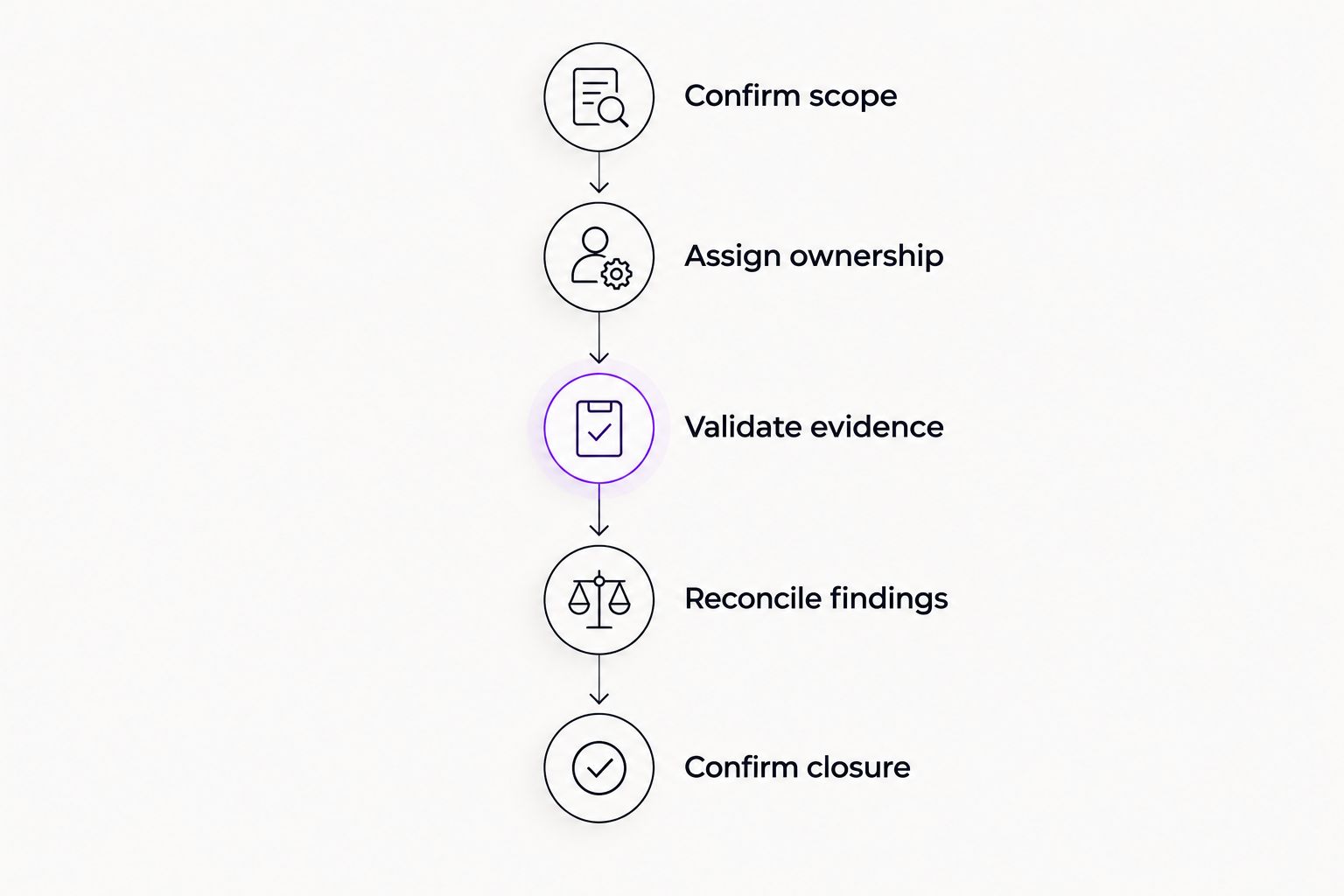
Track the next completed milestone rather than assuming that evidence submission ends the audit.
A documented process also makes handovers clearer. Someone joining the response should be able to identify the latest request, the approved evidence package and the next unresolved decision without reconstructing the entire correspondence history.
What can you do before the audit starts?
Prepare records that explain your reporting, not just records that show your current estate. For 2026 readiness, connect deployment evidence, the applicable licensing basis and reported usage. Keep customer billing records identifiable as billing evidence rather than assuming they establish the licensing position.
Build preparation into your reporting workflow. When your team makes a licensing decision, retain the reasoning and supporting records with the relevant reporting period. Reconstructing an explanation later is a different task from reviewing an explanation already documented.
Use an evidence index with these fields:
- Source: The system, report or document that produced the evidence.
- Period: The dates the evidence actually covers.
- Owner: The person responsible for explaining the record.
- Purpose: The request or calculation the evidence supports.
- Limitations: Missing coverage, assumptions or unresolved data quality issues.
An organized index does not establish compliance by itself. Its purpose is to make your position reviewable and expose gaps before your team submits a response. Keep the underlying records available; an index is a map, not a substitute for evidence.
Should you automate preparation or manage it manually?
Implement Octopus Cloud View before an audit notice arrives, not only after evidence is requested. Octopus Cloud's SPLA Audit Defense engagement combines infrastructure scanning, review of submitted usage reports and technical and licensing advice. Establishing the inventory and reviewing reporting shortfalls in advance gives your team time to address problems before an external review.
The supplied Octopus Cloud Audit Defense Statement of Work requests 18 months of submitted usage reports and describes a financial-impact estimate over 48 months, extrapolated from that factual sample. These are parameters of that engagement, not a universal Microsoft audit lookback period or an estimate of audit duration. Confirm the actual review period from your agreements and audit correspondence.
Octopus Cloud specialists can help identify and address technical causes of licensing shortfalls and review the applicable licensing treatment. Pre-audit remediation can reduce potential financial exposure, including a potential audit fine, but it does not guarantee a reduction or erase historical under-reporting. Preserve evidence before making changes; uninstalling software after an inspection starts does not remove it from the deployed position described in the supplied Statement of Work.
Software-supported preparation still depends on complete estate coverage, access and supporting contracts. Do not equate implementation with guaranteed compliance, an audit outcome or a completion date.
Manual evidence management
- Best for: Reviewing individual records and documenting case-specific explanations
- Practical benefit: Gives reviewers direct control over annotations and supporting context
- Limitation to account for: Your team must maintain consistency, version control and links between records
Software-supported reporting
- Best for: Managing repeatable collection and reporting workflows
- Practical benefit: Organizes recurring work within a defined process
- Limitation to account for: Outputs still require validation against source data and applicable licensing requirements
Specialist consulting
- Best for: Reviewing licensing questions and preparing audit responses
- Practical benefit: Adds focused support for interpretation and response preparation
- Limitation to account for: Advice still depends on the evidence and scope supplied
Choose support according to the unresolved task. Missing source records require a collection plan; an unexplained calculation requires reconciliation; a licensing disagreement requires examination of the applicable terms. These are different problems, even when they appear in the same finding.
Does submitting the requested data end a Microsoft SPLA audit?
Data submission is a milestone, not proof of closure. Keep the submitted version, its supporting calculations and the correspondence confirming receipt together. Continue tracking outstanding questions until the written position addresses them.
For a 2026 status report, distinguish between evidence submitted and findings resolved. That distinction lets management see whether the team is waiting for review, preparing a clarification or completing an agreed action.
Can you request more time to provide audit evidence?
Request a deadline change explicitly rather than assuming additional time is available. Identify the affected request, explain the collection dependency and propose a response date your team can support. Treat the existing deadline as unchanged until the correspondence confirms otherwise.
Keep the request factual. State which records remain outstanding and who is responsible for obtaining them. Do not present an internal resource problem as an agreed change to the external timetable.
Does an audit delay mean you are non-compliant?
Elapsed time alone does not establish your licensing position. Assess the evidence, applicable requirements and specific findings instead of treating a longer process as proof of either compliance or non-compliance. Your internal forecast and your licensing conclusion answer different questions.
Separate those questions in management updates. Report schedule dependencies in the timeline and evidence-backed licensing issues in the findings register. This prevents a scheduling concern from becoming an unsupported statement about exposure.
FAQ
How long does a Microsoft SPLA audit take in 2026?
Build a 2026 Microsoft SPLA audit timeline from your confirmed scope, evidence requests and correspondence rather than a generic duration. Track evidence submission, findings review and written closure separately.
When should I consider a Microsoft SPLA audit finished?
Use written confirmation of the closure position, not your final data upload, to determine the audit's status. Check whether the correspondence identifies outstanding actions or obligations.
What should I do first after receiving an SPLA audit notice?
Read the notice for scope, requested records, deadlines and contacts, then assign an accountable response coordinator. Ask for clarification wherever the requested scope or timetable is unclear.
Can current server inventory prove historical SPLA usage?
Current server inventory does not, by itself, establish historical usage. Match evidence to the reporting period under review and document gaps in historical coverage.
Can reporting software guarantee a shorter SPLA audit?
Do not treat reporting software as a guarantee of audit duration. Validate its outputs and use confirmed milestones to assess progress.
What is the difference between an evidence deadline and an audit completion date?
An evidence deadline sets when a requested response is due; an audit completion date concerns closure of the review. Submitting evidence does not establish that findings and follow-up questions are resolved.
Should I use customer invoices as SPLA licensing evidence?
Keep customer invoices available where relevant, but do not assume billing records alone establish the licensing position. Explain their relationship to deployment records, calculations and reported usage.
One last thing
Keep a dated evidence snapshot before correcting a reporting problem. If your team changes a calculation or replaces a file, preserve the original, the corrected version and the explanation for the change. Otherwise, the correction can remove the record needed to explain what happened.
For your 2026 audit plan, make the next action explicit: name the unresolved request, its owner, the evidence needed and the confirmed deadline. That is more actionable than an unsupported promise about when the entire audit will end.