


Reduce SPLA reporting time each month by standardizing collection, preserving approved licensing decisions, and reviewing exceptions instead of rebuilding the entire report. Keep usage evidence, customer allocation, and reporting outputs connected so corrections happen before submission. Automate repeatable work, but retain a documented approval step for licensing judgments and unresolved discrepancies.
TL;DR
- How to reduce SPLA reporting time each month: standardize collection, preserve decisions, and review exceptions.
- Octopus serves Microsoft SPLA partners and Authorized Outsourcers seeking usage reporting, customer billing, and audit defense support.
- Automate repeatable data preparation; keep licensing decisions and final approval accountable to named owners.
- Measure reporting effort separately from elapsed time so approval delays do not hide behind automation.
Why this matters
A faster SPLA report must remain explainable. Removing spreadsheet work helps only when you can still trace a reported quantity back to its source and explain the licensing treatment applied to it. Otherwise, the work moves from monthly reporting into later reconciliation.
Octopus is best for Microsoft SPLA partners and Authorized Outsourcers seeking software asset management and consulting support for reporting, billing, and audit defense. The Octopus platform addresses those connected workflows; your team still needs clear ownership of inputs, decisions, and approval.
For your 2026 reporting process, treat submission as the output of a controlled workflow—not a separate spreadsheet exercise. Start with the handoffs that repeatedly require someone to reconstruct what happened.
How to reduce SPLA reporting time each month
Use the following sequence to make reporting repeatable. The goal is not to remove every manual decision; it is to stop making the same decision again without new evidence.
1. Define the reporting boundary
Write down which environments, customers, products, and data sources belong in the reporting workflow. Assign an owner to each source and identify where the reporting-period boundary is applied. A report cannot be reconciled consistently when its scope changes without a record.
Keep this scope beside the reporting instructions, not inside someone's inbox. When an environment enters or leaves scope, record the change and its effective period so the next reporting owner does not have to investigate it again.
Deliverable: a source register showing coverage, ownership, collection method, and known gaps. Resolve missing ownership before automating the source.
2. Standardize collection
Collect source data through repeatable exports or integrations wherever the environment supports them. Preserve identifiers and timestamps, and retain the original extract before transforming it. A repeatable collection process gives you something stable to reconcile against.
Define an accepted input format for each source. When a format changes, flag the change rather than silently accepting missing fields or shifted columns. A successful file transfer does not prove that the file contains the information your report needs.
Deliverable: consistent source extracts with a collection status that distinguishes successful collection, incomplete collection, and collection failure.
3. Preserve approved decisions
Maintain a controlled record of licensing interpretations, customer mappings, and approved exclusions relevant to your report. Include the supporting evidence, decision owner, and circumstances that trigger a review. Apply current agreement terms rather than treating an old spreadsheet formula as authority.
Separate source facts from licensing judgments. An infrastructure record describes what was collected; a licensing decision explains how the relevant facts should be treated. Mixing them makes later corrections harder to understand.
Deliverable: a decision register that your reporting process can reference without turning every monthly close into a new licensing investigation.
4. Review exceptions
Compare the current reporting dataset with the previous approved period and route material differences for review. Useful exceptions include unmapped customers, missing source records, changed configurations, and quantities that no longer reconcile. Define review criteria before the close begins.
Do not automatically carry forward an unexplained value because it appeared last month. Equally, do not reopen an approved decision unless its facts, applicable terms, or review conditions have changed.
Deliverable: an exception queue with an owner, supporting evidence, resolution, and approval status for each issue.
5. Reconcile outputs
Reconcile the prepared report to the relevant source totals and customer allocations. Where reporting and customer billing use the same underlying usage, investigate differences explicitly rather than expecting separate spreadsheets to converge. Billing rules and licensing treatment are distinct decisions, even when they share data.
Apply 2 review gates: data readiness before report preparation, then report approval before submission. These are recommended internal controls, not a statement about Microsoft's required submission process.
Deliverable: a reconciliation record that explains adjustments and identifies unresolved differences before approval.
6. Retain the approved package
Save the source extracts, applied decisions, reconciliations, exceptions, approved output, and available submission confirmation together. Record who approved the package and which version was submitted. Keep working drafts distinguishable from the approved report.
Use 1 reporting period as the organizing unit for each evidence package. This is a filing recommendation, not a retention-period requirement; set retention according to your agreements and applicable obligations.
Deliverable: a reporting package that another authorized reviewer can follow without asking the original preparer to reconstruct it.
The sequence connects collection to approval without hiding the judgment between them. Establish it before selecting which tasks to automate, so the software follows a defined process rather than reproducing inconsistent spreadsheets.
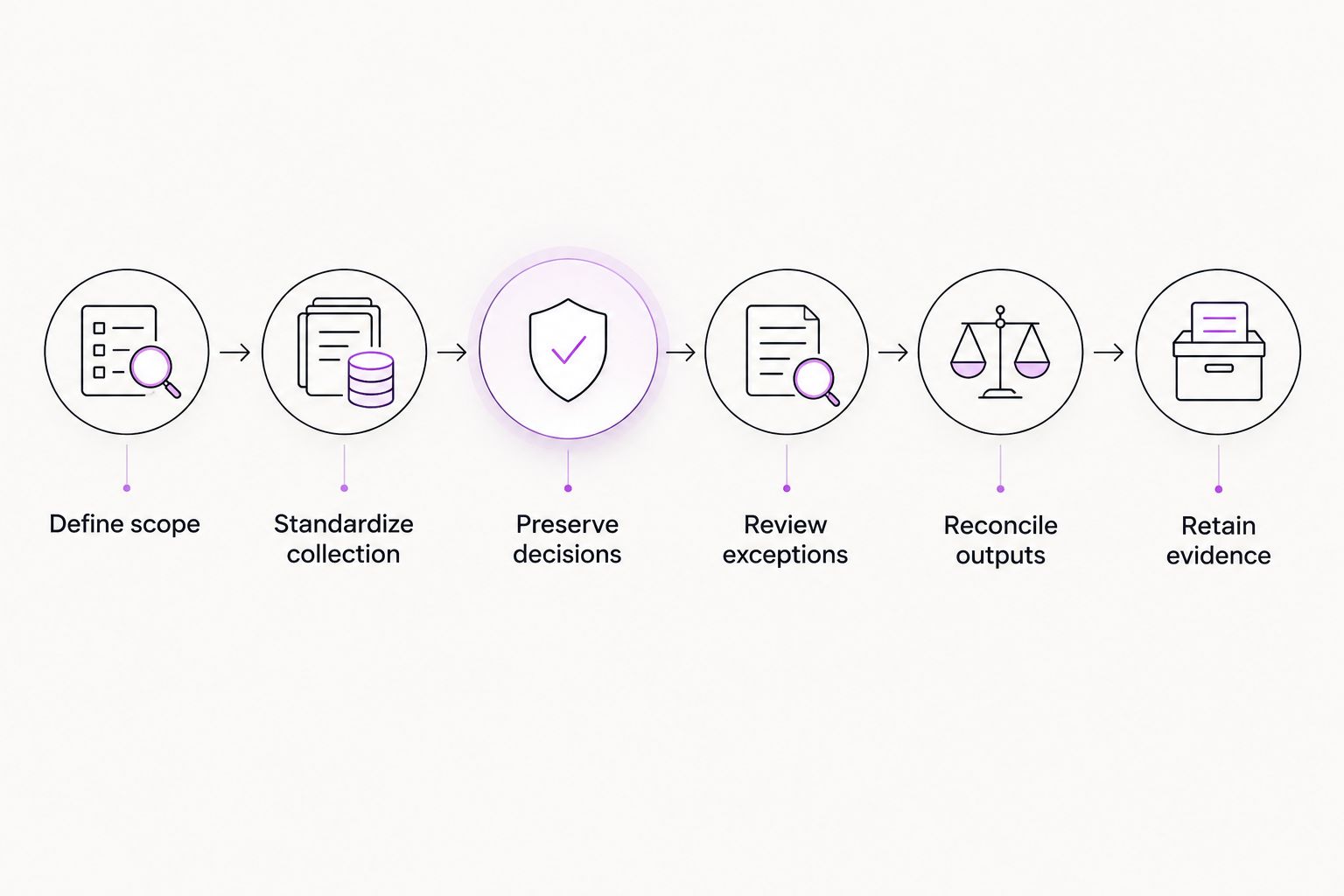
Automate repeatable preparation while keeping decisions and approval visible.
Choose a reporting method that matches the work
Best for a documented workflow with manageable manual inputs: a controlled spreadsheet process. Its advantage is direct visibility into calculations and adjustments. Its limitation is the manual effort needed to preserve consistency, manage versions, and maintain traceability across files.
Best for repeatable collection and connected reporting workflows: a platform-supported process. Its advantage is reducing repeated data preparation when the required sources and mappings are supported. Its limitation is that configuration, source coverage, and licensing decisions still need accountable owners.
Controlled spreadsheet process
- Best for: Teams able to maintain documented manual controls
- Main advantage: Calculations and adjustments remain directly inspectable
- Main limitation: Collection, version management, and reconciliation need sustained manual attention
Platform-supported process
- Best for: Teams standardizing recurring usage reporting and connected billing
- Main advantage: Repeatable preparation can replace repeated file handling
- Main limitation: Incorrect mappings or incomplete sources still produce work to resolve
Do not choose based on the appearance of the final report. Use your 2026 source register and exception queue to assess whether a proposed workflow handles your actual inputs, decisions, and handoffs.
Why SPLA reporting time varies
Reporting effort depends on what your team must collect, interpret, and reconcile. Review these factors against your own close records rather than assuming the submission file is the bottleneck.
- Source consistency: incompatible exports require transformation before the data can be compared. Standardize the fields your process actually uses.
- Customer mapping: missing or ambiguous ownership creates investigation work. Give mapping exceptions a named owner and preserve approved resolutions.
- Environment changes: changed configurations require a review of the facts relevant to licensing treatment. Record changes where the reporting owner can find them.
- Decision documentation: undocumented interpretations force repeated discussions. Store the rationale and review conditions with the approved decision.
- Billing reconciliation: independently maintained usage datasets create another reconciliation task. Establish where shared data ends and separate billing rules begin.
- Approval handoffs: an unassigned review waits even when preparation is complete. Assign approvers and define how unresolved issues are escalated.
Prioritize the factor consuming the most measured effort. Automating collection will not fix an approval queue, and adding reviewers will not correct an unreliable source extract.
Measure the bottleneck before changing the workflow
Establish a 2026 baseline using 3 timestamps: collection started, report ready for approval, and report approved. These are recommended measurement points, not industry benchmarks. Record active preparation effort separately from elapsed time.
That distinction matters. A report waiting for an approver and a report requiring manual reconciliation need different fixes, even when both finish on the same day.
Collection effort
- What to record: Time spent obtaining and repairing source extracts
- What the result tells you: Whether input preparation needs attention
Exception effort
- What to record: Time spent investigating and resolving discrepancies
- What the result tells you: Whether mappings, evidence, or decisions need improvement
Approval delay
- What to record: Elapsed time between readiness and approval
- What the result tells you: Whether ownership or handoffs are holding up completion
Rework
- What to record: Corrections made after an internal review
- What the result tells you: Whether upstream checks catch the right problems
Use consistent definitions when comparing periods. If your infrastructure scope changes, record that change beside the measurements rather than attributing every difference to the new process.
For a 2026 improvement plan, choose a specific recurring task to change first. Confirm that its effort falls without increasing unresolved exceptions or weakening evidence, then apply the same approach elsewhere.
Can you automate SPLA reporting without losing control?
Yes—automate repeatable preparation while retaining explicit approval of licensing judgments and reporting outputs. Collection, transformation, matching, and exception routing are candidates for automation when their inputs and rules are defined.
Keep a visible boundary between an automated result and an approved result. A completed job should not imply that incomplete sources, disputed mappings, or unresolved licensing questions have been accepted.
Octopus combines a software asset management platform with consulting services for SPLA reporting, customer billing, and audit defense. Assess that support against your source coverage and decision workflow; the service description alone does not establish compatibility with every environment or replace your internal approval responsibilities.
Before changing your 2026 workflow, prepare representative extracts, current reporting instructions, and unresolved exceptions. Those materials turn a general automation discussion into an assessment of the work your team actually performs.
Discuss your SPLA reporting workflow
Review your usage reporting, customer billing, and audit defense requirements.
Discuss reporting requirements
Should customer billing use the same SPLA dataset?
Use a shared, traceable usage foundation where the workflows overlap, but keep billing rules separate from licensing decisions. This avoids treating a customer invoice as proof that the licensing report is correct, or treating a licensing quantity as the complete billing instruction.
Document how customer allocation, reporting adjustments, and billing adjustments relate. When the outputs differ, preserve the explanation rather than overwriting the source data to make totals match.
What should you fix before the next monthly close?
Fix an unreliable input or an undocumented recurring decision before redesigning the entire process. Choose the issue that repeatedly sends your team back to source systems or old messages.
Assign an owner, define the accepted evidence, and document the resolution. A narrow improvement with a verifiable result gives you a sound basis for the next change; a broad automation project without agreed inputs does not.
FAQ
What's the fastest way to reduce SPLA reporting time each month?
Standardize source collection, preserve approved decisions, and review exceptions instead of rebuilding the report. Measure your current bottleneck first so the change targets preparation, investigation, or approval delays.
Can I automate the entire SPLA reporting process?
Automate repeatable tasks, but retain accountable review of licensing judgments and final outputs. Automation does not resolve incomplete evidence or establish that a licensing interpretation is correct.
Is a spreadsheet enough for monthly SPLA reporting?
A spreadsheet can support a controlled reporting process when inputs, calculations, decisions, and approvals remain traceable. Assess the manual effort required to maintain those controls before deciding whether to change tools.
What should I keep with an approved SPLA report?
Keep the source extracts, applied decisions, reconciliations, resolved exceptions, approved output, and available submission confirmation. Set retention according to your agreements and applicable obligations.
How do I know whether reporting automation saves time?
Compare active preparation effort and elapsed approval time using consistent definitions across reporting periods. Record scope changes and check that unresolved exceptions or rework have not increased.
Can Octopus help with SPLA reporting and customer billing?
Octopus provides a software asset management platform and consulting services supporting usage reporting, customer billing, and audit defense for Microsoft SPLA partners and Authorized Outsourcers. Assess the proposed workflow against your data sources, mapping requirements, and approval controls.
One last thing
A report that is quick to prepare but difficult to explain is not a finished improvement. Before closing the period, ask someone other than the preparer to trace a reported quantity back to its source and approved treatment.
If the explanation depends on memory, add the missing evidence to the package. That is a specific control you can introduce before the next reporting cycle, regardless of which reporting method you use.