The cost of non-compliance with Microsoft CSP licensing in 2026 is case-specific: calculate it from verified licensing gaps, applicable contractual obligations, and the work required to correct them. A licensing adjustment alone does not capture investigation, technical remediation, or reporting costs. Do not treat an estimated shortfall as a confirmed penalty, and do not apply a generic audit multiplier without an applicable contractual basis.
TL;DR
- The cost of non-compliance with Microsoft CSP licensing requires a contract-specific calculation, not a generic penalty estimate.
- Microsoft CSP licensing exposure starts with verified entitlements, actual usage, and applicable licensing terms.
- Separate confirmed obligations, unresolved exposure, and internal remediation costs before approving corrective action.
- SPLA reporting experience does not establish CSP licensing rights; assess each arrangement separately.
How much does non-compliance with Microsoft CSP licensing cost?
Build the estimate from evidence, not a headline fine. A useful calculation separates licensing corrections, contractual charges, internal work, and external assistance. If you need a licensing assessment, define that scope before requesting a financial estimate.
Licensing correction
- What to establish: Which deployments or users lack the required rights
- Evidence to retain: Entitlements, assignments, inventory, applicable terms
Contractual charges
- What to establish: Whether the governing agreement establishes additional obligations
- Evidence to retain: Relevant clauses and written correspondence
Internal remediation
- What to establish: Work needed to investigate, correct, and document the issue
- Evidence to retain: Task records, approved labor assumptions, change records
External assistance
- What to establish: Specialist support needed for the identified issue
- Evidence to retain: Agreed scope and written engagement terms
Operational impact
- What to establish: Whether corrective work creates a documented business impact
- Evidence to retain: Change plans, incident records, service dependencies
These are assessment categories, not charges that automatically apply to every case. Keep a category out of the confirmed total until you can support its inclusion.
Your estimate should also distinguish a purchasing decision from a compliance obligation. Buying additional subscriptions without resolving the underlying licensing question does not establish that the original deployment was permitted. First identify the missing right; then choose the correction.
Why this matters
A CSP subscription record, an infrastructure inventory, and a customer invoice answer different questions. The subscription record documents a purchase, the inventory describes a deployment, and the invoice records a charge. None substitutes for checking whether the actual use matches the applicable licensing rights.
For a 2026 assessment, connect those records before assigning a financial value. Otherwise, your team risks counting the same issue twice, treating an unverified finding as a liability, or overlooking remediation work that sits outside procurement.
The decision is not simply how many licenses to buy. It is which obligation exists, what evidence supports it, and which correction resolves it.
Separate confirmed cost from unresolved exposure
Use 3 categories in your assessment: confirmed obligations, unresolved exposure, and remediation work. This is a reporting structure, not a Microsoft penalty schedule.
Confirmed obligations
Record an obligation as confirmed only after you establish the relevant facts and the applicable basis for payment. Identify the affected product, customer or legal entity, deployment, and period where relevant.
The advantage is a financial estimate that procurement and finance can trace. The limitation is scope: a confirmed amount for an identified issue does not close other findings that remain unexamined.
Do not label an internal purchasing estimate as a contractual settlement. Preserve the distinction between what your team believes is needed and what has been formally established.
Unresolved exposure
Keep disputed deployment facts, incomplete entitlement records, and unanswered contractual questions separate from confirmed obligations. Give each item an owner and a specific evidence request.
This prevents an uncertain finding from becoming a false statement of liability. It also prevents uncertainty from disappearing inside a single total that looks more authoritative than its supporting records.
Do not assign an arbitrary probability to an unresolved issue just to produce a financial figure. If finance requires a provision or disclosure decision, involve the appropriate accounting and legal advisers.
Remediation work
Record the work required to correct assignments, deployments, reporting, or internal controls. Include only activities connected to the identified issue, with a documented scope and an accountable owner.
This category makes operational effort visible. Its limitation is estimation: an unapproved work plan is not the same as an incurred expense, so label planned and completed work separately.
Build a defensible estimate in 5 checks
Use these 5 checks for a 2026 licensing assessment. Each check should produce an evidence record that another reviewer can follow without relying on the original investigator's memory.
1. Establish entitlements
Collect the subscription, order, agreement, and assignment records relevant to the affected products. Identify the customer or legal entity associated with each record, rather than treating a shared procurement export as proof for every deployment.
Required output: a traceable entitlement record. A product name alone is insufficient when the licensing question depends on the subscription, edition, assigned user, or permitted use.
2. Verify usage
Identify what is deployed, who uses it, and where the workload runs. Reconcile technical records with the customer and subscription records used in the entitlement check.
Required output: a usage baseline with a defined scope and collection date. Preserve exclusions explicitly; an inventory that omits an environment cannot support a conclusion about that environment.
3. Validate rights
Compare the verified deployment against the applicable agreement and product terms. Check the actual use case rather than assuming that a purchase through CSP authorizes every hosting, outsourcing, or customer-access arrangement.
Required output: a finding that explains the relevant requirement, the observed condition, and the evidence connecting them. Escalate interpretation questions instead of converting assumptions directly into purchasing instructions.
4. Define corrections
Identify the action that resolves each validated gap. Depending on the established rights and deployment facts, the assessment should examine whether the correction concerns procurement, assignment, configuration, or the deployment itself.
Required output: a correction plan with an owner, dependencies, and a verification method. Do not recommend a technical change without checking its service impact and approval requirements.
5. Document closure
Retain the approved action, implementation evidence, and verification result. Update the entitlement and usage records so the corrected position is visible in the same evidence set used for the assessment.
Required output: a closure record showing what changed and why the finding is resolved. An invoice documents a transaction; it does not, by itself, demonstrate that every related deployment issue was corrected.
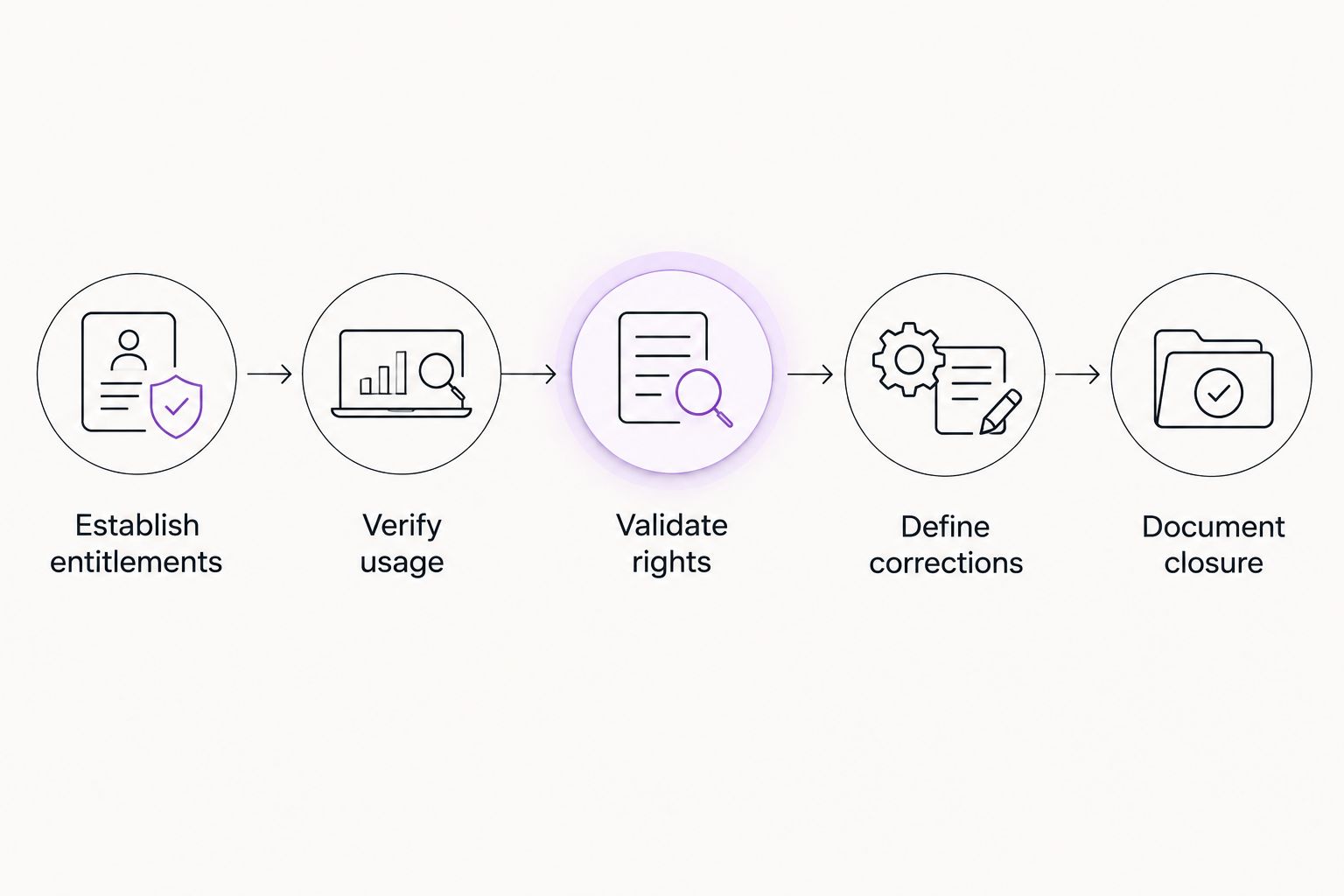
Validate the licensing gap before approving corrective work.
Why the cost of CSP non-compliance varies
A defensible estimate depends on the facts of the deployment and the governing terms. For your 2026 review, document these drivers rather than applying a generic uplift to subscription spending:
- Scope of the verified gap. Identify the affected products, users, deployments, or other applicable licensing units. Do not extrapolate a finding across unrelated environments without evidence.
- Applicable rights. Establish the permitted use under the relevant agreement and product terms. Similar product names do not replace a rights assessment.
- Relevant period. Determine which period the finding concerns and which records support it. Do not assume that a current inventory proves an earlier deployment state.
- Contractual obligations. Identify the actual basis for any additional charge or corrective requirement. A general description of an audit is not a substitute for the governing clause.
- Correction effort. Separate procurement administration from technical changes, validation, and reporting work. Use documented work estimates rather than an unexplained contingency.
- Evidence quality. Record missing or conflicting evidence as an investigation task. Do not turn an incomplete record into a confirmed licensing deficit without validation.
Keep assumptions visible beside each driver. A reviewer should be able to identify which change in evidence would change the estimate.
Should you buy more licenses or change the deployment?
Choose the correction that resolves the verified licensing issue. Procurement, reassignment, and technical changes address different problems; none is a universal answer.
Obtain required rights
- Best for: A validated deployment that needs additional entitlement
- Benefit: Aligns the entitlement record with the established requirement
- Limitation: Does not independently correct configuration or reporting errors
Correct assignments
- Best for: A validated assignment error where reassignment is permitted
- Benefit: Addresses the mismatch without redesigning the workload
- Limitation: Requires confirmation of applicable assignment rules
Change the deployment
- Best for: A use case that needs a different technical arrangement
- Benefit: Addresses the way the software is being used
- Limitation: Requires service-impact assessment and change control
Investigate before acting
- Best for: Incomplete or contradictory evidence
- Benefit: Prevents an unsupported correction decision
- Limitation: Leaves the finding unresolved until the evidence is complete
Do not choose an approach solely because it appears easier to purchase or implement. Require the finding owner to explain how the proposed action satisfies the relevant licensing requirement.
After implementation, repeat the affected checks. The correction is complete when the evidence supports closure, not merely when the purchase order or change ticket closes.
Can you calculate exposure from subscription spending alone?
Subscription spending alone does not establish the cost of non-compliance. It does not explain whether the correct users, deployments, entities, and use rights align.
Use spending records as part of the reconciliation, not as the denominator for an invented penalty percentage. A meaningful estimate connects a specific finding to its contractual basis and correction plan.
If management needs a preliminary view, present confirmed obligations and unresolved findings separately. Explain which evidence is still required without presenting the unresolved portion as a settled amount.
Does SPLA reporting settle a CSP licensing question?
SPLA reporting does not establish CSP licensing rights. Assess the relevant agreement and deployment facts for each arrangement, especially where your business manages different licensing models across customers.
A common internal inventory can support both investigations, but the resulting licensing conclusions need their own basis. Keep reporting records, entitlement evidence, and contractual interpretation distinct so that a conclusion under one arrangement is not copied into another without review.
Where Octopus fits
Octopus provides a software asset management platform and consulting services for Microsoft SPLA partners and Authorized Outsourcers, including usage reporting, customer billing, and audit defense.
Octopus is best suited to SPLA partners and Authorized Outsourcers managing usage reporting and audit defense. For a CSP question, define the products, agreements, environments, and required assessment deliverables before choosing support.
The fit is clear when your assessment concerns those software asset management activities. The boundary is equally important: Octopus software asset management support does not replace the need to establish the applicable contractual rights for a specific CSP deployment.
What should finance receive from the assessment?
Give finance 2 clearly labeled totals: confirmed obligations and planned remediation expenditure. Keep unresolved exposure in a separate findings register rather than hiding it inside either total.
For each included item, supply the evidence reference, responsible owner, approval status, and calculation basis. State whether the entry represents an established obligation, an approved work estimate, or an expense already incurred.
A useful 2026 assessment also preserves the version of the underlying evidence. If a later inventory or contractual clarification changes the conclusion, finance should be able to see why the estimate changed rather than receiving an unexplained replacement total.
FAQ
What is the cost of non-compliance with Microsoft CSP licensing?
The cost requires a case-specific calculation of verified licensing corrections, applicable contractual obligations, and documented remediation work. Separate confirmed obligations from unresolved exposure instead of using a generic fine.
Is there a standard Microsoft CSP non-compliance penalty?
Do not assume a standard penalty applies to your case. Establish the relevant agreement, product terms, findings, and written basis for any additional charge before recording it as an obligation.
Can I estimate licensing exposure from my monthly subscription bill?
Your monthly subscription bill alone does not establish licensing exposure. Reconcile purchases and assignments with actual usage and applicable rights before calculating a correction.
Does purchasing more licenses resolve every compliance issue?
Purchasing more licenses does not resolve every compliance issue. Assignment errors, deployment conditions, and reporting problems require corrections that address the specific finding.
Does SPLA compliance prove that a CSP deployment is compliant?
SPLA compliance does not establish CSP compliance. Evaluate each arrangement against its applicable agreement, product terms, and deployment facts.
What records should I prepare for a CSP licensing assessment?
Prepare entitlement records, subscription and assignment details, usage evidence, applicable agreements, and relevant correspondence. Keep the scope and collection date attached to technical evidence.
Is Octopus relevant to a licensing compliance assessment?
Octopus provides software asset management software and consulting for SPLA partners and Authorized Outsourcers. For CSP-specific work, establish the assessment scope and required deliverables before selecting support.
One last thing
Close the finding, not just the transaction. Before approving completion, ask the owner to show the original requirement, the correction, and the evidence that the corrected deployment satisfies it.
Make that closure record part of your 2026 control process. It gives the next reviewer a starting point and prevents your team from treating a completed purchase as proof of a completed compliance correction.