


The CISPE–Microsoft settlement is not, by itself, a basis for changing your SPLA rates. For a 2026 pricing decision, use the price list, agreement terms, and effective dates that apply to your organization. Any separate eligibility conditions or licensing obligations still need checking before you change customer billing or usage reporting.
TL;DR
- CISPE Microsoft settlement SPLA pricing decisions require applicable commercial terms, not an assumed automatic reduction.
- Separate SPLA rates, customer-owned licenses, and settlement eligibility before changing billing.
- Octopus fits Microsoft SPLA partners needing usage reporting, customer billing, and audit-defense support.
- Keep reporting actual usage while you verify any proposed licensing change.
Does the CISPE-Microsoft settlement change SPLA pricing?
Do not apply a SPLA rate reduction solely because of the settlement. A public announcement and an applicable commercial change are different forms of evidence. Your decision needs documentation that connects the change to your organization, the affected offering, and its effective period.
For operational context, the SAM guide for Microsoft SPLA partners addresses the reporting and compliance discipline behind that decision. Keep that discipline separate from assumptions about the settlement's commercial effect.
Use the following comparison when someone proposes changing a rate or licensing treatment:
Applicable SPLA price list
- Best for: Checking a reporting rate
- What it supports: The listed rate for the relevant offering and period
- Limitation: Does not establish every deployment right
Applicable agreement or amendment
- Best for: Checking contractual changes
- What it supports: Rights and obligations stated in the document
- Limitation: Must cover your organization and deployment
Written clarification tied to your agreement
- Best for: Resolving a specific ambiguity
- What it supports: An explanation of the identified issue
- Limitation: Must match the actual facts and terms
Settlement announcement
- Best for: Identifying issues to investigate
- What it supports: Context for a commercial or licensing review
- Limitation: Is not your organization-specific rate instruction
The practical test is documentary: what applicable record authorizes the proposed change? If the answer is only the settlement headline, leave the rate unchanged while you obtain the relevant terms.
Why this matters
A licensing announcement can trigger several different conversations: what you pay, which licensing route applies, what you report, and what you charge customers. Treating those conversations as interchangeable creates avoidable reconciliation work.
For your 2026 review, keep the commercial decision separate from the compliance decision. A different rate does not establish different deployment rights, and a different licensing route does not establish a lower rate under your existing SPLA arrangement.
Customer billing adds another boundary. Your customer agreement determines how a supplier-side change flows into the invoice; the settlement headline does not answer that question. Check both sides before changing a billing rule.
Separate a rate change from a licensing-route change
A rate change alters the applicable charge for a defined offering. A licensing-route change alters the basis on which software use is licensed. Those are distinct decisions, even when both affect the same hosted workload.
For example, an investigation into customer-owned licenses concerns entitlement and permitted deployment. It does not, on its own, establish that the rate for provider-reported SPLA usage has changed. Likewise, a revised rate does not prove that an existing deployment qualifies for another licensing route.
Ask your team to describe the proposed change without using the word settlement:
- Which offering or entitlement changes?
- Which agreement authorizes the change?
- Which customer and deployment does it cover?
- When does the change take effect?
- Which reporting or billing field needs updating?
If the proposal cannot answer those questions, it is not ready for implementation. Keep it in the review queue rather than translating an unresolved interpretation into a production billing rule.
How do you verify a SPLA pricing change in 2026?
Use 4 checks before approving a change. This sequence keeps evidence collection, licensing analysis, and operational implementation in the correct order.
- Establish scope. Identify the contracting entity, relevant agreement, affected offering, deployment, and reporting period. Write down exactly which rate or treatment someone proposes changing.
- Confirm terms. Obtain the applicable price list and any agreement language or amendment supporting the proposal. Match the effective date to the period you intend to change.
- Reconcile usage. Compare the proposed treatment with the inventory and usage records behind the report. Confirm that the change applies to the actual workload rather than a similarly named offering or a different customer scenario.
- Approve changes. Record the decision, evidence, owner, and effective period. Update the relevant reporting or billing rule only after the review is complete.
Keep the original records alongside the approved change. A later reviewer needs to understand both the result and the basis for reaching it; a spreadsheet containing only the replacement rate does not explain the decision.
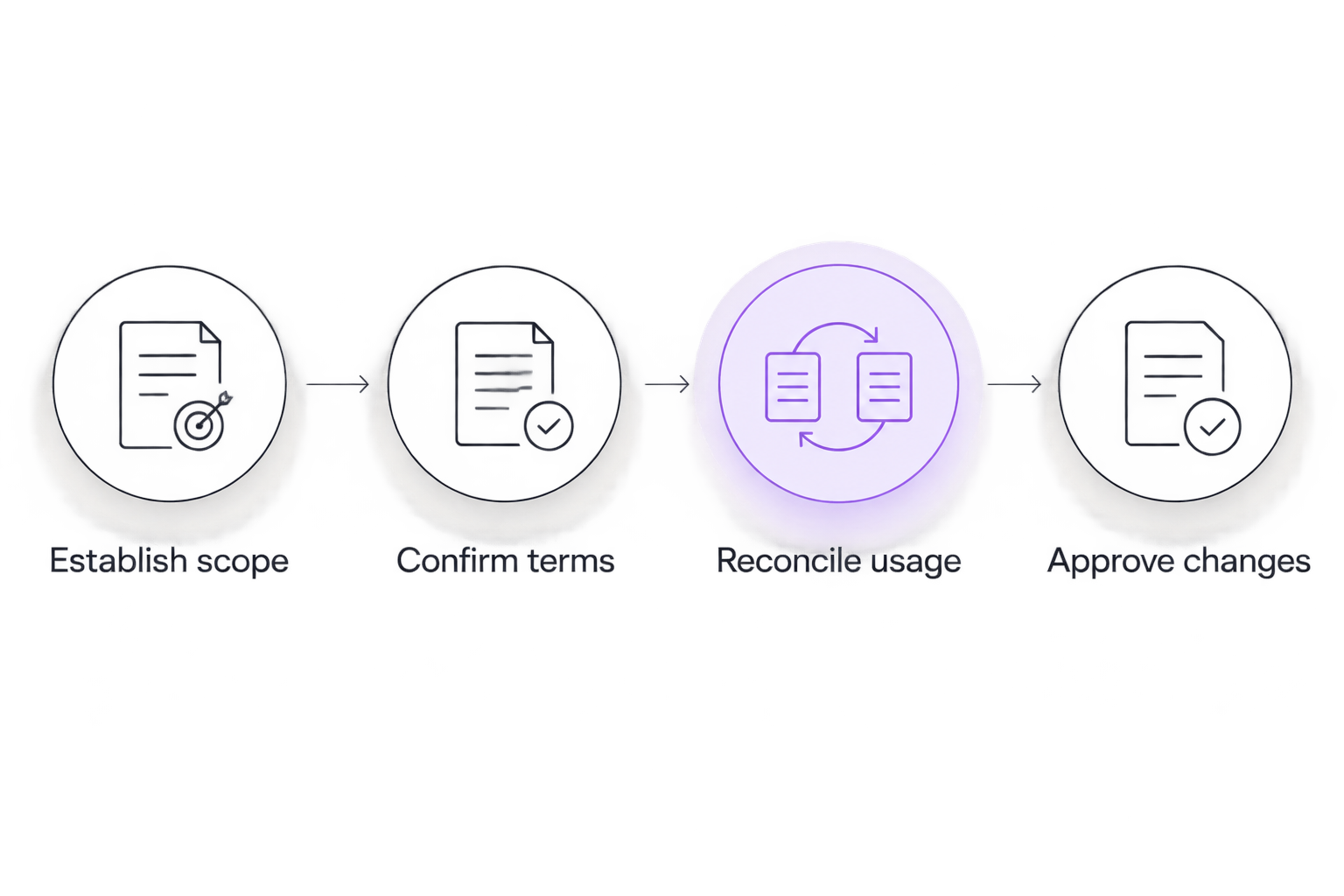
Confirm the applicable terms before changing reporting or billing rules.
Establish the baseline before comparing alternatives
Start with the licensing treatment currently used for the workload. Record the offering, deployment scope, customer allocation, reporting basis, and supporting agreement reference. That baseline makes the proposed difference visible.
Do not compare an existing SPLA report with an alternative described only in general terms. Compare the same workload under documented assumptions. Otherwise, a change in deployment scope can be mistaken for a change in licensing economics.
Keep effective dates attached to every decision
A valid change still needs the correct effective period. Record when the supporting terms apply and which report or customer invoice first reflects the approved treatment.
Do not use the date someone forwarded an announcement as the implementation date. Your 2026 decision log should point to the effective date in the applicable documentation, not the timing of an internal email.
Why the effect on your SPLA bill varies
Your SPLA bill is not determined by a settlement headline alone. The operational effect depends on the specific relationship between applicable terms, licensed usage, and billing treatment.
Review these factors separately:
- Agreement scope. Identify the entity and agreement covered by the proposed change. A statement about another commercial arrangement does not establish your entitlement.
- Offering and licensing basis. Match the change to the exact software offering and applicable licensing metric. Do not transfer a conclusion from one offering to another without checking its terms.
- Deployment facts. Confirm where the software runs and how the relevant environment is configured. The licensing analysis must describe the actual deployment.
- Customer entitlements. Where customer-owned licenses are involved, verify the entitlement and applicable hosting rights. Ownership alone does not answer every deployment question.
- Effective period. Apply a documented change to the period it covers. Keep earlier reporting decisions separate unless the documentation supports revisiting them.
- Customer billing terms. Check how your customer agreement treats supplier-side changes. A licensing decision and an invoice decision need their own supporting basis.
Do not attribute every movement in the total bill to a rate change. Usage, workload allocation, and approved licensing treatment also belong in the reconciliation. Compare those components before assigning a cause.
Can you change customer billing before confirming the terms?
Do not change customer billing based only on an expected settlement benefit. First establish the applicable supplier-side change, then check what your customer agreement requires.
Prepare a billing impact record that identifies the affected customer, workload, billing rule, effective period, and approval. Keep commercial approval separate from the technical configuration change so that the person updating the system has a clear instruction.
If a customer asks about the settlement during a 2026 renewal, explain the verification process rather than promising a reduction. State which applicable documents govern the proposal and which billing treatment has actually been approved.
That response is more useful than a broad assurance about savings. It gives the customer a decision they can inspect without committing your organization to an unsupported interpretation.
Does the settlement remove SPLA reporting obligations?
Do not stop or reduce reporting solely because of the settlement. Change a reporting obligation only when the applicable terms support that change for the workload and period concerned.
Continue collecting inventory and usage evidence while the licensing review is open. If the approved result changes the reporting treatment, those records help explain what changed and distinguish a documented transition from an unexplained omission.
Automation supports repeatable collection and processing, but it does not settle a disputed interpretation. Assign a licensing owner to the decision and a reporting owner to its implementation. Both need access to the same approved record.
What evidence should you keep for an audit?
Maintain 3 records for each approved change: the commercial authority, the workload evidence, and the decision log. Each serves a different purpose, so do not substitute one for another.
Commercial authority
- Best for: Showing why a change was permitted
- What to retain: Applicable terms, rate documentation, and relevant clarification
- Limitation: Does not establish actual usage
Workload evidence
- Best for: Showing what was deployed and reported
- What to retain: Inventory, usage records, and customer allocation
- Limitation: Does not establish contractual rights alone
Decision log
- Best for: Explaining implementation
- What to retain: Rationale, approval, effective period, and affected rules
- Limitation: Is only as sound as its supporting evidence
Make the connection between the records explicit. A reviewer should be able to follow the affected workload to its licensing basis and then to the reporting or billing decision without reconstructing the reasoning from disconnected emails.
For 2026 reviews, retain the version of the documentation used for approval. A later document can help with a new decision, but it does not explain which terms your team relied on at the time.
Where software and consulting fit
Octopus is best suited to Microsoft SPLA partners and Authorized Outsourcers that need software asset management and consulting support for reporting, customer billing, and audit defense. That is an operational fit, not evidence that the settlement changes a particular rate.
Octopus provides a SAM platform and consulting services for those activities. The benefit is support for the reporting and compliance workflow; the boundary is that applicable licensing terms still govern the decision. No platform output replaces the contractual basis for a rate or entitlement change.
Bring a defined question to the review: the workload, proposed treatment, relevant period, and supporting documents. A specific licensing question gives software and consulting work a clear decision to support.
Review your SPLA reporting controls
Discuss usage reporting, customer billing, and audit-defense requirements for your licensing workflow.
FAQ
Does the CISPE–Microsoft settlement automatically lower my SPLA rates?
Do not apply an automatic SPLA rate reduction based on the settlement alone. Use the applicable price list and agreement documentation to establish whether a change covers your organization, offering, and reporting period.
Which document should I check before changing a SPLA rate?
Check the applicable SPLA price list alongside the relevant agreement terms. Match the offering and effective period before updating a reporting or billing rule.
Can I change customer invoices as soon as a licensing change is announced?
Do not change customer invoices solely because of an announcement. Confirm the applicable supplier-side change and the treatment required by your customer agreement first.
Does a customer-owned license mean I should remove the workload from SPLA reporting?
A customer-owned license does not, by itself, establish that a workload should be removed from SPLA reporting. Verify the entitlement, permitted deployment, and applicable terms before approving a different treatment.
What should I retain to explain a settlement-related licensing decision?
Retain the applicable commercial documentation, workload evidence, and approved decision log. Connect those records to the affected reporting period and billing rule so that the decision can be traced.
Can reporting automation decide whether a settlement changes my licensing rights?
Reporting automation does not determine contractual rights. Use it to support inventory, reconciliation, and implementation after the applicable licensing treatment has been established.
Can Octopus help with SPLA compliance work?
Octopus provides a software asset management platform and consulting services for Microsoft SPLA partners and Authorized Outsourcers. Its stated scope includes usage reporting, customer billing, and audit defense.
One last thing
A correct rate applied to the wrong usage still produces an incorrect report. Before focusing the entire review on settlement-related pricing, reconcile the workload and reporting basis already in use.
Put the applicable terms and usage evidence beside each other. Approve the change only when both support the same treatment, then preserve the reasoning with the implementation record.