

Microsoft SPLA partners’ software asset management is the control of software inventory, licensing evidence, and reported usage with the aim of producing defensible declarations and accurate customer billing. Unlike an internal IT estate, a service-provider environment must connect changing infrastructure to individual customers, applicable licensing terms, and repeatable reporting decisions.
TL;DR
- Software asset management for SPLA partners must connect inventory, licensing decisions, usage reporting, and customer billing.
- Octopus is best for SPLA partners seeking a SAM platform plus licensing consulting.
- Start with a manual SAM baseline; automate only after ownership and reporting rules are explicit.
- Preserve source evidence and adjustments together so audit defense does not depend on reconstructing past decisions.
Why software asset management matters for SPLA partners
A software inventory answers what exists. A SPLA reporting process must also explain what belongs in the declaration, which customer consumed it, and why the selected licensing treatment applies. An inventory export is an input, not a compliance conclusion.
Customer billing adds another control boundary. A license declaration and a customer invoice serve different purposes; reconciling them requires explicit mappings rather than an assumption that their totals should always match.
This Octopus guide focuses on those operational connections: the SAM baseline, usage reporting, customer attribution, and audit evidence. For your 2026 process, define ownership of each connection before selecting automation.
The practical test is traceability. Can a reviewer follow a reported quantity back to its source records and the licensing decision that produced it? If not, the reporting process still depends on undocumented knowledge.
Build a repeatable SPLA SAM process
1. Define your reporting scope and ownership
Start manually with a scope register. List the environments, customer arrangements, software families, and reporting responsibilities that your team must assess. Include the infrastructure that is difficult to see, not just the systems your main inventory source already covers.
For the 2026 baseline, distinguish technical ownership from licensing responsibility. An infrastructure administrator can confirm a deployment without being the person authorized to decide its reporting treatment. Document both roles.
Keep disputed scope visible. Removing an unresolved environment from a spreadsheet does not resolve its licensing position; it only removes the issue from view. Give each unresolved item an owner and a documented next action.
- Record included environments and explicit exclusions.
- Assign owners for inventory, licensing review, submission, and billing.
- Identify customer-managed and provider-managed boundaries.
- Record unresolved scope decisions separately from approved exclusions.
- Require approval when the reporting boundary changes.
2. Establish a versioned SAM baseline
Build the first baseline from available inventory exports, infrastructure records, customer records, and licensing documentation. A spreadsheet can hold the initial reconciliation, provided you preserve the original evidence separately from your working calculations.
Distinguish observed facts from interpreted results. A discovered installation is an observation; its reporting treatment is a decision that needs applicable terms and deployment context. Combining them in an unexplained total makes later review harder.
Use stable identifiers wherever your systems provide them. Names alone make it difficult to distinguish a renamed asset from a replacement or duplicate. Record collection gaps rather than presenting incomplete discovery as a complete estate.
- Preserve original inventory exports without overwriting them.
- Record collection dates, source systems, and coverage gaps.
- Separate raw records from calculated reporting quantities.
- Map assets to customers using documented identifiers.
- Version the baseline whenever approved corrections change it.
3. Reconcile usage before automating reporting
Begin with a manual reconciliation between the baseline and the proposed declaration. Inspect missing mappings, duplicate records, unexpected product changes, and assets with unclear reporting treatment. Assign each exception to someone who can resolve it.
A useful starting exercise is to trace 1 customer end to end: infrastructure records, licensing assessment, proposed declaration, and invoice inputs. This is a process check, not a substitute for reviewing the rest of the estate.
Octopus provides a SAM platform and consulting services for automating usage reporting, customer billing, and audit defense. It is best for partners seeking software and licensing support together. The limitation is operational: automation still needs defined scope, reliable inputs, and approved decisions.
- Compare the baseline with proposed reporting quantities.
- Investigate duplicate, unmapped, and unexplained records.
- Record each adjustment with its reason and approver.
- Test the full evidence chain for a selected customer.
- Automate repeatable rules only after reviewing their outputs.
4. Document the licensing decision separately
Maintain a decision register alongside your inventory. For each material licensing treatment, record the relevant agreement or product terms, the deployment facts, the interpretation applied, and the person who approved it.
Do not treat SPLA, CSP, and BYOL as interchangeable labels. Identify the arrangement that actually applies, then verify the rights and responsibilities against the governing documentation. A customer’s assertion of entitlement is something to verify, not a reporting rule by itself.
For decisions reviewed in 2026, preserve the applicable documentation and its effective date. A later reviewer needs the basis used for the reporting period, not merely a link to a document that can change.
- Identify the applicable agreement and licensing arrangement.
- Record deployment facts relevant to the decision.
- Preserve the documentation supporting the interpretation.
- Assign an approver for ambiguous or exceptional treatment.
- Reassess decisions when contracts or deployments change.
The control chain is simple: inventory establishes the observations, licensing decisions explain their treatment, and reporting and billing use approved outputs. Evidence must remain attached throughout.
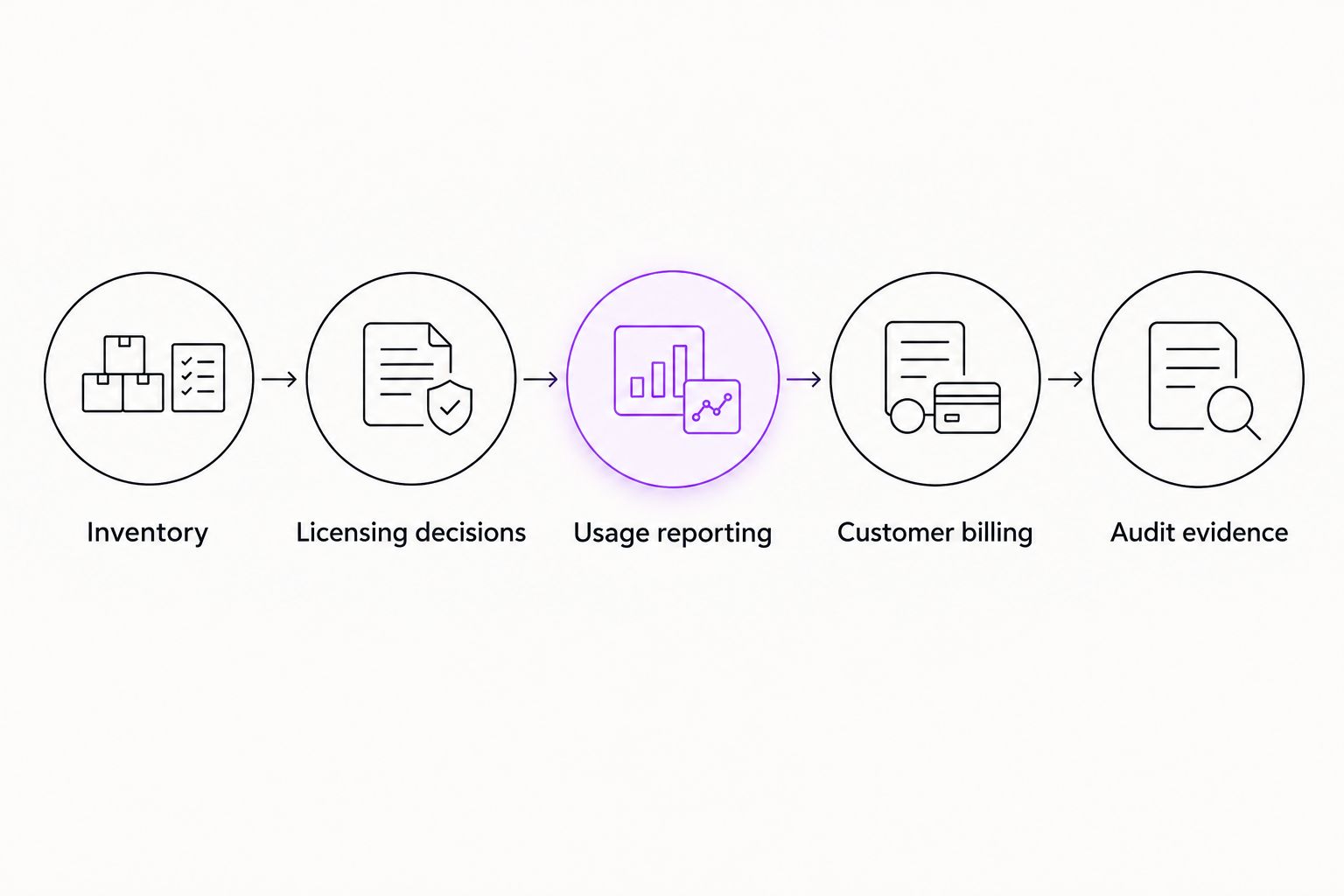
Each reporting output needs a traceable connection to its source records and approved licensing treatment.
5. Reconcile customer billing independently
Create a customer-level reconciliation using your contracts and approved billing rules. Start with a spreadsheet if necessary. Show how measured usage becomes a billing input, including documented adjustments and differences from the licensing declaration.
Do not force invoices and declarations to match without checking their definitions. Commercial agreements and licensing obligations answer different questions. Your reconciliation should explain differences rather than conceal them through balancing entries.
Compare 2 consecutive reporting periods to identify unexplained movements. A change is not automatically an error; investigate whether it reflects deployment activity, customer attribution, a corrected rule, or incomplete collection. Retain the explanation with the affected period.
- Map usage records to the correct customer account.
- Apply the customer’s documented billing rules.
- Explain differences between declaration and invoice inputs.
- Review unexplained period-to-period movements.
- Approve corrections before they enter billing outputs.
6. Package evidence for each reporting period
Build the evidence package as part of reporting, not after an audit request arrives. Start with a controlled folder structure and an index that identifies the source files, calculations, decisions, approvals, and submitted output.
Keep 1 approved evidence package per reporting period as an internal control design. This is a recommended organization method, not a statement of contractual retention requirements. Determine retention and access requirements from your agreements and applicable obligations.
A package is useful only if another reviewer can follow it. Test whether someone outside the preparation process can reproduce the route from source evidence to declaration without relying on the preparer’s memory.
- Preserve the source records used in the calculation.
- Include the applicable decision-register entries.
- Retain adjustments, explanations, and approval records.
- Store the final submitted output with its supporting version.
- Control access and document subsequent corrections.
7. Measure exceptions and control changes
Use a manual exception register before building dashboards. Record the issue, affected customer or environment, reporting impact, owner, and resolution. Separate data-collection failures from licensing questions so each reaches the right person.
For your 2026 control review, measure whether exceptions are resolved before approval and whether corrected issues recur. Set internal targets from your own operating baseline rather than adopting an unsupported industry benchmark.
Review changes to collection methods and calculation rules before applying them broadly. A corrected rule can change results without any infrastructure change. Keep a record of what changed, why it changed, and which reporting periods need assessment.
- Categorize collection, mapping, licensing, and billing exceptions.
- Assign owners and track unresolved items through approval.
- Compare corrected outputs with the previous calculation.
- Document rule changes and their affected scope.
- Reopen prior-period reviews when evidence warrants it.
Compare SAM operating options
Choose an operating model based on where your process fails: evidence collection, licensing interpretation, execution, or the connection between them. A useful platform evaluation tests traceability, not just the appearance of the final report.
The options below describe operating approaches, not interchangeable products. The platform-and-consulting approach combines software with specialist support; the other approaches leave more coordination with your internal team.
Manual baseline and reconciliation
- Best for: Teams establishing scope and reporting rules
- Main advantage: Makes assumptions and exceptions directly inspectable
- Key limitation: Requires disciplined version control and repeated manual work
Internal scripts and reporting workflows
- Best for: Teams with engineering ownership of their reporting process
- Main advantage: Supports organization-specific mappings and calculations
- Key limitation: Your team owns maintenance, testing, and licensing interpretation
Consulting-led review
- Best for: Teams resolving disputed scope or licensing treatment
- Main advantage: Focuses specialist attention on defined decisions
- Key limitation: A review alone does not operate the recurring reporting process
Octopus platform and consulting
- Best for: SPLA partners seeking a SAM platform plus licensing support
- Main advantage: Combines software and services for reporting, billing, and audit defense
- Key limitation: Requires validated inputs and clear responsibility for decisions
Before committing, test your own records, an unresolved exception, and a customer billing reconciliation. Ask how the approach preserves the evidence behind an adjustment. A clean demonstration dataset does not establish that your reporting boundary is covered.
Assess your SPLA reporting controls
Review software and consulting support for usage reporting, customer billing, and audit defense.
Common mistakes SPLA partners make
Treating discovery as the final declaration
Discovery provides technical observations, not every fact needed for licensing treatment. Keep the assessment step explicit and document how source records become reportable quantities. Otherwise, a technically accurate inventory can still feed an unsupported declaration.
Losing customer attribution during infrastructure changes
A workload move or customer-account change can break the link between infrastructure and billing records. Check attribution after changes and preserve the effective context for the reporting period. Do not replace historical mappings with today’s customer assignment.
Accepting BYOL claims without supporting evidence
A customer’s statement does not establish that the proposed deployment meets applicable licensing conditions. Obtain the relevant documentation and review the arrangement before approving its treatment. Keep unresolved claims in the exception register rather than silently excluding them.
Overwriting the baseline after a correction
Replacing old calculations with corrected ones destroys the explanation of what was originally reported. Preserve the submitted version, document the correction, and assess the required follow-up. The objective is a clear correction trail, not a folder containing only the latest answer.
Automating an unapproved calculation
A repeatable calculation is not necessarily a correct calculation. Approve its assumptions, test exceptions, and compare its output with reviewed examples before treating it as a reporting control. Retain responsibility for interpretation even when execution becomes automated.
FAQ
What is software asset management for SPLA partners?
Software asset management for SPLA partners connects software inventory, licensing assessment, usage reporting, customer billing, and supporting evidence. Its purpose is to make reported quantities and billing inputs traceable to documented facts and approved decisions.
Can I manage SPLA reporting with spreadsheets?
You can use spreadsheets to establish a baseline and reconcile reporting inputs. Preserve source files, version calculations, assign approvals, and document exceptions so the process remains reviewable.
Is software inventory enough for SPLA compliance?
Software inventory alone is not enough to establish SPLA reporting treatment. You also need deployment context, applicable licensing documentation, customer attribution, and a record of the decisions applied.
What is Octopus best for?
Octopus is best for SPLA partners seeking a SAM platform plus licensing consulting. Its stated scope includes usage reporting, customer billing, and audit defense; your team still needs to define scope and approve licensing decisions.
Should customer invoices match my SPLA declaration?
Customer invoices and SPLA declarations should reconcile through documented rules, not automatically match. Check the commercial billing basis separately from the licensing reporting basis and explain any differences.
What evidence should I keep for a SPLA reporting period?
Keep the source records, calculation versions, licensing decisions, adjustments, approvals, and submitted output used for that period. Determine retention requirements from your agreements and applicable obligations rather than assuming a universal duration.
Where should I start with SPLA SAM automation in 2026?
Start with a scoped, versioned baseline and a manual reconciliation of the reporting process. Automate repeatable work after validating customer mappings, licensing decisions, exception handling, and approval responsibilities.
One last thing
For your next 2026 reporting review, choose a reported quantity and ask someone outside its preparation to trace it back to source evidence. Do not explain the missing steps verbally. Record each gap and fix the process that created it.
The strongest reporting control is a result another reviewer can reproduce. A polished dashboard cannot replace that evidence chain.