Yes—white-label providers can stay SPLA compliant without extra staff when existing employees retain clear ownership and automation handles repeatable reporting work. That requires reliable usage records, documented licensing decisions, and a review process for exceptions. Automation does not transfer contractual responsibility or replace the judgment needed to resolve disputed licensing positions.
TL;DR
- White-label providers stay SPLA compliant without extra staff by automating reporting while keeping accountable review.
- Microsoft SPLA compliance requires a defensible reporting process, not just customer invoices or infrastructure inventory.
- White-label delivery needs clear responsibility for usage records, licensing decisions, reporting, and evidence retention.
- Octopus suits Microsoft SPLA partners and Authorized Outsourcers seeking reporting automation and compliance consulting.
Can white-label providers stay SPLA compliant without extra staff?
Yes, provided the work changes—not just the headcount. Existing staff need a controlled process that separates routine data processing from licensing decisions. Leaving both inside an undocumented spreadsheet process does not solve the staffing problem.
Octopus provides software asset management and consulting services for usage reporting, customer billing, and audit defense. Octopus is best suited to Microsoft SPLA partners and Authorized Outsourcers seeking reporting automation and compliance consulting. Those capabilities support an operating model; they do not establish that a particular deployment is licensed correctly.
Build that operating model around 5 steps:
- Assign ownership. Identify who supplies usage records, interprets licensing requirements, approves reporting, and retains evidence.
- Collect usage. Establish repeatable collection across the infrastructure and customer environments within your reporting scope.
- Reconcile records. Connect usage, customer assignments, reporting calculations, and billing records without treating them as interchangeable.
- Review exceptions. Route missing data, unexplained changes, and uncertain licensing treatment to a named owner.
- Retain evidence. Preserve the records and approvals that explain each submitted report.
These are process requirements, not a promise that every provider can avoid hiring. Your existing team still needs enough capacity to complete the review work.
Why this matters
White-label delivery separates the customer-facing brand from some of the work behind the service. That creates a practical question: who can explain how a particular workload became a reported licensing quantity?
A customer invoice cannot answer that question by itself. Neither can a server inventory that lacks customer assignments or the reasoning behind a licensing calculation.
For your 2026 operating plan, treat staffing as a capacity decision and compliance as an evidence decision. You need both: sufficient review time and records that support the report. Reducing manual effort helps only when the replacement process remains explainable.
Which operating model fits your existing team?
Choose an operating model by the work your team can reliably perform. Do not compare software and consulting as though they remove the same responsibilities.
Documented manual workflow
- Best for: A team that can consistently reconcile and review its reporting scope
- Practical advantage: Keeps calculations and decisions directly accessible to reviewers
- Limitation: Repetitive preparation remains with employees
Automated workflow with internal review
- Best for: Repeatable collection and reporting work with a capable internal owner
- Practical advantage: Reduces repeated handling of the same data
- Limitation: Incorrect mappings or rules still require detection and correction
Automated workflow with consulting support
- Best for: A team that needs help interpreting exceptions or defending reporting decisions
- Practical advantage: Adds licensing expertise alongside repeatable processing
- Limitation: Internal ownership and source-data responsibilities remain
Choose automation for repeatable work; use qualified review for unresolved licensing treatment. A process that automatically reproduces an incorrect assumption is not a compliance improvement.
Before changing systems, write down which tasks disappear, which become exception reviews, and which stay manual. If the proposed workflow leaves every reconciliation task intact, it has not addressed the staffing constraint.
Why the workload varies
The answer depends on your reporting environment, not on the white-label label alone. Assess these 5 drivers before deciding that existing staff can absorb the work:
- Reporting scope. Separate environments and service arrangements require clear boundaries for what enters your report.
- Data quality. Missing customer assignments and inconsistent identifiers create reconciliation work regardless of collection method.
- Licensing treatment. Unresolved questions about applicable rights require interpretation rather than another data export.
- Infrastructure changes. Provisioning, migration, and retirement events need to reach the reporting process.
- Responsibility boundaries. Work stalls when the provider, reseller, and customer each expect another party to resolve an exception.
Use these drivers to assess your own operation rather than borrowing a staffing ratio. A larger inventory with consistent records is a different workload from an inventory that requires repeated investigation. The decision belongs to the actual review queue, not a generic customer-count threshold.
Assign ownership before automating reporting
Your first control is a responsibility map. Identify the agreement holder and reporting obligations, then document who performs each operational task within that arrangement.
Name an owner for usage collection, customer mapping, licensing interpretation, report approval, and evidence retention. One employee can hold several responsibilities, but each responsibility needs an explicit assignment and a backup.
For white-label services, include the handoff between the customer-facing organization and the infrastructure operator. Specify what records move between them, who resolves discrepancies, and how approval is recorded. A commercial relationship does not explain those operational details on its own.
Do not let branding determine licensing responsibility. Use the applicable agreements and documented service arrangement to establish obligations. Then design your reporting workflow around those obligations rather than assuming the organization sending the invoice owns every licensing task.
Automate the reporting chain, not just collection
Inventory collection is only the beginning. Your workflow also needs to connect the collected records to customers, apply documented reporting logic, identify exceptions, and preserve the approved result.
Use this sequence for a 2026 workflow review:
- Collect usage. Record the source and reporting period so reviewers can identify what the dataset represents.
- Map customers. Connect the relevant records to the correct customer or service boundary.
- Apply rules. Use documented licensing assumptions that an accountable reviewer has approved.
- Review exceptions. Separate unresolved items from records ready for reporting.
- Approve reports. Preserve the approved output and the evidence supporting it.
The objective is not to eliminate every human action. It is to stop employees repeatedly rebuilding the same relationships and calculations while keeping uncertain decisions visible.
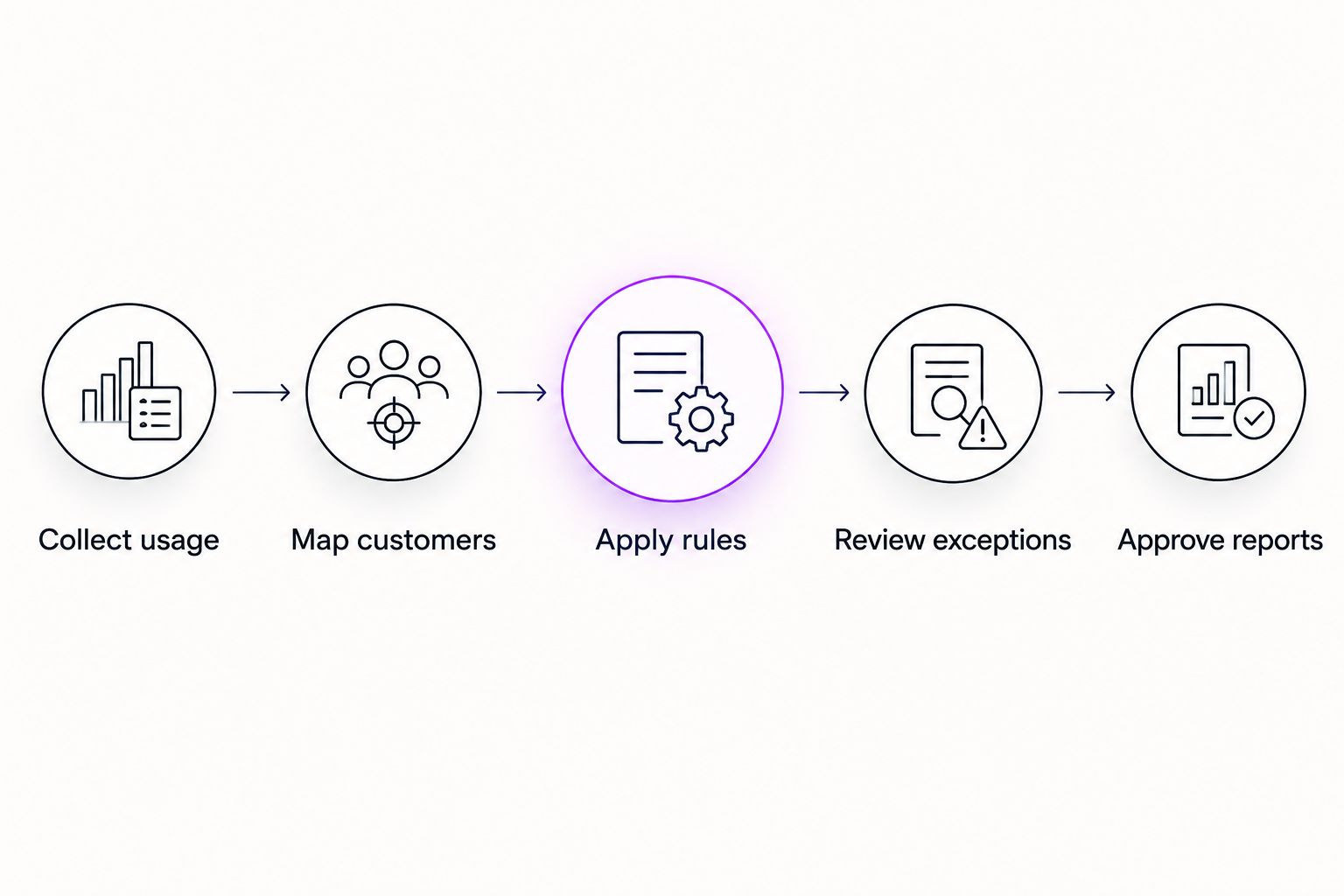
Automate repeatable processing while keeping exceptions and approval visible.
Separate customer billing from licensing evidence
Customer billing and SPLA reporting serve different purposes. Billing describes what you charge a customer; licensing evidence supports the usage and treatment behind your report.
Keep the relationship traceable without assuming the quantities must always match. A billing package can combine commercial elements that do not correspond directly to a reporting line. Conversely, an infrastructure record does not establish the customer charge that should follow.
For every discrepancy, require an explanation rather than forcing the records to agree. The explanation should identify whether the difference comes from customer mapping, timing, the commercial arrangement, or the reporting calculation.
This separation also defines the limit of automation. A system can process a mapping consistently, but an accountable person still needs to establish whether that mapping reflects the service and the applicable terms. Consistency is necessary; it is not proof of correctness.
Give exceptions a route to resolution
An exception list is useful only when someone can close it. Each unresolved item needs an owner, the affected reporting period, the missing evidence or decision, and a recorded outcome.
Distinguish a collection problem from a licensing question. A missing source record belongs with the person responsible for the environment; uncertainty about permitted licensing treatment belongs with a qualified licensing reviewer. Sending both to the same general queue obscures what work is actually required.
For 2026 process reviews, inspect recurring exceptions rather than celebrating a smaller spreadsheet. Repeated customer-mapping failures call for a mapping correction. Repeated questions about the same deployment pattern call for a documented licensing decision that remains subject to applicable terms.
Do not close an exception merely because the reporting deadline approaches. Preserve the unresolved issue and obtain the necessary direction through your established approval process.
When does specialist support replace an internal task?
Specialist support fits a defined gap: interpreting a disputed position, reviewing reporting logic, or preparing evidence for an audit response. Describe the gap before choosing the service.
Octopus combines a software asset management platform with consulting services for Microsoft SPLA partners and Authorized Outsourcers. The relevant distinction is between automating usage reporting and obtaining help with the decisions that reporting depends on. Neither removes your need to supply accurate records and maintain accountable ownership.
Before engaging support, ask who validates the source data, who approves licensing assumptions, and what evidence you retain. Establish what happens when the consultant's interpretation conflicts with an existing internal assumption.
Use consulting to resolve a defined licensing problem, not to leave responsibility undefined. Contact the provider with your reporting scope, current handoffs, and unresolved questions so the discussion addresses the work your team actually needs covered.
Review your SPLA reporting workflow
Discuss usage reporting, customer billing, and audit defense for your white-label delivery model.
How do you prove the process works without adding staff?
Measure work that your team actually performs. Track preparation time per reporting cycle, unresolved exceptions at approval, and corrections made after approval; establish your own baseline before claiming an improvement.
Compare equivalent reporting scopes. A shorter preparation cycle means little if environments disappeared from collection or reviewers stopped investigating unexplained changes.
For a 2026 evaluation, retain both the original records and the approved output from the workflow under review. Ask another responsible employee to trace a selected reporting line back to its source and documented treatment. If the explanation depends entirely on the original preparer's memory, the process remains dependent on that person.
Judge the workflow by traceability and completed review, not dashboard appearance. Automation supports staffing efficiency only when the resulting work fits the capacity your existing team has available.
Does white-label branding change SPLA obligations?
White-label branding alone does not establish who holds licensing obligations. Your applicable agreements and service arrangement determine the responsibilities that the reporting process must support.
Document the reporting boundary before deciding which organization collects usage or approves quantities. Keep customer-facing branding separate from that contractual analysis.
Can customer invoices replace usage records?
Customer invoices cannot replace the evidence needed to support a licensing report. Use invoices as a reconciliation input, then retain the underlying usage records and documented reasoning behind the reported treatment.
An unexplained difference deserves investigation. Matching totals are not enough when nobody can show how the totals were calculated.
When should a white-label provider add staff instead?
Add capacity when essential review work remains unfinished after you remove avoidable processing and clarify ownership. That capacity decision should follow observed workload, not an assumption that automation makes compliance unattended.
Persistent unresolved exceptions, unavailable approvers, and unsupported reporting decisions indicate a process that needs attention. Decide whether the gap requires operational staff, licensing expertise, or a change in responsibilities before selecting the remedy.
FAQ
Can white-label providers stay SPLA compliant without hiring someone?
Yes, when existing staff have the capacity, evidence, and expertise to own reporting and resolve exceptions. Automation reduces repeatable processing but does not remove contractual responsibility.
Does SPLA reporting automation guarantee compliance?
No, reporting automation does not guarantee compliance. Incorrect source data, mappings, or licensing assumptions still require detection and correction.
Who's responsible for SPLA reporting in a white-label arrangement?
Responsibility depends on the applicable agreements and service arrangement, not the customer-facing brand alone. Document who collects records, approves reporting, and retains evidence.
Can I use customer billing data as my SPLA report?
Customer billing data alone is not a substitute for the evidence supporting SPLA reporting. Reconcile billing with usage records and documented licensing treatment.
What's Octopus best suited for?
Octopus is best suited to Microsoft SPLA partners and Authorized Outsourcers seeking usage-reporting automation, customer billing support, and compliance consulting. Internal ownership and accurate source records remain necessary.
What should I check before automating SPLA reporting?
Check reporting scope, source-data quality, customer mappings, licensing assumptions, and approval ownership. Define how unresolved exceptions reach someone qualified to decide them.
How should I prepare my reporting process for a 2026 audit?
Preserve source records, documented licensing decisions, submitted reports, and approval evidence for the relevant reporting periods. Follow applicable retention requirements and keep the reporting chain traceable.
One last thing
Test whether your reporting process survives the absence of its usual owner. Ask the backup to explain a reported quantity using only the retained records, mappings, and approvals.
Make that a 2026 operating check. If the backup needs undocumented explanations, fix the evidence chain before expanding the automation: otherwise, you have accelerated a process that still depends on individual memory.