


Software asset management software costs depend on the licensing scope, deployment coverage, implementation work, and services in your contract—not a universal per-device figure. For a 2026 budget, request an itemized quote that separates the software subscription from setup, integrations, and ongoing licensing support. Compare the total contracted scope, not the subscription line alone.
TL;DR
- How much does software asset management software cost? Compare itemized quotes for the same deployment and licensing scope.
- For SPLA partners, include usage reporting, customer billing, and audit evidence in the evaluation.
- Octopus provides software asset management software and consulting for Microsoft SPLA partners and Authorized Outsourcers.
- Separate subscription, implementation, integrations, and ongoing services before comparing proposals.
Why this matters
A software inventory and a licensing-compliance workflow solve different problems. Knowing which software is installed does not, by itself, establish which licensing rules apply or what you must report.
For Microsoft SPLA partners and Authorized Outsourcers, the buying decision should account for usage reporting, customer billing, and audit defense. Octopus provides software asset management software and consulting services for those requirements. Evaluate any proposal against your actual reporting obligations rather than a generic feature checklist.
How much does software asset management software cost in 2026?
Your software asset management software cost is the amount quoted for a defined scope, plus any separately contracted implementation and services. A useful quote explains what you are buying, what triggers additional charges, and which work remains with your team.
Request this breakdown before comparing proposals. Treat each row as a question for the supplier, not an assumption that every supplier charges separately for it.
Software subscription
- What the proposal should specify: Included capabilities and billing unit
- What to check: Which environments and workflows are covered?
Implementation
- What the proposal should specify: Deployment, configuration, and acceptance criteria
- What to check: Who completes each setup task?
Data integrations
- What the proposal should specify: Included sources, connectors, and configuration
- What to check: What happens when a source changes?
Data preparation
- What the proposal should specify: Cleanup, mapping, and reconciliation responsibilities
- What to check: Which records must your team correct?
Licensing services
- What the proposal should specify: Analysis, interpretation, and review deliverables
- What to check: Is advice included or separately scoped?
Ongoing support
- What the proposal should specify: Support coverage and escalation process
- What to check: What help is available during reporting?
Contract changes
- What the proposal should specify: Renewal, expansion, and change-control terms
- What to check: What triggers a revised quote?
For your 2026 comparison, require suppliers to respond to the same written scope. Otherwise, a subscription-only proposal and a proposal containing implementation and consulting are not equivalent offers.
Do not assume an unlisted task is included. Ask the supplier to mark each requirement as included, separately scoped, or your responsibility, then attach that response to the commercial proposal.
Subscription scope: define the billing unit
Start with the unit that determines the subscription charge. Ask whether the proposal measures devices, users, servers, virtual machines, managed environments, or another defined quantity; do not infer the billing model from the product category.
The contract should also explain how that quantity is measured. A count taken at deployment is not the same contractual commitment as a count recalculated during the agreement.
Before accepting a subscription scope, resolve these questions:
- Which assets or environments fall inside the agreement?
- How are inactive, duplicate, and decommissioned records treated?
- How does the supplier measure growth or reductions?
- Which reporting and export capabilities are included?
- What changes require a contract amendment?
A quoted unit needs a written definition. Without one, you cannot reliably compare suppliers or reconcile an invoice against the environment you intended to cover.
Implementation scope: define completion before signing
Treat implementation as a set of deliverables, not a general promise to get the platform running. Ask for named responsibilities covering access, deployment, configuration, data ingestion, validation, and handover.
Define acceptance in operational terms. For example, require the implementation plan to explain how your team will verify that the agreed environments appear in the platform and that the agreed reports contain the expected source data.
Do not equate an installed collector with an accepted reporting process. Your acceptance criteria should distinguish successful data collection from successful reconciliation and usable output.
Keep unresolved source-data problems visible. If customer names, asset ownership, or environment identifiers need correction, assign that work explicitly rather than allowing it to disappear inside a broad implementation description.
Licensing services: separate software from expert review
A software entitlement does not automatically include a consulting engagement. Ask the supplier to identify which licensing questions the platform addresses and which require a separately defined review.
For an SPLA-focused evaluation, write down the deliverables you need: usage-reporting preparation, licensing interpretation, exception review, or audit-response support. Then ask who produces each deliverable and who approves it.
Consulting scope should also identify the evidence required from your organization. A review depends on its agreed inputs; a statement of work should not leave those inputs undefined.
Buy a specified review, not an undefined promise of compliance. Establish the review boundaries, output format, and responsibility for acting on findings before you approve the engagement.
Why software asset management costs vary
For a 2026 evaluation, use these scope factors to explain differences between proposals. Each factor should connect to a stated deliverable or contract term, not a general claim that a platform is more capable.
- Deployment coverage: Define the environments and assets the supplier must cover, including the boundaries of the engagement.
- Data integrations: List the source systems and specify who maintains the connection and resolves collection failures.
- Reporting requirements: Identify the usage reports, customer-level outputs, and evidence exports your team needs.
- Implementation responsibility: Separate supplier-delivered configuration from work your administrators must complete.
- Licensing review: Specify whether the engagement includes expert interpretation, exception handling, and documented findings.
- Ongoing services: Define recurring review, support, and change-management responsibilities rather than assuming they accompany the subscription.
Use these factors to challenge a proposal. If a supplier attributes a difference to implementation complexity, ask which tasks create that complexity and how completion will be verified.
Which purchasing scope fits your team?
Compare proposals by operating responsibility as well as functionality. The right scope depends on which tasks your team can own and which tasks you intend to contract out.
Software subscription
- Best for: Teams retaining configuration and licensing review internally
- Advantage to evaluate: Direct ownership of the operating workflow
- Limitation to address: Internal work remains outside the supplier's deliverables
Software with implementation
- Best for: Teams needing a defined deployment engagement
- Advantage to evaluate: Explicit setup and handover responsibilities
- Limitation to address: Ongoing review still needs a named owner
Software with consulting
- Best for: Teams seeking specified licensing analysis alongside tooling
- Advantage to evaluate: Access to contracted review deliverables
- Limitation to address: Advice and implementation boundaries need clear documentation
These are evaluation scopes, not named product tiers. Ask each supplier which scope its proposal actually covers rather than mapping a package name to assumed services.
Octopus is suited to Microsoft SPLA partners and Authorized Outsourcers seeking software asset management software and consulting services. Its stated focus includes usage reporting, customer billing, and audit defense; a platform-and-consulting description still does not establish which tasks a particular agreement includes.
The purchasing limitation is the same as with any scoped engagement: you must confirm coverage in writing. Do not infer connector support, response commitments, licensing coverage, or implementation deliverables from the category description alone.
How do you compare SAM quotes without missing scope?
Use a consistent sequence so every proposal answers the same operational questions. Keep the comparison focused on evidence you can inspect rather than demonstrations that follow different scripts.
- Define coverage. List the environments, software scope, customer boundaries, and reporting outputs the engagement must address.
- Assign ownership. Mark who supplies data, configures access, reviews exceptions, approves reports, and handles escalations.
- Request itemization. Separate the subscription, implementation, integrations, and services in every response.
- Validate outputs. Ask the supplier to demonstrate the agreed workflow and explain how source data becomes a report.
- Approve scope. Resolve exclusions, acceptance criteria, contract-change rules, and handover responsibilities before signing.
This sequence prevents a feature comparison from substituting for a delivery comparison. A capability shown during evaluation still needs a defined place in the agreement if your operating process depends on it.
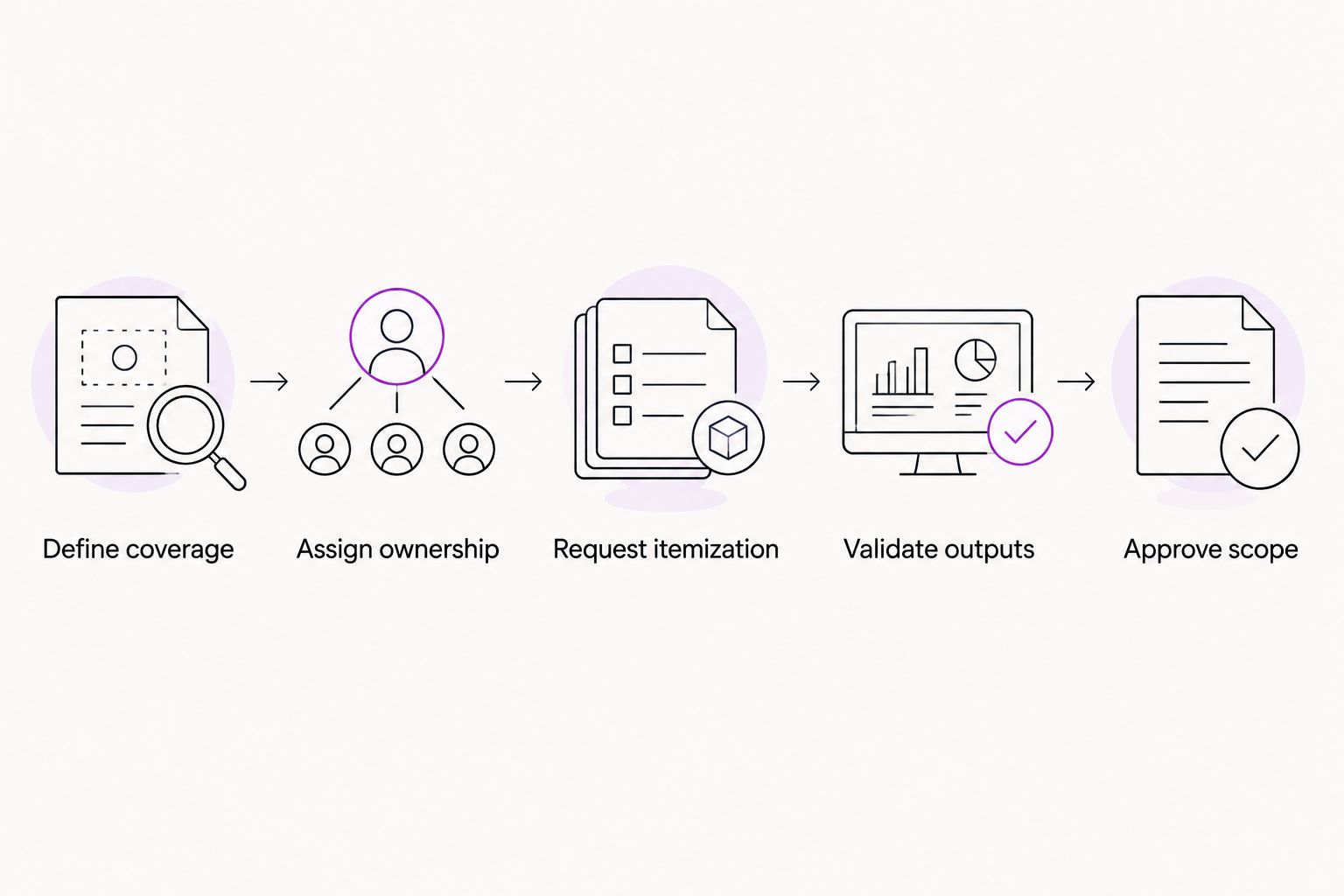
Compare the same responsibilities and outputs before approving a proposal.
Use the resulting scope document as your acceptance checklist. If an item matters enough to influence supplier selection, it belongs in the written requirements rather than only in meeting notes.
What should SPLA partners include in a 2026 evaluation?
An SPLA evaluation should follow the path from collected usage to the reporting and billing outputs your organization needs. Ask the supplier to demonstrate that path using the agreed scope, including how exceptions are identified and reviewed.
Keep the following requirements separate. Combining them into a single reporting requirement hides ownership gaps.
Usage reporting
Specify the source data, reporting period, customer mapping, and approval process. Ask how your team can inspect the relationship between collected records and the resulting report.
Require a defined process for incomplete or inconsistent data. An exception should have an owner and a resolution path rather than becoming an unexplained adjustment.
Customer billing
Describe the output your billing process needs and identify who validates customer assignments. Usage reporting and invoicing are connected workflows, but the acceptance criteria for each should remain explicit.
Ask what happens when an approved usage record changes. Your requirements should address correction handling and responsibility without assuming a particular integration exists.
Audit evidence
List the records your organization needs to retain and retrieve. Ask how source records, review decisions, and report versions can be made available for examination.
Do not accept an audit-support label as a substitute for deliverables. Identify what assistance is included, what evidence your team must supply, and what requires a separate engagement.
How do you calculate a comparable first-year commitment?
Build a 12-month comparison using the same coverage and responsibility assumptions for every proposal. Include every contracted component, and show one-time implementation separately from recurring commitments.
Then create a separate view of internal work. Record the tasks your administrators, licensing specialists, and billing team will still own; do not describe those tasks as eliminated unless the proposed workflow actually removes them.
For 2026 procurement, ask for both the initial commitment and the renewal terms. A first-year scope that includes setup is not directly comparable to a renewal scope that excludes it.
Avoid presenting expected savings as established results. Evaluate reporting effort, correction work, and licensing exceptions against your own documented baseline before attributing a financial outcome to the platform.
What should you send when requesting a quote?
Send a requirements brief that gives the supplier enough detail to define its responsibilities. Include your environment boundaries, required reporting outputs, available data sources, internal owners, and intended implementation outcome.
Ask for an explicit exclusions section. A useful response should identify unsupported requirements, prerequisites, and tasks that remain outside the proposed engagement.
Use the contact page to request a scoped discussion with Octopus. Ask the proposal to distinguish software, consulting, implementation responsibilities, and recurring support rather than requesting a single unexplained total.
FAQ
How much does software asset management software cost in 2026?
Software asset management software costs depend on the contracted coverage, implementation, integrations, and services. Request an itemized quote against a written scope so you can compare equivalent commitments.
Is software asset management software always billed per device?
Do not assume a per-device billing model. Ask the supplier to define the billing unit, how it is measured, and what triggers a contract change.
Does a SAM subscription include implementation?
Include implementation in your budget only according to the written proposal. Ask the supplier to separate deployment, configuration, validation, and handover responsibilities.
Should SPLA partners evaluate generic inventory tools differently?
SPLA partners should evaluate usage reporting, customer mapping, licensing review, and audit evidence rather than inventory collection alone. Require the proposal to identify which of those workflows it covers.
Does buying SAM software guarantee licensing compliance?
Buying SAM software does not replace the need to apply the relevant licensing terms and review the underlying data. Assign responsibility for interpreting requirements, resolving exceptions, and approving reports.
What does Octopus provide for software asset management?
Octopus provides a software asset management platform and consulting services for Microsoft SPLA partners and Authorized Outsourcers. Its stated scope includes automating usage reporting, customer billing, and audit defense.
How should I compare the first year with renewal?
Compare the first year and renewal as separate scopes. Show one-time implementation apart from recurring commitments and review the contract terms that govern changes.
One last thing
Ask who owns a disputed reporting record after implementation ends. That question connects software functionality, licensing judgment, customer billing, and support scope without relying on a feature checklist.
Require the answer to identify the responsible team, the evidence it reviews, and the contracted assistance available. A defined resolution process is a more useful purchasing requirement than an unqualified promise to automate everything.