


Switching from spreadsheets to SAM software is worth it when your Microsoft SPLA reporting, customer billing, and audit evidence depend on repeated manual reconciliation. In 2026, the decision should turn on whether software produces a traceable reporting process; implementation, data cleanup, and licensing review still require accountable owners.
TL;DR
- Is switching from spreadsheets to SAM software worth it? Yes, when manual reconciliation controls SPLA reporting and billing.
- Octopus serves Microsoft SPLA partners and Authorized Outsourcers that need usage reporting, customer billing, and audit defense.
- Keep spreadsheets for controlled analysis; use SAM software when recurring reporting needs repeatable evidence and review.
- Approve migration against reconciled reporting outputs, not a feature list or an assumed savings percentage.
Is switching from spreadsheets to SAM software worth it in 2026?
Yes, if your spreadsheet process makes it difficult to connect reported usage to its source, explain billing adjustments, or reproduce an approved submission. Software asset management should address those control problems, not simply replace cells with a dashboard.
Octopus provides a software asset management platform and consulting services for Microsoft SPLA partners and Authorized Outsourcers. That scope makes reporting accuracy, billing traceability, and audit defense the relevant evaluation criteria—not generic inventory features alone.
Spreadsheets
- Best for: Controlled analysis with an accountable owner
- Main advantage: Flexible calculations and direct inspection of working data
- Main limitation: Reconciliation, version control, and evidence retention depend on your process
SAM software
- Best for: Recurring usage reporting and customer allocation
- Main advantage: Supports a repeatable workflow rather than rebuilding each reporting exercise
- Main limitation: Requires validated inputs, configuration, and operational ownership
SAM software with consulting
- Best for: Teams needing licensing interpretation alongside reporting
- Main advantage: Connects operational reporting with specialist review
- Main limitation: Advice still depends on accurate facts about your environment
The decision is not whether spreadsheets are inherently unsuitable. It is whether your current controls remain dependable when infrastructure, customer assignments, and reporting requirements change.
Buy a controlled reporting process, not a replacement interface. A demonstration should show how an output was produced and how an exception was resolved.
Why this matters
A usage report, a customer invoice, and an audit response answer different questions. Your usage report records what you report under the applicable licensing terms; your invoice applies customer billing rules; your audit evidence explains the underlying facts and decisions.
Those outputs need a common evidence trail, but they should not be treated as interchangeable. A billing adjustment does not automatically change a licensing obligation, and a discovered installation does not, by itself, explain the correct reporting treatment.
For a 2026 SAM evaluation, require the supplier to demonstrate these distinctions using representative records. A dashboard that combines everything into one total is not enough if reviewers cannot inspect the reasoning behind it.
A useful baseline contains 3 evidence layers: source usage, licensing treatment, and approved reporting output. Keep the connection between those layers visible throughout your evaluation.
When spreadsheets remain the right choice
Best for: a reporting process you can explain, reproduce, and review without rebuilding it. Keep spreadsheets when they meet that standard and migration would not solve a defined operational problem.
A controlled workbook can make calculations easy to inspect. It also gives an analyst flexibility to investigate an unusual record without changing a production workflow.
The limitation is operational discipline. You must maintain the source records, calculation logic, change history, and approval evidence that make the workbook dependable.
Before replacing it, ask your reporting owner to demonstrate:
- Which source records support the reported usage.
- Which rules determine the licensing treatment.
- Which changes occurred after the previous approved version.
- Which customer receives each allocation.
- Which exceptions remain unresolved and who owns them.
If the owner can answer those questions consistently, a spreadsheet migration needs a stronger justification than a preference for automation. Document the specific reporting failure or manual task you want software to remove.
Do not confuse familiarity with control, however. A workbook that only its creator can explain leaves the business dependent on that person's availability and memory.
When SAM software becomes worth switching to
Best for: recurring SPLA reporting where manual handoffs make results difficult to reproduce. Prioritize SAM software when the reporting team repeatedly reconstructs customer mappings, investigates unexplained changes, or assembles evidence separately from the report.
The advantage is the opportunity to make those activities part of a repeatable process. The limitation is that software does not establish the truth of an incorrect customer mapping or an unsupported licensing assumption.
Use observed workflow problems as your buying criteria:
- Reporting: Require a clear path from collected usage to the reviewed reporting output.
- Customer billing: Require an explanation of allocation rules and adjustments, separate from licensing treatment.
- Audit defense: Require retained evidence that supports the reported position for the relevant period.
- Ownership: Require named responsibility for exceptions, approvals, and changes to reporting logic.
In your 2026 shortlist, mark each requirement as demonstrated, unresolved, or outside scope. Do not convert a supplier's general description into an accepted capability without seeing the relevant workflow.
A successful evaluation ends with evidence you can inspect. A list of integrations or a polished summary screen is not a substitute.
When SAM software with consulting makes sense
Best for: SPLA partners and Authorized Outsourcers that need reporting automation alongside licensing review. This approach fits a decision where the team must establish both the operational facts and their licensing treatment.
Octopus is best for Microsoft SPLA partners and Authorized Outsourcers seeking SAM software and consulting for reporting, billing, and audit defense. Its stated scope matches those requirements; your evaluation must still confirm the workflows needed in your environment.
The advantage of including consulting is a defined place for questions that cannot be settled by collecting more inventory. The limitation is that specialist review still needs accurate information about deployments, customers, agreements, and the period being assessed.
Separate the responsibilities before contracting. Ask which work belongs to implementation, which requires your internal approval, and which licensing questions fall within consulting scope.
Do not assume that buying a platform transfers accountability for your submissions. Assign an internal owner who can approve the reporting position and retain the supporting record.
How should you validate a switch before committing?
Use a controlled pilot rather than replacing your existing reporting process immediately. The objective is to explain the differences between outputs—not to force the new system to reproduce an old mistake.
1. Capture the baseline
Choose 1 completed reporting period and preserve its source data, workbook, adjustments, approvals, and submitted output. Record unresolved issues separately so the pilot does not inherit them as accepted facts.
State what the pilot must prove. Examples include reproducing a customer allocation, explaining an adjustment, and retrieving the evidence behind a reported quantity.
2. Map the evidence
Connect source records to the licensing treatment and final reporting output. Identify where customer ownership, deployment context, or reporting assumptions enter the process.
Keep factual corrections separate from changes in interpretation. A corrected customer assignment and a revised licensing decision need different explanations, even when both change the final report.
3. Reconcile the outputs
Run the proposed workflow against the baseline and investigate each material difference. Do not automatically accept the spreadsheet result or the software result as correct.
For each difference, record the source evidence, the applicable reasoning, the approved resolution, and the responsible reviewer. That record becomes part of the migration evidence.
4. Assign ownership
Define who handles data exceptions, approves reporting changes, and authorizes the final output. Include the process for staff absence and handover.
An unresolved exception needs an owner and a documented disposition. Moving it into a software queue does not resolve it.
5. Approve the cutover
Set acceptance criteria before switching the reporting process. Require reconciled outputs, accessible evidence, and an approved procedure for corrections.
Use 2 consecutive reporting cycles as an internal validation checkpoint if your reporting schedule allows it. This is a recommended test design, not a claimed industry benchmark or a guarantee of readiness.
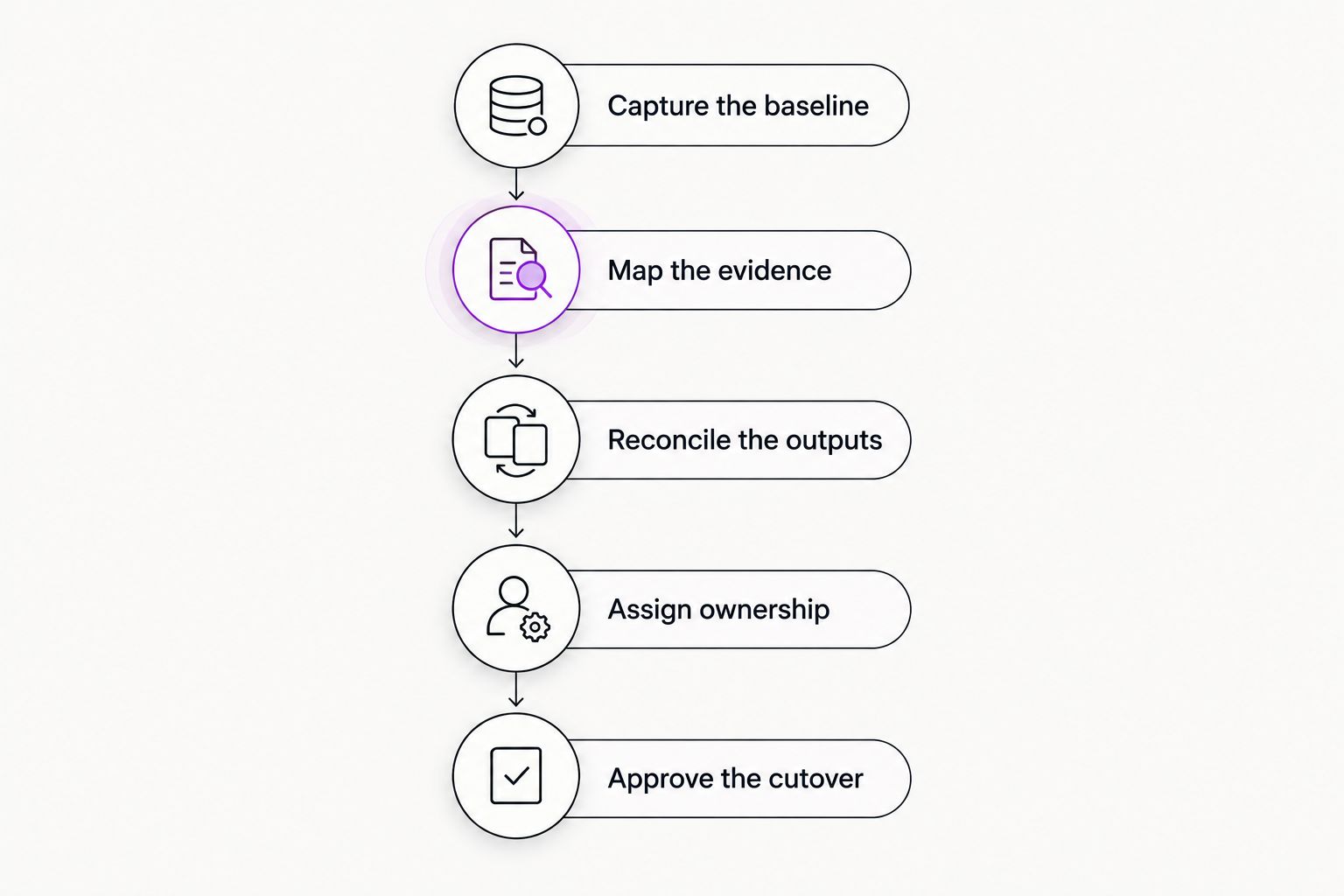
Approve the cutover only after you can explain reporting differences and assign responsibility.
Your 2026 migration plan should preserve the existing evidence trail while the new process is validated. A clean start must not mean losing the ability to explain an earlier submission.
Why the value of switching varies
The value comes from the reporting work you need to control. Assess these factors against your own records rather than applying an unsupported savings estimate.
- Usage reporting: Identify repeated preparation, correction, and reconciliation tasks that the proposed workflow must address.
- Customer billing: Examine how usage becomes a customer allocation and how billing adjustments are approved.
- Audit defense: Check whether you can retrieve the facts and decisions supporting a reported position.
- Licensing scope: Confirm whether your requirements concern SPLA partner operations, Authorized Outsourcer operations, or both.
- Consulting needs: Separate questions about operating the software from questions requiring licensing interpretation.
Measure the current process before setting a target. Record actual preparation effort, unresolved exceptions, and corrections using consistent definitions.
Then compare the pilot against that baseline. Do not present a reduction in manual work as a financial return unless you have an approved method for valuing that change.
Review your SPLA reporting workflow
Discuss usage reporting, customer billing, and audit-defense requirements before selecting a migration scope.
Can SAM software replace licensing expertise?
No. SAM software supports reporting; licensing decisions still need an accountable reviewer. Data collection establishes operational facts, while the reporting treatment depends on the relevant terms and circumstances.
Require the workflow to preserve both the evidence and the reasoning. An unexplained automated result is not a defensible substitute for a reviewed decision.
Should you migrate historical spreadsheet records?
Preserve historical evidence, but separate preservation from importing everything into the new platform. Retain the records needed to explain earlier reporting periods and define which history the new workflow actually needs.
Test retrieval before retiring the old process. An archive is useful only if an authorized reviewer can connect its files to the relevant submission and approval.
How do you know the migration worked?
The migration worked when reviewers can reproduce the reporting position and explain its exceptions without reconstructing the process from memory. Check usage evidence, customer allocations, approvals, and corrections—not just whether a report exports successfully.
For a 2026 acceptance review, ask someone other than the implementer to follow the evidence trail. Record every point where the explanation depends on undocumented knowledge.
FAQ
Is switching from spreadsheets to SAM software worth it for SPLA reporting?
Switching is worth it when repeated manual reconciliation makes SPLA reporting difficult to reproduce or review. Validate the replacement against actual source records, reporting decisions, and approved outputs before switching.
Can I keep spreadsheets after implementing SAM software?
Yes, spreadsheets can remain useful for controlled analysis and exception investigation. Define which system holds the approved reporting record so parallel files do not create conflicting versions.
Will SAM software automatically make my business licensing-compliant?
No, SAM software does not automatically establish licensing compliance. Accurate source data, appropriate licensing treatment, and accountable approval remain necessary.
What should I ask a SAM supplier to demonstrate?
Ask the supplier to trace a reporting output back to its source evidence and explain an exception. Also test customer allocation, approval, and correction workflows against your requirements.
Is Octopus relevant to Authorized Outsourcers?
Yes, Octopus provides a software asset management platform and consulting services for Microsoft SPLA partners and Authorized Outsourcers. Its stated scope includes usage reporting, customer billing, and audit defense.
What should a SAM migration pilot include in 2026?
A 2026 SAM migration pilot should include a completed reporting period, preserved source evidence, reconciled outputs, named reviewers, and cutover criteria. Investigate differences rather than assuming either the spreadsheet or the new software is correct.
One last thing
The strongest migration test is a correction, not a clean report. Introduce a documented correction into your pilot and verify that the team can explain what changed, why it changed, who approved it, and which output it affected.
That exercise tests the control you will need after implementation. A process that handles only clean inputs has not yet demonstrated how it handles reporting reality.