An audit defense retainer requires a scope-specific quote; a generic monthly figure is not a sound budget for Microsoft SPLA audit support. Separate ongoing readiness work from active audit response, and check whether technical reconciliation, legal advice, and remediation are included or billed separately. For your 2026 budget, compare the work covered and the limits on that work—not just the recurring fee.
TL;DR
- How much does an audit defense retainer cost? Compare scoped quotes, not unsupported averages.
- Separate SPLA reporting readiness, active audit response, and remediation when evaluating coverage.
- Octopus serves Microsoft SPLA partners and Authorized Outsourcers needing software asset management and consulting.
- Require written deliverables, escalation terms, and exclusions before signing an audit defense retainer.
Why this matters
A retainer buys defined access to people and services. It does not, by itself, tell you whether someone will reconcile deployment evidence, challenge a licensing interpretation, prepare submissions, or support customer billing corrections. Those distinctions determine whether the agreement covers the work you actually need.
Octopus provides software asset management software and consulting for Microsoft SPLA partners and Authorized Outsourcers. That context matters: compare licensing-specific support with licensing-specific support, rather than treating every service labeled audit defense as equivalent.
How much does an audit defense retainer cost?
Use a written quote tied to your environment, audit stage, and required deliverables. Before accepting a 2026 proposal, ask the provider to distinguish the recurring commitment from charges triggered by an audit, additional investigation, or work outside the agreed scope.
The following table compares buying structures to discuss with prospective providers. These are evaluation categories, not named service packages or claims about any provider’s contract.
Ongoing readiness retainer
- Best for: Providers maintaining reporting evidence before an audit
- Main benefit: Defined recurring review work
- Main limitation: Active audit response can fall outside the agreement
- What the quote must explain: Review frequency, deliverables, and audit activation terms
Active audit engagement
- Best for: Providers responding to an audit already underway
- Main benefit: Work organized around a current request
- Main limitation: Historic reconstruction and later requests need explicit coverage
- What the quote must explain: Audit stages, submissions, meetings, and exclusions
Combined readiness and response
- Best for: Providers seeking continuity between reporting and defense
- Main benefit: Connects preparation with response
- Main limitation: Broad wording can conceal limits
- What the quote must explain: Included tasks, capacity limits, and escalation rules
Do not infer coverage from the structure’s name. A readiness agreement can contain substantial technical work, while an audit response agreement can exclude data preparation. The statement of work is the comparison unit.
Build the budget around separate workstreams
Ask each bidder to identify the same workstreams so that proposals remain comparable:
- Recurring readiness: Evidence reviews, reporting checks, exception tracking, and agreed follow-up.
- Audit response: Request assessment, evidence preparation, reconciliation, and support for agreed communications.
- Remediation: Changes to reporting processes, deployment records, customer allocation, or other identified control gaps.
Keep any potential licensing liability separate from professional service fees. An adviser’s engagement fee and the commercial consequences of an audit are different budget items; the contract should not leave you guessing about either.
Readiness coverage: define the recurring work
Best for: providers that want reporting evidence organized before an audit request arrives. A readiness retainer should specify what gets reviewed, what the provider returns, and who resolves exceptions. Ask for deliverables rather than promises of general oversight.
Useful deliverables to request include a documented reporting baseline, an evidence register, an exception log, and a record of decisions requiring approval. Define the systems and reporting periods covered by each deliverable. A review without a clear boundary is difficult to assess or repeat.
The benefit is a recurring process for finding and addressing evidence gaps. The limitation is scope: readiness does not automatically include preparing an audit submission or responding to disputed findings. Require an explicit handoff into active response rather than assuming that coverage continues unchanged.
Active audit coverage: define the response boundaries
Best for: providers handling an audit request with identified deadlines and evidence requirements. Ask the proposed adviser to map its work against the current request, not a generic list of audit services. Identify who prepares records, reviews them, approves release, and communicates with the requesting party.
The engagement should distinguish technical findings from licensing interpretations and contractual questions. Ask which specialists perform each task and whether separate legal counsel is required. Do not treat the phrase audit defense as a description of legal representation.
The benefit is a defined response process. The limitation is that additional reporting periods, systems, requests, or disputed issues can change the assignment. For a 2026 engagement, require a written change-control process before work begins.
Why audit defense retainer scope varies
Compare proposals against these factors. Each changes the work you are asking the adviser to perform, even when the headline service description stays the same.
- Environment coverage: Specify which customers, hosting environments, systems, and reporting processes are included. Work outside that boundary needs a separate decision.
- Evidence condition: Distinguish reviewing an organized evidence set from reconstructing incomplete deployment, usage, or reporting records. Ask the provider to state its starting assumptions.
- Audit stage: Separate preventive review, initial request support, reconciliation, and disputed findings. Require the proposal to identify its starting and ending points.
- Technical depth: Confirm whether the assignment includes data collection, normalization, customer mapping, licensing analysis, or only advisory review of material you supply.
- Responsibility split: Identify what your infrastructure, finance, compliance, and legal teams must deliver. An external adviser cannot complete tasks that depend on unassigned internal work.
- Contract limits: Check included capacity, response commitments, exclusions, and approval requirements for additional work. Those terms define how the retainer functions under pressure.
Do not compare retainers until these assumptions match. Otherwise, a narrower assignment can appear more economical simply because it leaves more work with your team.
How to compare audit defense proposals
Use the same evaluation process for every bidder. You need an auditable purchasing decision, not a collection of differently worded service descriptions.
Define the scope
Write a shared brief covering your licensing context, reporting process, environment boundaries, audit status, and known evidence gaps. Separate confirmed facts from issues that still require investigation. Ask each provider to quote against that brief.
Do not include unnecessary sensitive material in an initial request. Agree on confidentiality, access, and document-handling arrangements before sharing detailed customer or infrastructure records.
Map the deliverables
Translate service descriptions into outputs your team can accept or reject. Replace general language such as ongoing assistance with a named review, documented finding, reconciled dataset, or approved submission package.
For each output, identify its owner and acceptance criteria. If the provider only advises on a submission your team prepares, record that distinction explicitly.
Assign the owners
Name an internal owner for evidence collection, technical validation, licensing decisions, and external communication. Ask the adviser to name the corresponding engagement responsibilities.
This prevents a common contractual ambiguity: both sides assuming that the other side owns the same task. Make dependencies visible before they become deadline problems.
Check the exclusions
Read exclusions alongside deliverables, not after commercial approval. Ask specifically about historical reconstruction, additional environments, customer-level investigation, legal advice, and remediation work.
An exclusion is not automatically a reason to reject the proposal. It becomes a purchasing problem when the excluded work is necessary and nobody has budgeted or assigned it.
Approve the changes
Require written approval before work expands beyond the agreed assignment. The approval should state the added task, its deliverable, its commercial treatment, and any effect on the schedule.
For your 2026 procurement record, retain the original scope and subsequent approvals together. That makes it easier to distinguish purchased coverage from later additions.
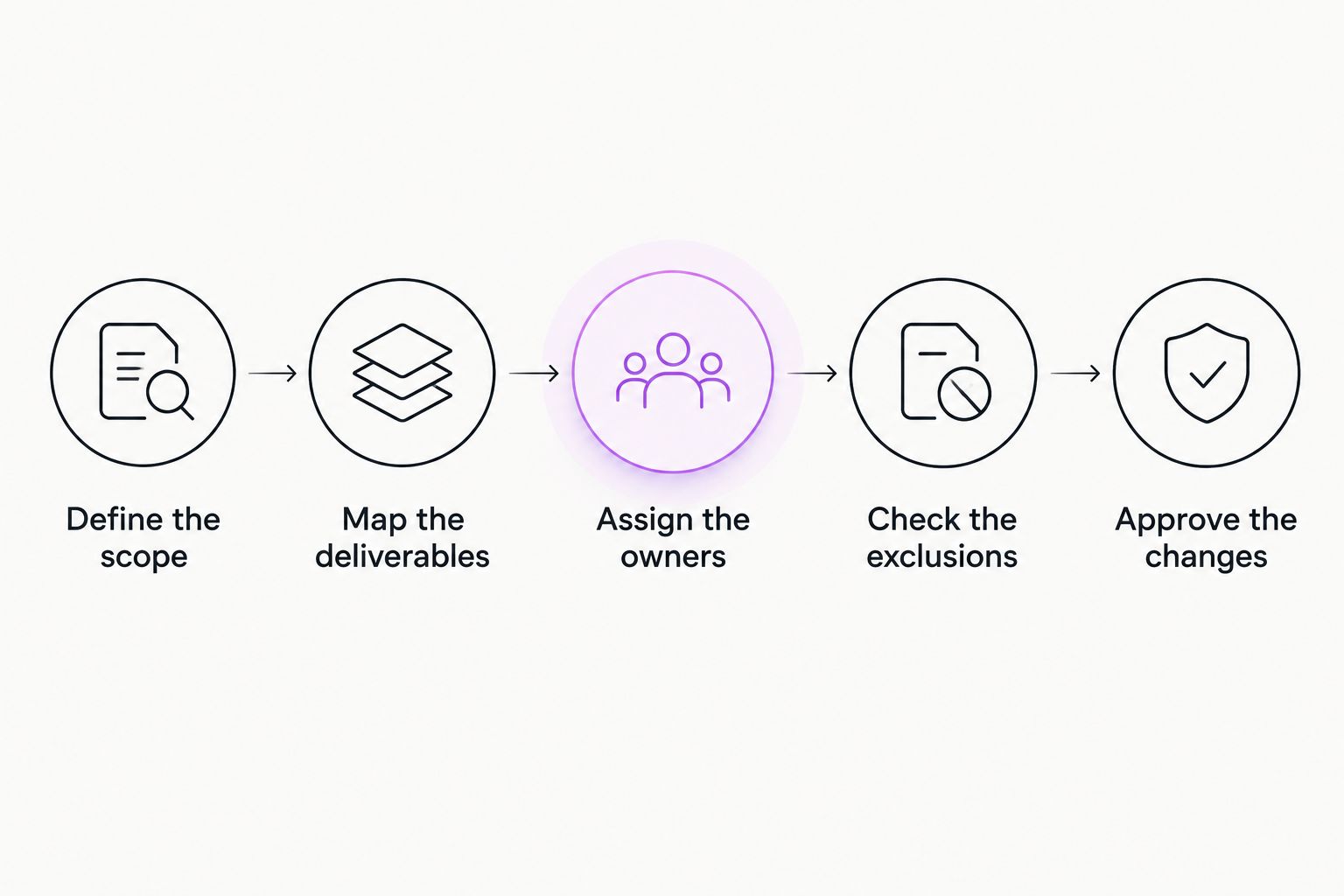
Compare deliverables and exclusions before approving the commercial terms.
What should the retainer agreement include?
A useful agreement lets your team answer practical questions without reopening a sales discussion. Who acts when an audit request arrives? What evidence will be reviewed? Which outputs are included? What requires separate authorization?
Require clear language covering:
- Service boundary: The entities, environments, licensing context, and reporting periods included.
- Named deliverables: The records, analyses, reviews, and response materials you will receive.
- Access and handling: How the adviser receives, protects, retains, and returns sensitive information.
- Response process: How requests enter the engagement and how urgent issues are escalated.
- Commercial controls: Included work, additional-work approval, renewal, termination, and handover.
- Decision authority: Who approves interpretations, submissions, remediation, and communications.
Also ask what remains usable when the engagement ends. Your team should understand the handover arrangements for evidence registers, reconciliations, assumptions, and unresolved exceptions. Do not assume access to working material continues after termination.
Is an audit defense retainer better than project support?
An audit defense retainer suits recurring, defined work; project support suits a bounded assignment. Choose based on the work you need, not on the label. An ongoing agreement adds little value when nobody has defined its recurring outputs.
For a discrete audit request, project scope can make responsibilities easier to inspect. Its limitation is the boundary: later requests or broader investigations need explicit treatment. For recurring readiness, a retainer creates an agreed review process, but your team still needs to supply evidence and close assigned actions.
Does an audit defense retainer include legal advice?
An audit defense retainer includes legal advice only when the agreement explicitly provides it through the appropriate professionals. Technical reconciliation, licensing consulting, and legal representation are different assignments. Confirm who handles contractual disputes and who authorizes communications.
Avoid relying on service names as evidence of coverage. Ask the provider to identify the people, qualifications, responsibilities, and engagement terms relevant to any legal work.
Is software enough to replace an audit defense retainer?
Software and an audit defense retainer address different responsibilities. Software can support record collection, reporting, and repeatable workflows; consulting addresses the analysis and decisions included in its engagement. Neither description establishes that every audit task is covered.
Octopus is best for Microsoft SPLA partners and Authorized Outsourcers seeking software asset management software and consulting. Its stated scope includes usage reporting, customer billing, and audit defense. Confirm the proposed engagement’s deliverables rather than assuming a particular retainer package or contractual outcome.
Use the contact page to discuss your environment and required work with Octopus. Bring the scope brief, audit status, evidence gaps, and responsibility map so the discussion starts with the assignment rather than a generic service label.
FAQ
How much does an audit defense retainer cost in 2026?
An audit defense retainer requires a scope-specific quote for a meaningful budget. Compare recurring readiness, active response, additional-work terms, and exclusions on the same basis.
What's included in an audit defense retainer?
An audit defense retainer includes the services named in its agreement. Check for evidence review, technical reconciliation, submission support, response responsibilities, and explicit limits.
Can I buy audit defense only after receiving an audit notice?
You can seek an active audit engagement after receiving a notice. Ask the prospective adviser to assess the request, deadlines, evidence condition, and assignment before agreeing to coverage.
Does an audit defense retainer cover licensing liabilities?
Do not treat an audit defense retainer as coverage for licensing liabilities. Check the contract and budget professional services separately from any licensing-related commercial outcome.
Is a retainer better than a one-off audit project?
A retainer fits defined recurring work, while a project fits a bounded assignment. Compare deliverables, responsibility boundaries, and change-control terms before choosing.
Can Octopus help with Microsoft SPLA audit defense?
Octopus provides software asset management software and consulting supporting Microsoft SPLA audit defense. Its stated audience includes Microsoft SPLA partners and Authorized Outsourcers.
What should I prepare before requesting a retainer quote?
Prepare your environment boundaries, audit status, reporting process, known evidence gaps, and required deliverables. Agree on confidentiality and document handling before sharing sensitive records.
One last thing
Ask what happens when the adviser identifies an exception your team cannot resolve immediately. The answer should name the decision owner, documentation required, escalation route, and treatment of additional work. That question tests whether the proposed retainer is an operating agreement or just a service description.
Before signing a 2026 agreement, trace a sample issue from discovery through approval and closure. If responsibilities disappear between those stages, fix the scope before committing.