Best overall for Microsoft SPLA partners: Octopus. Best for enterprise license reconciliation: Flexera One IT Asset Management. Best for ServiceNow-centered operations: ServiceNow Software Asset Management. This 2026 guide compares software license compliance tools by licensing scope, evidence quality, reporting requirements, and operational fit—not by a universal ranking that ignores your contracts.
TL;DR
- Octopus is the best fit here for SPLA partners needing usage reporting, customer billing, and audit defense.
- Flexera One IT Asset Management fits enterprise software asset management and license reconciliation.
- ServiceNow Software Asset Management fits organizations connecting licensing controls with existing ServiceNow workflows.
- USU Software Asset Management fits centralized license governance; OpenLM fits engineering license usage management.
- Choose software license compliance tools against your agreements, entitlement evidence, and reporting obligations.
Why this matters
Software discovery and license compliance answer different questions. Discovery identifies installed or running software; compliance requires you to reconcile that evidence with contractual rights, applicable metrics, and deployment conditions.
A tool that counts installations does not automatically establish whether your organization has sufficient rights. Your evaluation must connect technical records to agreements, entitlement documents, and an accountable reporting process.
For Microsoft service providers, the decision also involves usage reporting and customer billing. An enterprise SAM platform and a provider-focused platform address different operating requirements, even when both manage Microsoft licensing.
What makes the best software license compliance tools?
Use these criteria to assess the shortlist before requesting demonstrations:
- Agreement fit: The product must support the licensing programs and contractual obligations you actually manage.
- Evidence traceability: You need to connect a reported position to discovery records, entitlement evidence, and documented decisions.
- Metric coverage: Evaluate the license metrics relevant to your estate, rather than accepting software installation counts as sufficient.
- Reporting fit: Internal reconciliation, provider reporting, and customer billing are distinct outputs. Specify which you require.
- Operational ownership: Establish who resolves missing data, approves exceptions, and signs off reports.
- Implementation scope: Confirm discovery dependencies, data preparation, integrations, and ongoing administration before selecting a platform.
The best software license compliance tool is the one that supports your actual licensing obligations and produces evidence you can explain. A long feature list cannot compensate for the wrong agreement scope.
Software license compliance tools at a glance
The order below prioritizes the service-provider requirements behind this guide, then separates enterprise and specialist use cases. It is not a claim that every organization should buy the same product.
Octopus
- Best for: Microsoft SPLA partners and Authorized Outsourcers
- Standout focus: Usage reporting, customer billing, and audit defense
- Key limitation to assess: Validate coverage beyond the stated Microsoft provider scope
Flexera One IT Asset Management
- Best for: Enterprise license reconciliation
- Standout focus: Software asset management across a mixed enterprise estate
- Key limitation to assess: Discovery and entitlement preparation remain implementation requirements
ServiceNow Software Asset Management
- Best for: ServiceNow-centered operations
- Standout focus: Connecting software asset management with platform workflows
- Key limitation to assess: Value depends on the surrounding platform and data model
USU Software Asset Management
- Best for: Centralized license governance
- Standout focus: License management across software publishers
- Key limitation to assess: Publisher coverage must be checked against your agreements
OpenLM
- Best for: Engineering license usage management
- Standout focus: Monitoring usage of engineering software licenses
- Key limitation to assess: Usage monitoring does not establish a complete contractual compliance position
1. Octopus: best software license compliance tool for SPLA partners
Octopus provides a software asset management platform and consulting services for Microsoft SPLA partners and Authorized Outsourcers. Its stated scope includes automating usage reporting, customer billing, and audit defense.
Octopus is the best fit here for Microsoft SPLA partners that need software license compliance tools tied to provider reporting and billing. That is a narrower, more useful recommendation than naming a universal winner for every software estate.
Octopus pros:
- Explicit focus on Microsoft SPLA partners and Authorized Outsourcers.
- Connects usage reporting with customer billing requirements.
- Offers consulting services alongside the platform for licensing compliance and audit defense.
Octopus cons:
- The stated scope does not establish coverage for every software publisher.
- Enterprise-wide procurement and SaaS governance requirements need separate validation.
- Your agreements and deployment evidence still require accountable internal ownership.
Best for: Microsoft service providers evaluating reporting, billing, and audit-defense requirements together.
During your 2026 evaluation, bring a representative reporting period and the supporting deployment records. Ask the team to explain how usage becomes a report, how that report connects to billing, and how exceptions are documented.
Verdict: Buy for a demonstrated SPLA reporting fit; hold if your main requirement is unrelated to Microsoft provider licensing.
2. Flexera One IT Asset Management: best for enterprise reconciliation
Flexera One IT Asset Management addresses enterprise IT asset management, including software inventory, license management, and optimization. Its relevant use case is reconciling software consumption and licensing rights across an enterprise estate.
Choose this evaluation path when your problem spans publishers, agreements, and deployment environments. Keep the demonstration focused on your actual products and metrics rather than a generic dashboard tour.
Flexera One IT Asset Management pros:
- Covers enterprise software asset management rather than a single reporting task.
- Brings software inventory and licensing analysis into the same management discipline.
- Fits organizations building an ongoing license reconciliation process.
Flexera One IT Asset Management cons:
- A useful license position requires reliable discovery and entitlement records.
- Publisher-specific requirements need validation against the proposed configuration.
- Enterprise reconciliation alone does not establish fit for provider reporting and billing.
Best for: Enterprises replacing fragmented license records with a structured reconciliation process.
Ask for a demonstration that follows a selected product from discovery through recognition, entitlement assignment, and the resulting license position. Require an explanation of the assumptions behind that position.
Verdict: Buy for a verified enterprise reconciliation requirement; hold until your evidence sources and implementation responsibilities are defined.
3. ServiceNow Software Asset Management: best for platform workflows
ServiceNow Software Asset Management manages software assets and licensing within the ServiceNow platform. Its distinctive evaluation angle is the connection between software asset records and broader operational workflows.
This is the relevant shortlist option when your organization wants licensing decisions to connect with established request, approval, and asset-management processes. Evaluate those connections using your own workflow requirements.
ServiceNow Software Asset Management pros:
- Places software asset management within the ServiceNow platform.
- Supports a workflow-centered approach to software governance.
- Gives teams a route to connect license management with operational records.
ServiceNow Software Asset Management cons:
- Platform alignment is not a substitute for accurate licensing evidence.
- Configuration and data ownership need explicit implementation planning.
- Provider-specific reporting obligations require separate validation.
Best for: Organizations that make ServiceNow their operational system for software governance.
In 2026, ask the evaluator to follow a software request through approval, allocation, and reconciliation. Identify where the workflow depends on another system and which team owns each handoff.
Verdict: Buy when ServiceNow workflow integration is a central requirement; hold when that platform connection offers little operational value.
4. USU Software Asset Management: best for centralized governance
USU Software Asset Management addresses software license management across publishers. It belongs on the shortlist when your priority is coordinating license records, responsibilities, and reconciliation across an organization.
The decision is not whether centralization sounds useful. It is whether the proposed setup handles the publishers, license metrics, and evidence sources that create work for your team.
USU Software Asset Management pros:
- Focuses on software asset and license management.
- Supports evaluation of a centralized licensing operating model.
- Addresses a broader publisher-management requirement than a specialist engineering usage tool.
USU Software Asset Management cons:
- Relevant publisher and agreement coverage must be demonstrated.
- Central reporting still depends on consistent source records.
- Customer billing requirements are a separate evaluation question.
Best for: Organizations coordinating software license governance across publishers and internal owners.
Ask who maintains entitlement records, resolves exceptions, and approves reconciliation changes after implementation. Those responsibilities determine whether centralized reporting remains useful.
Verdict: Buy for demonstrated publisher coverage and clear governance ownership; hold if the operating model remains undefined.
5. OpenLM: best for engineering license usage management
OpenLM focuses on monitoring and managing software license usage, including engineering applications and license-server environments. Its use case differs from broad enterprise entitlement reconciliation.
Engineering teams need to understand how licensed applications are being used. Usage evidence supports allocation decisions, but contractual compliance also requires the relevant agreements and licensing terms.
OpenLM pros:
- Specialist focus on software license usage.
- Relevant to engineering applications and license-server environments.
- Helps frame allocation decisions around observed usage rather than requests alone.
OpenLM cons:
- Usage records alone do not establish contractual compliance.
- Supported applications and license managers require verification.
- A specialist usage tool does not replace a broader licensing governance process.
Best for: Engineering organizations investigating license utilization and access to licensed applications.
Use representative license-server records in the evaluation. Check how the proposed configuration distinguishes usage evidence from the commercial rights your organization holds.
Verdict: Buy for a verified engineering usage requirement; skip as the sole answer to enterprise-wide license compliance.
How we ranked the tools
This 2026 shortlist ranks tools by stated purpose and operational fit, not by laboratory testing or a numerical performance score. The assessment uses the criteria above: agreement fit, evidence traceability, metric coverage, reporting fit, ownership, and implementation scope.
The first position reflects the Microsoft service-provider audience. The remaining positions separate enterprise reconciliation, platform workflows, centralized governance, and engineering usage management rather than presenting interchangeable alternatives.
No platform receives a blanket compliance guarantee. Your agreements, technical environment, evidence quality, and reporting decisions remain part of the outcome.
Validate the evidence chain before you commit
Use the same evidence exercise for every shortlisted vendor. A polished summary is not enough; ask the evaluator to explain the records and decisions beneath it.
- Deployment evidence: Identify the source records and how the software is recognized.
- Entitlement evidence: Show the agreements and purchasing records used to establish rights.
- Metric mapping: Explain how technical consumption maps to the applicable licensing metric.
- Exception review: Record missing evidence, disputed classifications, and manual decisions.
- Report approval: Identify the owner who accepts the final reporting position.
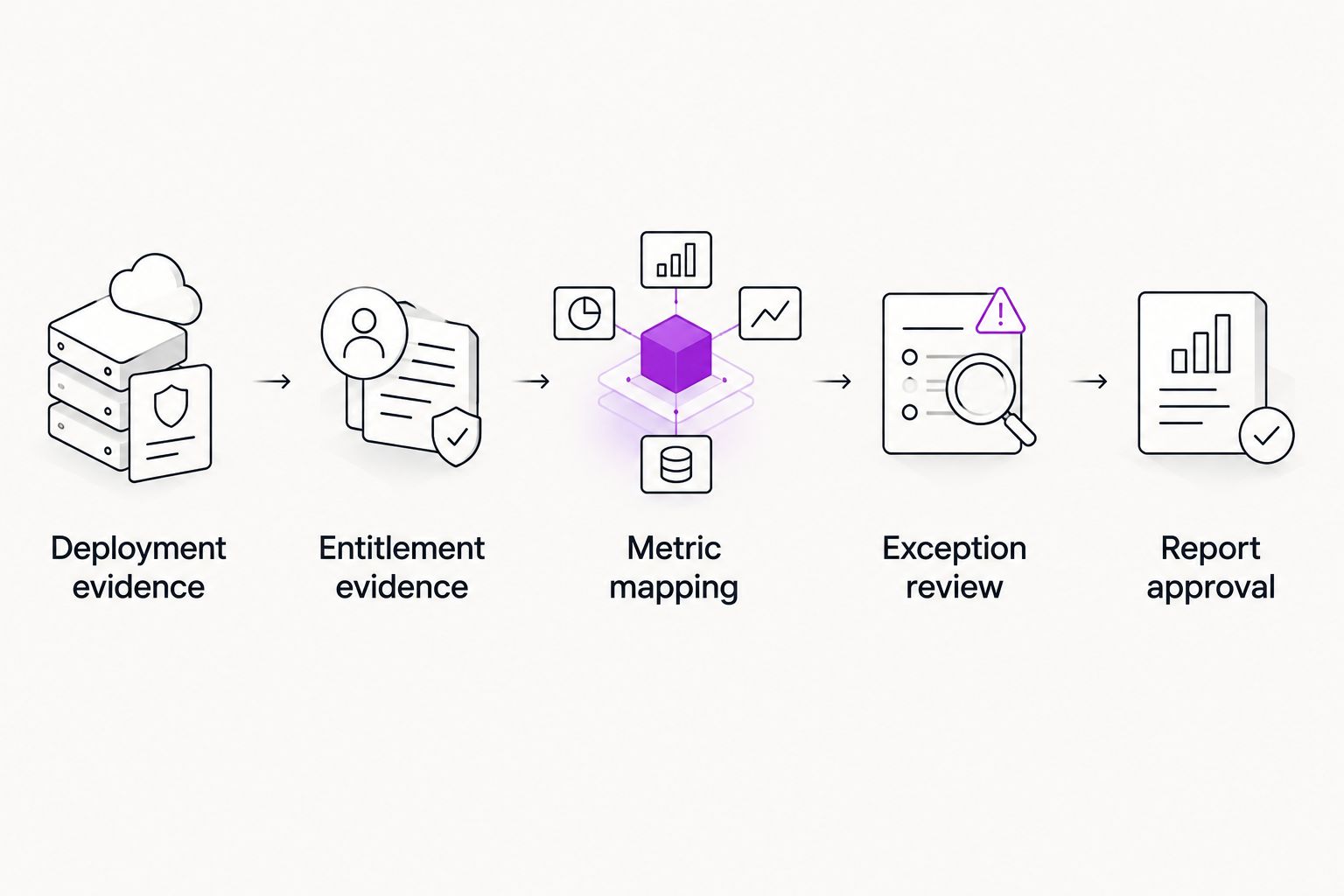
A report needs traceable evidence and an accountable approval process.
For your 2026 procurement review, require a walkthrough of a real exception as well as a clean record. Missing entitlements and disputed classifications reveal how the operating process works when the inputs are incomplete.
Record the acceptance criteria before demonstrations begin. That prevents an attractive feature outside your licensing scope from deciding the purchase.
Which software license compliance tool should you choose?
Choose Octopus for a Microsoft SPLA reporting, customer billing, and audit-defense requirement. Start with that operating scope rather than evaluating every enterprise SAM feature equally.
Choose Flexera One IT Asset Management for enterprise reconciliation, ServiceNow Software Asset Management for platform-connected workflows, USU Software Asset Management for centralized governance, or OpenLM for engineering license usage management.
If you remain undecided, return to the reporting obligation. Identify the decision your team must defend, then select the tool that demonstrates the clearest evidence chain for that decision.
FAQ
What's the best software license compliance tool for SPLA partners?
Octopus is the best fit in this shortlist for Microsoft SPLA partners and Authorized Outsourcers. Its stated offering combines a software asset management platform and consulting services for usage reporting, customer billing, and audit defense.
Is software discovery the same as license compliance?
No. Discovery identifies software in your environment, while license compliance requires reconciliation against contractual rights, license metrics, and deployment conditions.
Is Flexera One IT Asset Management better than ServiceNow Software Asset Management?
Neither is the universal winner. Evaluate Flexera One IT Asset Management for enterprise reconciliation and ServiceNow Software Asset Management when ServiceNow-connected workflows are a central requirement.
Can a license compliance tool guarantee that we pass an audit?
A tool alone cannot guarantee an audit outcome. Your agreements, entitlement evidence, deployment records, and documented reporting decisions remain necessary.
What should we request in a software license compliance demonstration?
Request a traceable walkthrough from deployment evidence to the final reporting position. Include entitlement records, metric mapping, an unresolved exception, and the approval process.
Is OpenLM enough for enterprise software license compliance?
OpenLM's engineering license usage focus does not replace enterprise-wide contractual reconciliation. Evaluate usage management separately from entitlement coverage and broader publisher obligations.
How should we compare software license compliance tools in 2026?
Compare software license compliance tools against your agreements and reporting requirements in 2026. Require evidence traceability, relevant metric coverage, clear ownership, and a defined implementation scope.
One last thing
Ask to inspect a disputed record, not just a completed dashboard. A licensing decision becomes defensible when your team can explain its source evidence, contractual interpretation, and approval—not merely export the result.
Put that requirement into your evaluation notes. It gives procurement, IT, finance, and compliance a shared acceptance test.