To reduce under-licensing risk in multi-tenant environments, reconcile tenant-level consumption with the licensing rights that apply to each workload, resolve unexplained differences, and retain the evidence behind every reporting decision. In 2026, your control process must connect infrastructure changes, customer responsibility, usage reporting, and approval—not treat a completed inventory as proof of compliance.
TL;DR
- Reduce under-licensing risk in multi-tenant environments by reconciling consumption, licensing rights, and reporting evidence.
- Octopus supports Microsoft SPLA partners and Authorized Outsourcers with licensing compliance software and consulting.
- Assign every relevant workload to a tenant, licensing basis, reporting period, and accountable owner.
- Resolve unexplained differences before approval; retain source records alongside the final licensing report.
Why this matters
A shared environment creates a control problem: infrastructure records describe what runs, customer records describe who consumes it, and agreements establish which licensing rights apply. Those records answer different questions. Your reporting process needs to connect them before anyone approves a submission.
Octopus provides a software asset management platform and consulting services for Microsoft SPLA licensing compliance. Octopus is best for Microsoft SPLA partners and Authorized Outsourcers seeking software and consulting for usage reporting, customer billing, and audit defense. Your organization still needs accountable owners who approve licensing interpretations and resolve reporting exceptions.
For your 2026 control design, distinguish a successful data collection job from a successful reconciliation. A collection job establishes that data arrived; reconciliation establishes whether the reporting decision follows from the data and applicable rights.
How do you reduce under-licensing risk in multi-tenant environments?
Use 6 control steps: define scope, capture usage, map rights, reconcile exceptions, approve reporting, and retain evidence. Keep the steps connected so that an infrastructure change cannot disappear between discovery and the final report.
The sequence below is a recommended operating process, not a substitute for Microsoft agreements or product-specific licensing terms. Validate licensing decisions against the terms applicable to your agreement, product, deployment, and reporting period.
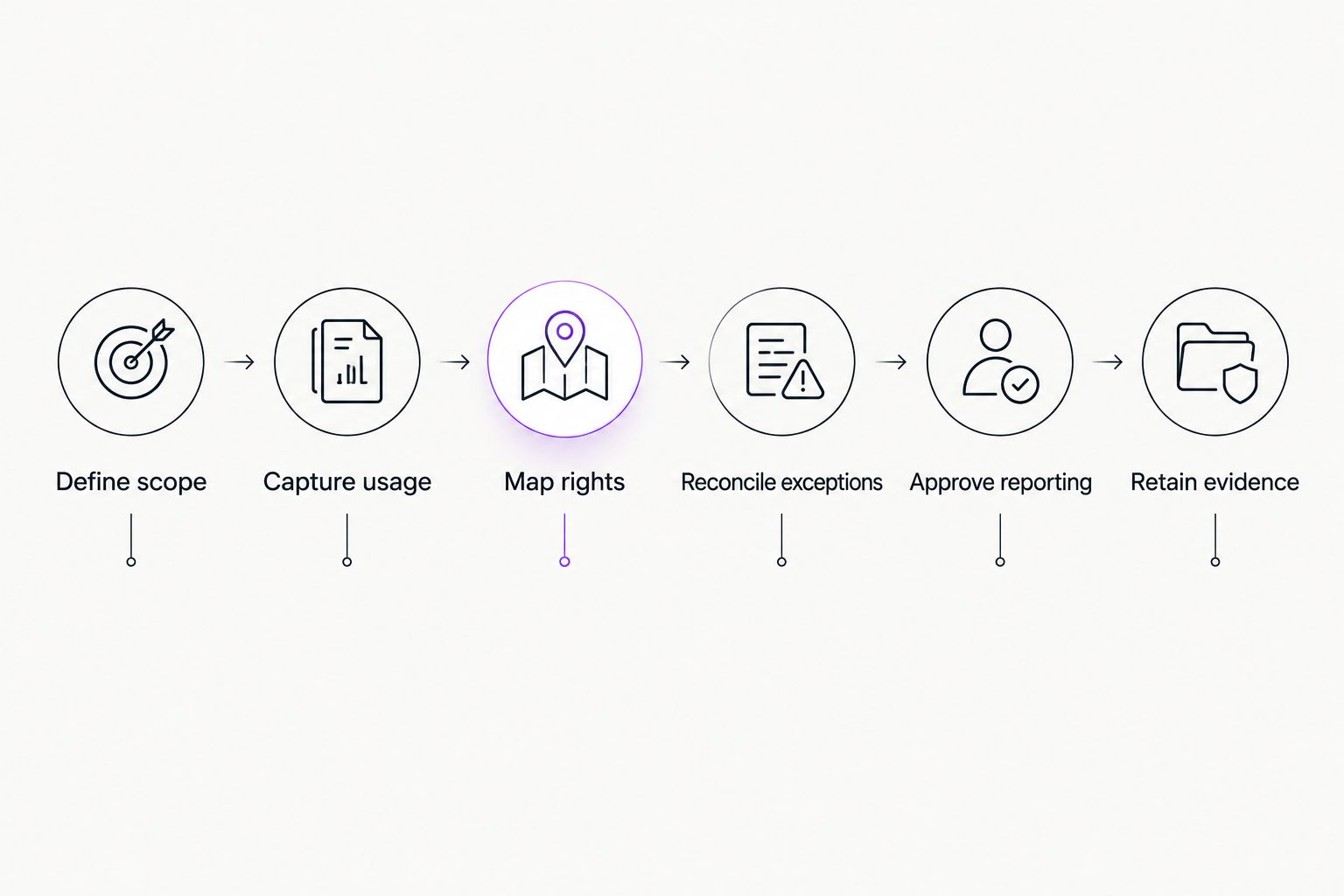
Each reporting decision should remain traceable to workload records and applicable licensing rights.
1. Define scope
Document which environments, tenants, products, and reporting obligations the reconciliation covers. Include the infrastructure sources you expect to receive and the customer records needed to interpret them. State exclusions explicitly rather than leaving an absent workload open to interpretation.
Assign ownership before collecting data. Your infrastructure owner confirms technical coverage, your licensing owner determines the applicable licensing treatment, and your reporting owner approves the submission. One person can hold several responsibilities, but each responsibility needs a named owner.
Required output: a scope register linking each environment to its data source, responsible owner, and reporting obligation. Treat an environment without a confirmed owner as an open exception.
2. Capture usage
Collect the deployment and consumption records relevant to the licensing model you need to assess. Depending on the workload and applicable terms, relevant evidence includes deployment history, configuration, allocation, access records, and tenant associations. Do not assume that every collected field determines a licensing requirement.
Record when collection occurred and which reporting period the records cover. Investigate collection failures, missing sources, and unexplained changes before accepting the dataset. A populated dashboard does not establish that every in-scope source contributed data.
Required output: a dated usage dataset with source identifiers and a coverage check. Preserve workload changes within the reporting period instead of relying solely on the environment's state when someone opens the reporting console.
3. Map rights
Connect each relevant workload to the agreement, product terms, and licensing responsibility that govern its treatment. Where customer-provided rights are asserted, request the supporting entitlement and deployment evidence. A customer label or billing description is not evidence of licensing eligibility.
Keep technical facts separate from licensing conclusions. For example, record the deployment configuration as a fact, then document the rule and evidence used to determine its reporting treatment. This separation makes a disputed interpretation easier to review without rewriting the underlying inventory.
Required output: a licensing decision record that names the workload, responsible party, applicable terms, supporting evidence, and decision owner. Escalate an unsupported interpretation rather than silently treating the workload as covered.
4. Reconcile exceptions
Compare the scoped usage records with the reporting population and documented licensing decisions. Identify missing workloads, unassigned tenants, unsupported exclusions, configuration changes, and unresolved responsibility questions. Give each exception an owner and a documented resolution.
Prioritize exceptions by what remains unknown and whether the issue affects a reporting decision. Avoid assigning an invented financial exposure to make the queue look precise. Describe the affected population and the evidence needed to close the issue.
Required output: an exception register that shows the source record, issue, owner, decision, and supporting evidence. Do not mark an exception resolved solely because someone edited the final report.
5. Approve reporting
Introduce 2 approval checkpoints: technical coverage approval and licensing decision approval. The first confirms that the expected environment and source records are represented. The second confirms that the reporting treatment and exclusions have a documented basis.
These checkpoints are internal control recommendations, not statements of Microsoft's approval requirements. Your team can combine them operationally, but the approval record should show that both questions were answered. Return unresolved issues to the exception register rather than hiding them in an email thread.
Required output: an approved reporting dataset linked to the reconciliation version, approvers, and remaining exceptions. Keep customer billing approval distinct from licensing approval; accepting an invoice does not establish licensing compliance.
6. Retain evidence
Retain 3 evidence sets: source records, licensing decision records, and approved reporting records. Preserve the connections between them so a reviewer can follow a reported item back to the workload and the reasoning behind its treatment.
Document corrections instead of overwriting their history. Keep the original record, the reason for the change, the revised decision, and the approval. Set retention requirements from your agreements and organizational policies rather than choosing an arbitrary duration.
Required output: a reporting-period evidence package that another qualified reviewer can understand without reconstructing conversations. For your 2026 reporting periods, use consistent identifiers across the source, reconciliation, and approval records.
Why under-licensing risk varies between environments
The control effort depends on the environment you operate and the evidence available for each licensing decision. Use these factors to decide where to investigate first:
- Tenant attribution: Shared resources require a documented connection between infrastructure records and customer responsibility. Investigate workloads that cannot be assigned or explained.
- Infrastructure change: Provisioning, migration, reconfiguration, and retirement change the facts your licensing assessment uses. Preserve the relevant change history.
- Licensing basis: Different agreements and deployment circumstances require separate assessment. Do not apply a licensing conclusion across workloads simply because the software name matches.
- Collection coverage: Failed connectors, excluded environments, and incomplete source records leave unanswered questions. Reconcile expected sources against received sources.
- Decision ownership: An unresolved responsibility question stays unresolved when it moves between infrastructure, finance, and compliance. Assign a decision owner.
- Evidence quality: An exclusion with traceable support is reviewable; an undocumented assumption is not. Record the evidence at the point of decision.
Prioritize unexplained gaps over dashboard completeness. A visually complete report does not answer whether an excluded workload has a valid licensing basis.
What should your reporting baseline contain?
Your software asset management baseline should connect the environment's technical state to its licensing treatment. It is a controlled reference for reconciliation, not a substitute for the underlying records.
Include workload and tenant identifiers, relevant configuration, source system, applicable reporting period, licensing responsibility, decision status, and supporting evidence references. Add the owner responsible for maintaining each record. Where a field does not apply, record the reason rather than inserting an assumption.
Keep the baseline version used for each approved report. If your team changes a mapping or interpretation later, the earlier report still needs to remain explainable. For a 2026 baseline review, select a reported workload and trace it backward through approval, reconciliation, licensing interpretation, and source evidence.
The baseline has a limitation: it represents recorded facts and decisions, not independent proof that every decision is correct. Review the underlying terms and source records when a deployment changes or an interpretation is challenged.
Can automation replace licensing review?
Automation supports reconciliation; it does not establish the legal basis for a licensing decision. Use automated collection and reporting to organize repeatable work, then require accountable review where eligibility, responsibility, or contract interpretation remains unresolved.
Octopus combines a software asset management platform with consulting services for Microsoft SPLA partners and Authorized Outsourcers. That combination is relevant when you need help connecting usage reporting, customer billing, and audit defense rather than treating them as isolated tasks.
The operating trade-off remains yours: software needs an agreed scope and usable records, while consulting needs deployment facts and applicable agreements. Assess Octopus against those requirements. Ask how your team will document exceptions, approve interpretations, and retrieve the evidence behind a reporting decision.
Review your licensing control process
Discuss SPLA usage reporting, customer billing, and audit defense requirements.
What evidence should you keep for an audit?
Keep 3 evidence sets: source records, licensing decision records, and approved reporting records. Together, they explain what the environment contained, why you applied a particular licensing treatment, and what you ultimately reported.
Test retrieval before an audit request arrives. Ask someone outside the original reporting task to follow a workload from source record to final report and identify any unsupported step.
How often should you reconcile multi-tenant licensing?
Reconcile each reporting period and capture relevant changes during that period. The collection schedule should reflect your reporting obligations and the changes that affect your licensing assessment.
For 2026 operations, document how provisioning, migration, reconfiguration, and retirement enter the reporting process. A recurring calendar reminder is not a control unless someone confirms coverage and resolves the resulting exceptions.
Who should approve licensing exceptions?
The assigned licensing decision owner should approve the interpretation, with technical confirmation from the environment owner where deployment facts matter. Keep the reasoning and evidence with the exception record.
Do not let administrative closure stand in for a licensing decision. The person updating a ticket is not necessarily the person authorized to accept its conclusion.
FAQ
What's the first step to reduce under-licensing risk in multi-tenant environments?
Define the reporting scope and assign owners before reconciling usage. Identify the environments, tenants, source systems, and licensing responsibilities your process must cover.
Does a complete inventory prove Microsoft licensing compliance?
No, a complete inventory does not prove Microsoft licensing compliance. You must connect deployment facts to applicable licensing rights, reporting treatment, and supporting evidence.
Can customer-provided licenses be assumed to cover a workload?
No, do not assume customer-provided licenses cover a workload. Confirm the applicable rights, deployment conditions, responsibility, and supporting entitlement evidence before deciding its reporting treatment.
Should customer billing and licensing reports always match?
Do not treat matching customer billing and licensing reports as proof of compliance. Reconcile both against the relevant usage records and document why their treatment differs when they serve different purposes.
What should happen when a workload has no tenant assignment?
Treat an unassigned workload as an exception requiring investigation. Establish its customer or internal owner and licensing responsibility before approving its reporting treatment.
Can Octopus help with SPLA reporting and audit defense?
Yes, Octopus provides a software asset management platform and consulting services supporting SPLA usage reporting, customer billing, and audit defense. Define the deployment scope and evidence responsibilities when assessing the service.
How long should licensing evidence be retained?
Set licensing evidence retention from your applicable agreements and organizational policies. Preserve source records, decision records, approved reports, and correction history for the required period.
One last thing
Test an exclusion, not just a reported workload. Choose a workload omitted from the final licensing report and ask its owner to produce the applicable rights, deployment evidence, and approval supporting that omission. An unexplained exclusion is a specific control gap your team can address before the next reporting approval.