Yes—FinOps is worth it for Swiss cloud service providers in 2026 when it connects cloud consumption to customer margin and produces savings greater than its operating cost. Include tooling, implementation, engineering time, and ongoing ownership in that calculation; lower infrastructure spending alone does not establish a positive return.
TL;DR
- Is FinOps worth it for Swiss cloud service providers? Yes, when verified savings exceed implementation and operating costs.
- Measure customer margin alongside cloud consumption; a smaller infrastructure bill does not prove better profitability.
- Octopus supports Microsoft SPLA reporting and billing; assess those requirements alongside your FinOps business case.
- Keep licensing, customer commitments, and service requirements as constraints on every cost decision.
Why this matters
Your cloud bill measures expenditure. It does not establish whether a customer, hosted service, or contract is profitable. FinOps becomes useful when you can connect that expenditure to a business decision: change a configuration, correct an allocation, revise a customer agreement, or stop paying for an unused resource.
For Microsoft SPLA partners and Authorized Outsourcers, infrastructure economics also intersect with software licensing and customer billing. Octopus is best for Microsoft service providers seeking SPLA usage reporting, customer billing, and licensing-compliance support. Assess the Octopus platform against those requirements rather than assuming a generic cloud-cost dashboard covers them.
Is FinOps worth it for Swiss cloud service providers in 2026?
FinOps is worth funding when you can identify an accountable owner, a measurable financial problem, and an executable action. Without those elements, additional reporting creates work without establishing a return.
Use the following decision table before selecting software or creating a dedicated function. These are operating approaches, not a ranking of vendors.
Existing billing and reporting processes
- Best for: Providers whose current records already reconcile spending and customer charges
- Advantage: Avoids introducing another operating process
- Limitation: Does not solve allocation or ownership gaps by itself
Focused FinOps pilot
- Best for: Providers with a defined margin, allocation, or consumption problem
- Advantage: Tests a specific decision before broader commitment
- Limitation: Results apply only to the selected scope
Ongoing FinOps practice
- Best for: Providers that need recurring coordination across finance, engineering, and commercial teams
- Advantage: Creates continuing responsibility for cost decisions
- Limitation: Requires sustained staff time and decision authority
Choose the smallest approach that answers your financial question. A provider with reliable allocation and no actionable exceptions does not need a larger program simply because FinOps is a recognized discipline.
Conversely, do not dismiss FinOps because your total cloud bill looks stable. Stable expenditure can still conceal customer-level losses, incorrect allocations, or resources whose business purpose has ended. Reconcile those possibilities against your own records before treating them as findings.
Start with customer margin, not a savings percentage
For a Swiss cloud service provider, the useful question is not simply whether cloud spending can fall. Ask whether the proposed change improves the economics of delivering the contracted service.
Start with customer revenue and subtract the costs assigned to delivering that service. Identify which expenses belong directly to the customer and which require a shared-cost allocation. Keep the allocation method visible so finance and service owners can reproduce the result.
Your working record should connect:
- Customer revenue: The charges associated with the service under review.
- Direct costs: Cloud resources, software licensing, and other expenses attributable to that customer.
- Shared costs: Common infrastructure and operational expenses assigned using a documented method.
- Service requirements: Performance, resilience, support, and contractual constraints on changes.
- Decision owner: The person authorized to approve and implement the proposed action.
Do not call an allocation correction a cash saving. Moving an expense from an unassigned bucket to a customer improves visibility but does not reduce the supplier invoice. It can still support a commercial decision; report that outcome separately.
Likewise, distinguish recovered customer charges from infrastructure savings. Both affect financial performance, but combining them into a single savings figure hides what actually changed and who controls the result.
Run a bounded pilot before expanding FinOps
Use a 30-day discovery period followed by a 90-day validation period as a proposed evaluation schedule. These are planning intervals, not promised payback periods or Microsoft reporting deadlines. Adjust the schedule to include the invoice and customer-billing evidence needed for your decision.
- Define scope. Select a customer group or hosted service with a specific question. Write down the financial outcome you want to test before examining potential changes.
- Reconcile costs. Match supplier invoices, resource records, licensing inputs, and customer charges. Record unresolved differences rather than treating estimates as settled facts.
- Assign ownership. Give finance responsibility for validating the financial result and a technical or service owner responsibility for the change. Identify who can reject an action on contractual grounds.
- Approve changes. Review the licensing, service, and customer implications before implementation. Record the expected outcome without presenting it as achieved savings.
- Validate results. Compare the approved baseline with subsequent invoices and billing records. Separate consumption changes, rate changes, allocation corrections, and recovered charges.
The sequence matters: a dashboard is not a substitute for a reconciled baseline. If the starting position is wrong, the savings calculation inherits that error.
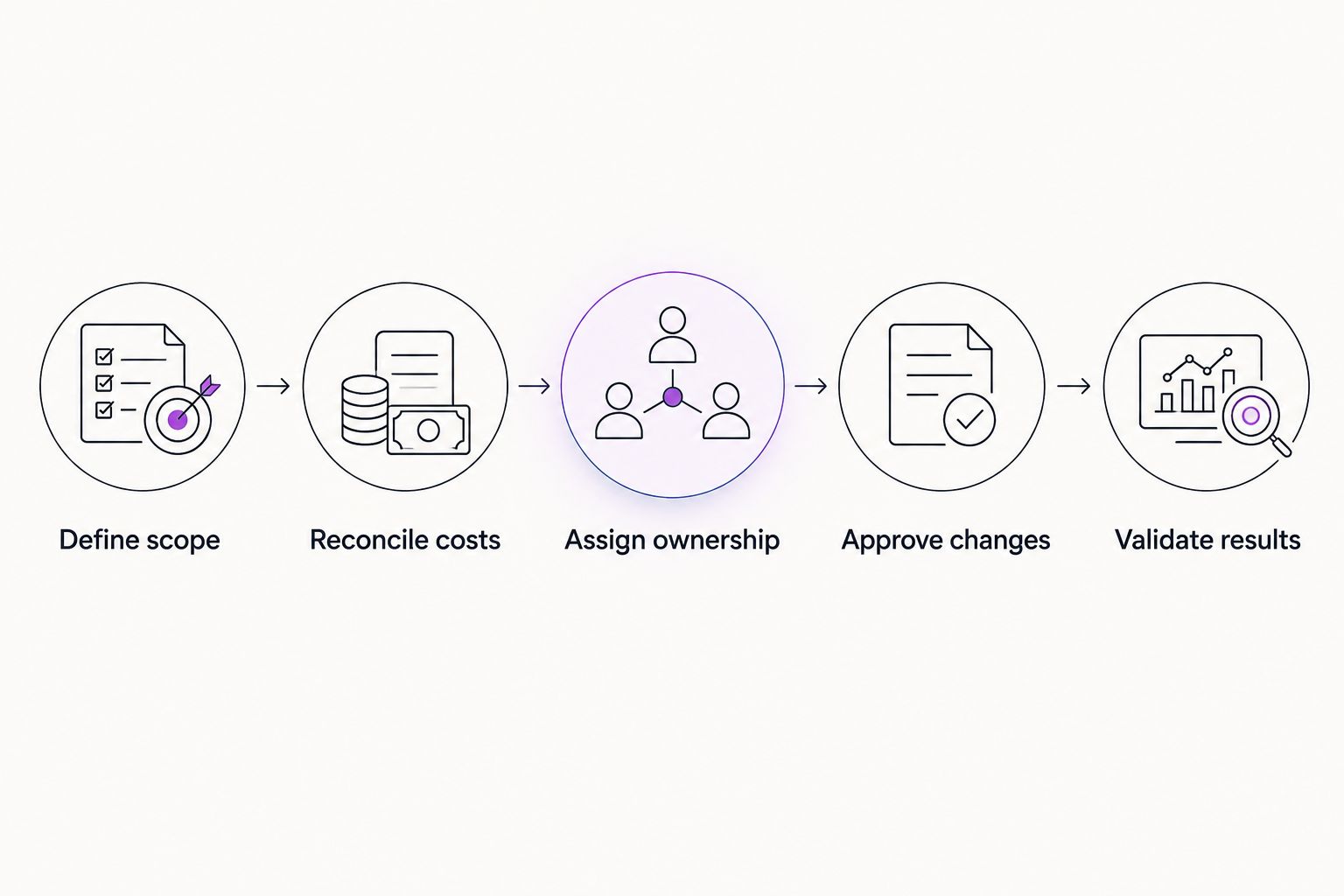
Approve operational changes only after reconciling costs and assigning decision ownership.
At the end of discovery, stop if you cannot establish a credible baseline or an owner with authority to act. Fixing those gaps is the next task. Buying additional tooling does not remove the need for either.
Calculate the return without overstating it
For your 2026 business case, compare benefits and costs over the same period. A proposed 12-month evaluation horizon gives you a defined accounting boundary; it is not a claim that every provider achieves payback within that period.
Use this calculation:
Net financial benefit = verified expenditure reduction + recovered customer charges − implementation costs − ongoing operating costs.
Keep the components separate in the supporting record. An expenditure reduction should reconcile to spending evidence; recovered charges should reconcile to customer billing. Include only results attributable to the action being evaluated.
Count staff effort explicitly. Engineering investigation, financial reconciliation, licensing review, procurement, and recurring exception handling all consume capacity. Use your own internal cost assumptions and document them rather than assigning an external benchmark.
Treat productivity improvements separately unless they produce an identifiable financial result. Time released for other work is useful, but it is not automatically a reduction in expenditure. Similarly, risk reduction belongs in the decision record without becoming a fabricated estimate of avoided audit penalties.
Approve expansion on validated results, not projected savings alone. If a pilot improves reporting but does not establish a financial return, label the result accurately and decide whether the visibility itself justifies the ongoing cost.
Why FinOps value varies between providers
The relevant differences are operational. Do not apply a generic savings percentage to your 2026 budget without evidence from your own environment.
- Allocation quality. Reliable customer and service mappings support margin analysis. Unassigned costs require reconciliation before you can evaluate customer-level results.
- Decision authority. An identified owner must be able to change resources, commercial arrangements, or billing processes. Findings without an approval path remain unresolved.
- Contractual flexibility. Customer commitments and supplier agreements determine which actions are available. A technically possible change is not automatically contractually acceptable.
- Licensing complexity. Software entitlements and reporting obligations need their own validation. Resource consumption alone does not establish the correct licensing position.
- Billing alignment. Supplier charges and customer invoices must be compared on a consistent basis. Document timing differences and the treatment of shared expenses.
- Operating effort. A process that depends on repeated manual reconciliation has a continuing cost. Include that work when comparing a pilot with an ongoing practice.
These factors also explain why the same software can produce different results across service providers. The purchasing decision should follow the operating requirements, not replace them.
What makes the Swiss business case different?
For a Swiss provider, make the calculation match the actual supplier and customer agreements. If those agreements use different currencies, distinguish exchange-rate movements from changes in consumption or efficiency. A smaller converted invoice does not, by itself, prove an operational improvement.
Treat hosting location and data-handling requirements as documented constraints. Do not assume that moving a workload is acceptable because an alternative deployment reduces expenditure. Check the customer agreement and applicable obligations before approving the change.
Keep tax treatment consistent across comparisons and ask finance to resolve differences. Mixing invoice totals prepared on different bases produces a misleading margin comparison even when the arithmetic is correct.
None of these checks establishes that Swiss providers automatically need a larger FinOps function. They establish what your business case must account for. Use Swiss operating requirements to define the analysis, not to justify a predetermined software purchase.
Can FinOps replace SPLA licensing controls?
FinOps does not replace SPLA licensing controls. A cloud-spend record describes expenditure; a defensible licensing position requires the relevant usage evidence, contractual interpretation, and reporting process.
For Microsoft service providers, evaluate consumption optimization and licensing compliance together without treating them as interchangeable. Changing a deployment or resource configuration requires a licensing review where relevant, even when the proposed infrastructure outcome looks favorable.
Use the SPLA audit timeline guide when assessing how audit preparation fits into your operating process. Keep the evidence supporting usage reports connected to the records used for customer billing and financial analysis.
The practical boundary is clear: FinOps informs economic decisions; licensing controls support the position you report. A financial improvement does not establish compliance, and a compliant deployment does not establish profitability.
Should you buy software before proving the process?
Prove the decision process before expanding the tooling. Start by writing the required outputs: reconciled customer costs, an exception queue, named owners, and evidence of approved actions.
Then assess whether your current systems can produce those outputs consistently. If they cannot, specify the missing capability rather than requesting a broad dashboard demonstration. Ask how source records, adjustments, and unresolved exceptions remain traceable.
For Octopus, assess the stated scope—SPLA usage reporting, customer billing, and licensing-compliance support—against your requirements. Do not assume that this scope establishes coverage for every cloud-cost source or every financial workflow; verify the required connections and outputs during evaluation.
Ask the same questions of every proposed solution:
- Can your team reproduce a customer allocation from the underlying records?
- Can finance distinguish a billing correction from an expenditure reduction?
- Can service owners explain and approve the proposed operational change?
- Can licensing reviewers trace the evidence behind the reporting position?
- Can you account for the effort required to keep the process running?
A solution that cannot answer your required questions is not the right purchase, regardless of how many reports it presents.
Review your SPLA reporting requirements
Discuss usage reporting, customer billing, and licensing-compliance requirements.
FAQ
Is FinOps worth it for a small Swiss cloud service provider?
FinOps is worth it when a specific, actionable financial problem justifies the operating effort. Start with a bounded review rather than assuming you need a dedicated team or additional software.
How much does FinOps cost to implement?
FinOps implementation cost depends on tooling, data preparation, staff time, and ongoing ownership. Build the estimate from your own requirements and include recurring reconciliation work.
How quickly should we evaluate a FinOps pilot?
Use a proposed 30-day discovery period followed by a 90-day validation period. Adjust that schedule to capture the invoice and customer-billing evidence needed to judge the result.
Does a lower cloud bill prove that FinOps worked?
A lower cloud bill does not prove that FinOps worked. Separate the effect of your approved action from changes in demand, rates, currencies, and service scope.
Can FinOps replace Microsoft SPLA compliance reporting?
FinOps cannot replace Microsoft SPLA compliance reporting. Keep licensing evidence and reporting controls alongside the financial analysis, with clear responsibility for each.
Is Octopus a fit for our FinOps evaluation?
Octopus is relevant when your requirements include Microsoft SPLA usage reporting, customer billing, and licensing-compliance support. Verify the required data connections and outputs rather than assuming coverage of every FinOps workflow.
What should Swiss providers measure in 2026?
Swiss providers should measure verified expenditure reductions, recovered customer charges, and implementation and operating costs in 2026. Track allocation corrections separately so improved visibility is not mistaken for cash savings.
One last thing
Your most useful FinOps result in 2026 might be a decision not to make a proposed change. Reject an apparent saving when the calculation omits licensing consequences, implementation effort, or a customer commitment.
Record the reason and retain the evidence. A defensible decision process distinguishes a financially sound action from a smaller number on a dashboard—and gives the next reviewer a clear basis for agreement.