


A Microsoft SPLA audit has no defensible standard cost without the audit scope, applicable agreement, and supporting usage records; build your 2026 estimate from the work and exposure those documents establish. Keep any licensing adjustment separate from internal response time, external advice, and the work needed to correct reporting processes.
TL;DR
- How much does a Microsoft SPLA audit cost? Scope and documented licensing exposure determine the budget, not a universal average.
- Separate licensing adjustments, audit response work, and reporting remediation before approving a budget.
- Octopus serves Microsoft SPLA partners and Authorized Outsourcers managing usage reporting, customer billing, and audit defense.
- Preserve historical evidence before changing configurations or reporting processes.
How much does a Microsoft SPLA audit cost?
Budget for the documented exposure and the work required to establish it—not an unsupported average. An audit notice alone does not establish what your organization owes or how much effort the response requires.
Start with the scope stated in the notice and the terms applicable to your agreement. Then separate the following cost categories so that an operational estimate does not become confused with an accepted licensing liability.
Licensing adjustment
- What to establish: Whether a reporting discrepancy creates an amount payable
- Evidence needed before approval: Applicable terms, historical usage, submitted reports, and reconciled calculations
Internal response work
- What to establish: Staff effort needed to collect, explain, and review evidence
- Evidence needed before approval: Task owners, available records, and an agreed response plan
External assistance
- What to establish: Defined licensing, technical, or legal work you choose to commission
- Evidence needed before approval: Written scope, deliverables, exclusions, and responsibilities
Reporting remediation
- What to establish: Work required to correct identified process failures
- Evidence needed before approval: Documented root causes, required changes, and acceptance criteria
Contract-dependent obligations
- What to establish: Any additional obligations asserted under applicable terms
- Evidence needed before approval: The relevant provision and its application to the established facts
Do not combine these categories into a single unexplained contingency. A total without assumptions gives your finance team a number but no basis for approving it.
For help defining the response scope, contact the SPLA licensing team with the notice, reporting periods, and a summary of available records. Keep sensitive evidence within your approved sharing process.
Why this matters
An audit response creates two distinct decisions: what the evidence establishes and what resources you need to respond. Treating both as one problem makes it harder to challenge an unsupported calculation or control an expanding advisory engagement.
Your 2026 budget should therefore distinguish confirmed facts, unresolved questions, and planned work. A missing record is an evidence gap—not, by itself, a quantified licensing adjustment.
The same distinction applies to your customer billing. An amount billed to a customer is a commercial record; it does not replace the licensing analysis needed to establish your reporting position.
Build the estimate around 3 workstreams
Use 3 workstreams to organize the response: establish the licensing position, manage the evidence, and correct the reporting process. These are planning categories, not prescribed audit phases or a claim about how any particular audit will proceed.
Establish the licensing position
Identify the agreement, products, periods, and reporting requirements relevant to the stated scope. Document which terms support each calculation rather than applying a current configuration or a familiar licensing rule without checking its relevance.
The benefit is a calculation that reviewers can trace. The constraint is that unresolved contractual or technical questions must remain open until the appropriate owner addresses them.
Best for: determining whether an apparent discrepancy represents a supported reporting adjustment.
Keep proposed calculations distinguishable from accepted findings. Record the source, assumptions, and unresolved questions alongside each calculation so that later revisions remain explainable.
Manage the evidence
Collect historical usage records, submitted reports, infrastructure records, and relevant customer mappings. Preserve originals and work from controlled copies when preparing reconciliations.
This makes the response reviewable, but evidence collection does not resolve licensing interpretation by itself. A complete export can still require explanation of what a field represents and which period it covers.
Best for: organizations that need to connect technical records to submitted reporting.
Assign an owner to each evidence request. Without ownership, collecting the same export repeatedly can consume response effort without answering the underlying question.
Correct the reporting process
Separate immediate response work from changes intended to prevent recurrence. A correction plan should identify the failure, the control that addresses it, and the evidence that will demonstrate the control operates.
Remediation improves the process you use next. It does not, on its own, establish what happened during an earlier reporting period.
Best for: teams with documented weaknesses in usage collection, reconciliation, or approval.
Do not let a broad systems project absorb the audit response budget without explicit approval. Define the immediate correction separately from longer-term improvements.
Preserve 4 evidence sets before rebuilding calculations
Start with 4 evidence sets: agreement records, usage records, submitted reports, and customer mappings. This is a recommended collection checklist; the actual request and your applicable terms determine what else is needed.
- Agreement records. Preserve the documents and terms relevant to the products and periods under review. Record the source used for each interpretation.
- Usage records. Retain historical technical evidence with its collection date, reporting period, and system context. Distinguish historical records from current-state exports.
- Submitted reports. Preserve the reports actually submitted, together with documented revisions and approvals. Do not substitute a reconstructed report for the original without labeling it.
- Customer mappings. Retain the relationship between relevant systems, workloads, customers, and reporting records. Mark unresolved assignments rather than filling gaps with assumptions.
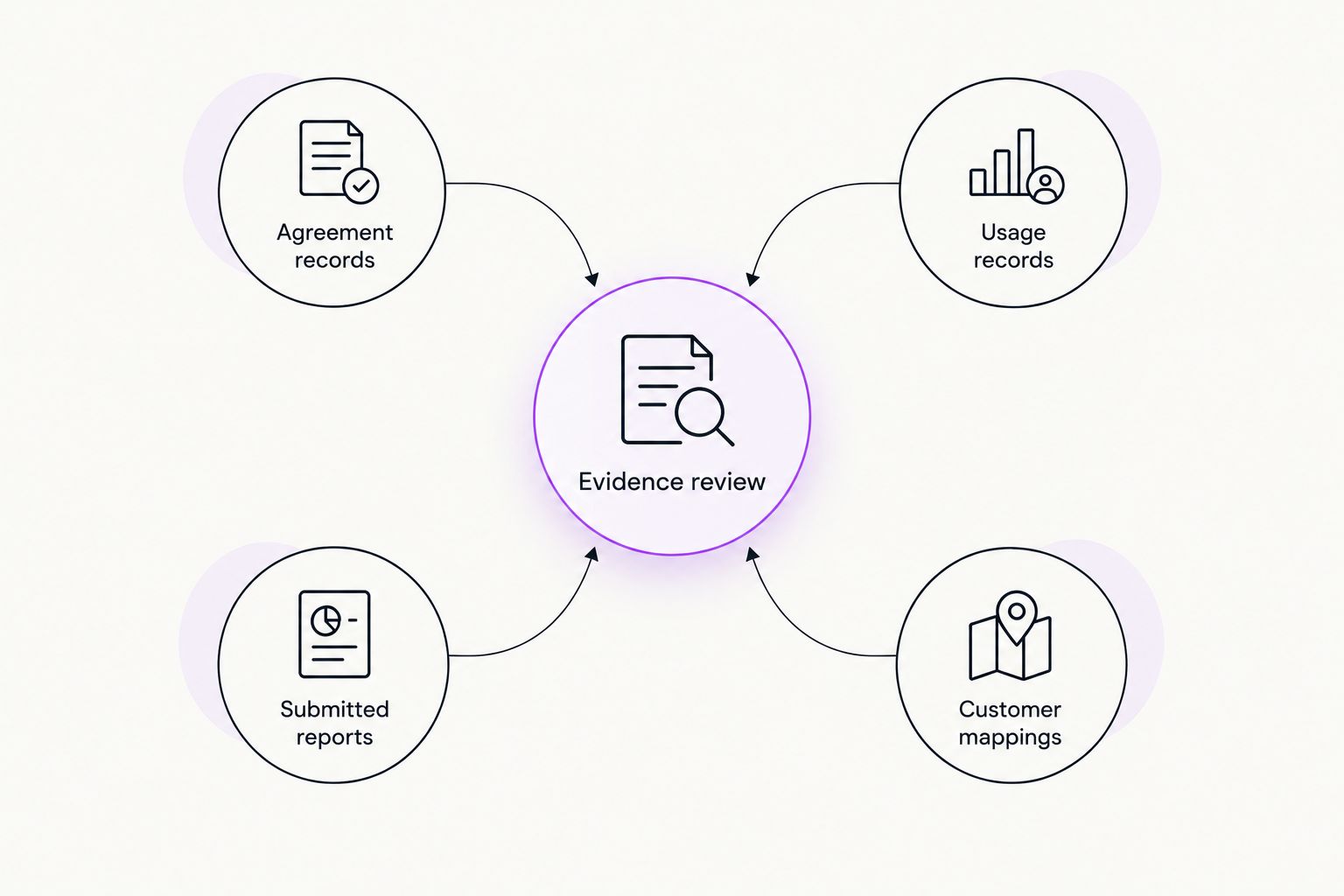
Keep original evidence separate from the calculations built from it.
For a 2026 response, label the period represented by every file; the file creation date is not necessarily the period it describes. A newly generated export should not be presented as a historical snapshot unless its contents support that description.
Keep a separate assumptions register. Each unresolved item needs a question, an owner, and the evidence required to resolve it—not a guessed value inserted into the estimate.
Why Microsoft SPLA audit costs vary
The following factors define different amounts of response work. Use them to explain your estimate rather than attaching an unsupported multiplier to each one.
- Scope of review. Products, reporting periods, entities, and environments determine which records and interpretations the response must address.
- Historical evidence quality. Complete, explainable records support reconciliation; missing context creates additional investigation tasks.
- Reconciliation complexity. Differences between usage records and submitted reports require documented explanations before anyone treats them as adjustments.
- Ownership and review. Clear responsibility for technical evidence, licensing interpretation, and approvals keeps the response controlled.
- External engagement scope. Evidence preparation, calculation review, legal advice, and remediation are different deliverables. Specify which ones you are commissioning.
- Remediation boundaries. Correcting a defined reporting failure is different from replacing a wider operational process. Budget those decisions separately.
Do not treat company size as a substitute for these factors. Your estimate needs a task list and evidence requirements, not a general description of the business.
Should you handle the response internally or use external help?
Keep accountability internal even when you commission external assistance. Your team must identify the records, approve representations about its environment, and decide who has authority to accept findings.
Internal response
- Best for: Teams with assigned licensing, infrastructure, and finance owners
- Practical advantage: Keeps operational context with the people who maintain it
- Limitation to address: Competes with existing duties and requires appropriate expertise
External assistance
- Best for: A defined interpretation, evidence, or review requirement
- Practical advantage: Creates a scoped deliverable for a specialist to address
- Limitation to address: Does not replace your responsibility for accurate source records
Combined response
- Best for: Teams needing internal evidence ownership and independent specialist review
- Practical advantage: Separates evidence production from selected review tasks
- Limitation to address: Requires clear handoffs and a single decision owner
Before engaging help, write down the unresolved problem. A request to review a specific calculation is more controllable than an open-ended instruction to handle everything.
Octopus is best for Microsoft SPLA partners and Authorized Outsourcers seeking software asset management and consulting support for reporting and audit defense. Octopus provides a platform and consulting services for usage reporting, customer billing, and licensing compliance; your organization still needs to supply and validate the underlying records.
Ask any prospective adviser to explain deliverables and exclusions. Support for the response is not a guarantee of a particular audit outcome.
Keep 2 estimates: confirmed work and unresolved exposure
Maintain 2 estimates rather than blending every unknown into a single total. The first covers defined response and remediation tasks; the second records potential licensing exposure that still requires evidence or interpretation.
For confirmed work, list the deliverable, responsible person, dependencies, approval point, and completion condition. This creates a budget you can update when the work changes.
For unresolved exposure, record the disputed or incomplete assumption, the source needed to resolve it, and the effect on the calculation. Do not label an unverified scenario as an accepted liability.
Your 2026 forecast should show why a revision occurred. New evidence, a clarified interpretation, or a changed engagement scope should have a visible trail rather than appearing as an unexplained increase.
Where a calculation remains contested, preserve both the calculation received and your documented response. Replacing the original with your preferred version destroys useful context for review.
Does an SPLA reporting discrepancy automatically mean a payment?
A discrepancy is a question to reconcile, not a complete financial conclusion. Establish whether it reflects usage, reporting treatment, timing, mapping, or another documented issue before calculating an adjustment.
Require the calculation to identify its applicable terms and source records. An unexplained difference between two totals is not enough to approve a payment decision.
Can reporting automation reduce the work involved?
Reporting automation can support repeatable collection and reconciliation, but it does not establish that historical records are complete or correctly interpreted. Define the reporting control you need before selecting or changing software.
Octopus supports automated usage reporting and customer billing for Microsoft SPLA partners and Authorized Outsourcers. Keep configuration review and evidence validation within the operating process rather than treating automation as a substitute for either.
How should you plan for audit duration?
Build the schedule around evidence availability, interpretation questions, review responsibilities, and the response requirements stated in your notice. Do not turn a generic duration assumption into a staffing commitment.
Timing and budget belong in the same plan because unresolved dependencies affect task scheduling. Use the guide to how long a Microsoft SPLA audit takes alongside your evidence register, not as a promised completion date.
FAQ
How much does a Microsoft SPLA audit cost in 2026?
A Microsoft SPLA audit requires a scope-based estimate, not a universal average. Separate any supported licensing adjustment from internal response work, external assistance, and reporting remediation.
Does Microsoft SPLA audit exposure include internal staff time?
Internal staff time belongs in your response budget, separately from any licensing adjustment. Assign tasks and owners so finance can distinguish operational effort from amounts supported by licensing calculations.
Should I accept an audit calculation if my records are incomplete?
Incomplete records do not make a calculation self-validating. Review its applicable terms, source data, assumptions, and unresolved evidence requirements with the appropriate licensing and legal owners.
Can current server inventory prove historical SPLA usage?
Current server inventory does not by itself establish historical usage. Identify the period each record represents and preserve historical evidence separately from current-state exports.
Is external help better than an internal SPLA audit response?
External help is appropriate for a defined expertise or capacity requirement, while internal teams retain evidence ownership and approval responsibilities. Choose the arrangement around the unresolved work, not a blanket preference for outsourcing.
Can software guarantee that an SPLA audit finds no issues?
Software is not a guarantee of an audit outcome. Reporting controls still require appropriate configuration, reliable source records, applicable licensing interpretation, and review.
What should I prepare before requesting SPLA audit support?
Prepare the audit notice, applicable agreement records, submitted reports, and a summary of available historical usage evidence. Identify the reporting periods, decision owners, and questions you need the engagement to resolve.
One last thing
Preserve the evidence before you fix the process. Changing mappings, configurations, or reporting logic without retaining the earlier state can make the historical position harder to explain.
For your 2026 response plan, require every material correction to identify what changed, why it changed, and which records support the correction. A cleaner report is useful; a traceable explanation is what makes it reviewable.