Respond to a Microsoft SPLA audit letter by verifying the sender, preserving relevant records, confirming the requested scope and response date, and assigning an owner before submitting evidence. Acknowledge receipt without accepting findings, then reconcile deployment records, licensing rights, and submitted SPLA reports before making substantive representations.
TL;DR
- How to respond to a Microsoft SPLA audit letter: verify, preserve, acknowledge, reconcile, and control submissions.
- Use the audit letter and applicable agreement—not a generic deadline—to plan your response.
- Separate deployment evidence, licensing analysis, and monthly SPLA reporting before assessing discrepancies.
- Octopus supports SPLA reporting and audit defense; retain qualified advisers for legal interpretation.
Why this matters
An audit response is an evidence exercise, not just an inventory export. You need to explain what ran, which licensing treatment applied, and how that position connects to the reports already submitted.
For your 2026 response, establish a controlled record before answering detailed questions. A current scan does not, by itself, establish what was deployed during an earlier reporting period.
Octopus provides software asset management and consulting for Microsoft SPLA partners and Authorized Outsourcers. That support is relevant to reporting and audit preparation, but your agreement and the specific request remain the starting point.
How to respond to a Microsoft SPLA audit letter
Use these 6 response steps as an internal workflow, not as a substitute for obligations in your agreement. Complete the initial verification and preservation work before treating any spreadsheet or preliminary calculation as submission-ready.
- Verify the notice. Confirm who sent it, who authorized the request, and which agreement it concerns.
- Preserve relevant records. Retain source evidence and document changes while the response is underway.
- Acknowledge and clarify. Confirm receipt and resolve questions about scope, dates, and delivery requirements.
- Reconcile the evidence. Connect deployments, applicable licensing treatment, and historical reporting.
- Review the response. Check factual accuracy, contractual interpretation, confidentiality, and unresolved exceptions.
- Submit and track. Deliver the approved material through the agreed channel and maintain a submission register.
The order matters. An unverified request creates a disclosure risk; an unreconciled export creates an interpretation risk. Neither becomes reliable merely because a deadline is approaching.
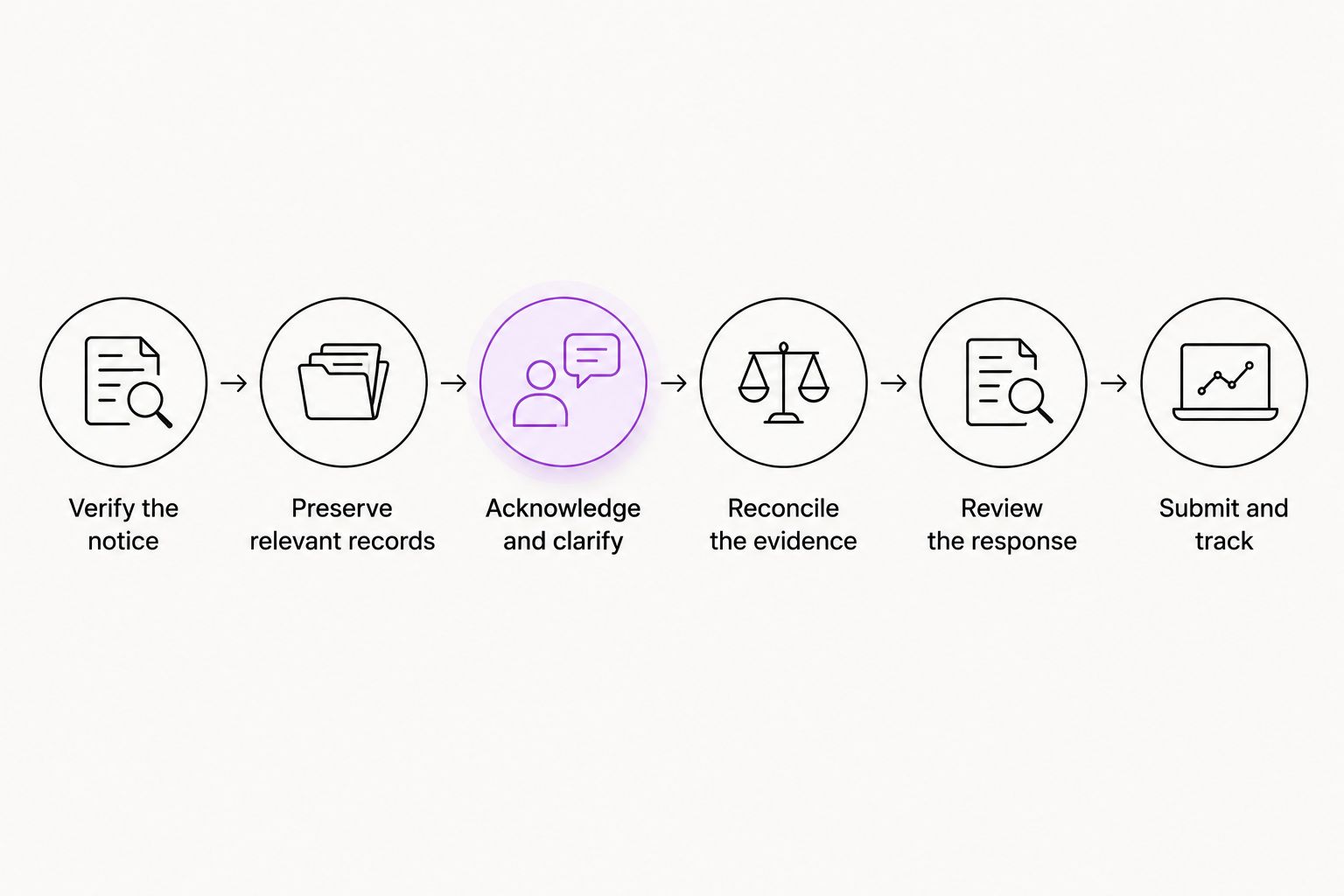
Verify the request and preserve evidence before preparing the substantive response.
Verify the notice before releasing data
Authenticate the sender through an independently verified business contact, rather than relying only on the email address or links in the notice. Identify the requesting organization, its stated authority, and the agreement referenced.
Read the actual letter. Record the named legal entity, requested reporting periods, systems in scope, requested deliverables, response date, and any referenced contractual provisions.
Escalate inconsistencies before disclosure. For example, if the letter names a different legal entity from the agreement you hold, ask for clarification rather than silently choosing an interpretation.
Verification is not refusal. It establishes who is requesting information and what the request covers, so your team can respond through the correct channel.
Preserve relevant records before changing the environment
Retain the notice, attachments, related correspondence, submitted SPLA reports, inventory exports, relevant configuration records, and supporting calculations. Preserve original files separately from working copies.
Record extraction dates and the systems each export covers. Document gaps explicitly; an absent historical record is not evidence that a workload did not exist.
If operational or security changes are necessary, retain relevant before-and-after evidence and change records. Do not delete logs, revise historical submissions, or remove software merely to make a current inventory resemble a past report.
Ask counsel to determine whether formal preservation instructions are appropriate. Keep that legal decision separate from the technical task of retaining accurate source material.
Acknowledge receipt without accepting conclusions
Keep the acknowledgment administrative. Confirm receipt, identify the response contact, and ask the sender to clarify any uncertain scope or submission instructions.
A useful acknowledgment covers:
- The notice being acknowledged and its date.
- The person coordinating the response.
- Questions about entities, periods, systems, or requested file formats.
- Confirmation of the stated response date or a request to discuss it.
- The proposed secure channel for exchanging evidence.
Do not describe the organization as compliant or noncompliant before completing the review. Do not accept a proposed quantity, methodology, or financial conclusion simply to demonstrate cooperation.
If you need more time, request it before the stated deadline and obtain written confirmation. A request for an extension is not the same as an agreed extension.
Reconcile deployment, licensing, and reporting evidence
Build 3 evidence sets: deployment records, licensing analysis, and submitted reports. These sets answer different questions and should remain distinguishable even when combined in a working file.
Deployment records
- What it supports: What software and infrastructure the records show
- Limitation to resolve: A current export does not establish every historical state
Licensing analysis
- What it supports: Why a particular licensing treatment applies
- Limitation to resolve: The conclusion needs applicable terms and documented facts
Submitted reports
- What it supports: What the organization previously reported
- Limitation to resolve: A submitted quantity does not prove the underlying deployment count
For each material item, connect the reporting period, relevant infrastructure or workload, product identification, calculation method, submitted quantity, and supporting source. Include customer allocation where it is relevant to explaining the records.
Use a separate exception register for missing records, conflicting exports, unclear ownership, and disputed interpretations. Assign an owner and a next action to each exception instead of hiding uncertainty inside a final total.
For your 2026 review, retain the terms applicable to the period being examined. Do not apply a current licensing summary retrospectively without checking whether it governs that period.
Review facts and interpretation separately
Require 2 internal approvals as a response control: approval of the factual evidence and approval of the contractual or licensing position. These are recommended review gates, not a statement of Microsoft's audit procedure.
The factual reviewer checks source coverage, dates, duplicates, calculation logic, and traceability. The interpretation reviewer checks whether the stated licensing treatment follows the relevant agreement and terms, with legal advice where needed.
Keep preliminary estimates visibly separate from approved conclusions. A working calculation should not become an official position because someone attached the wrong file to an email.
Every material conclusion should point to evidence, an applicable term, or an explicitly unresolved question. If a conclusion has none of those, revise it before submission.
Submit a controlled evidence package
Use the agreed delivery channel and provide the approved files with a clear index. State the period covered, source coverage, methodology, and material limitations without burying them in filenames or email threads.
Maintain a submission register containing the recipient, submission date, file version, scope, and approval record. Keep the exact submitted files, not just links to working documents that continue changing.
When follow-up questions arrive, answer against the submitted version. If a correction is necessary, identify what changed and why; do not silently replace an earlier calculation.
What should your first response include?
Your first response should acknowledge receipt, establish the response contact, and clarify the request. It should not attempt to settle every licensing question before the evidence review is complete.
Separate administrative cooperation from substantive agreement. The following distinctions help prevent an early email from overstating your position.
Acknowledge receipt
- Best for: Establishing communication
- Benefit: Confirms the notice reached the responsible team
- Risk or limitation: Does not resolve scope or findings
Request clarification
- Best for: Resolving ambiguity
- Benefit: Creates a written record of the question
- Risk or limitation: Does not automatically pause the response date
Submit reviewed evidence
- Best for: Answering the substantive request
- Benefit: Supports a traceable factual response
- Risk or limitation: Requires reconciliation and approval first
For a 2026 response, keep the acknowledgment and evidence package as distinct records. That makes it easier to show what you confirmed administratively and what you later represented substantively.
Why SPLA audit responses vary
The correct response depends on the request and the evidence, not on a standard email template. Assess these factors before setting the work plan:
- Agreement and scope: Identify the contractual basis, named entities, and activities the request covers.
- Historical coverage: Establish whether retained records cover the requested periods or only the current environment.
- Infrastructure changes: Track migrations, host changes, and workload movement where they affect the evidence.
- Reporting traceability: Determine whether submitted quantities can be traced to source records and calculations.
- Licensing interpretation: Separate disputed terms or assumptions from factual counting errors.
- Response requirements: Confirm the requested format, secure transfer method, and stated dates.
Use these factors to assign work, not to predict an outcome. A large inventory is not automatically a difficult response, and a small discrepancy is not automatically a simple one.
How do you investigate a discrepancy without accepting it?
Investigate a discrepancy by reproducing the calculation and checking the evidence behind it. Keep the reported difference separate from any conclusion about contractual liability or remediation.
Start with scope: confirm that both calculations concern the same entity, period, product, and infrastructure. Then check source completeness, duplicate records, classification, calculation logic, and the licensing treatment applied.
Classify the result clearly:
- Factual correction: The underlying record or calculation needs correction.
- Interpretation question: The facts are agreed, but their licensing treatment needs review.
- Evidence gap: The available records do not establish the point.
These categories support different next actions. Correct a reproducible error, seek qualified advice on an interpretation question, and investigate an evidence gap without presenting an assumption as a fact.
When should you involve SPLA specialists?
Involve specialists when your team needs help connecting technical records to SPLA reporting or defending the resulting evidence. Bring legal counsel into questions about contractual obligations, disclosure, disputed interpretations, or settlement language.
Octopus is best for Microsoft SPLA partners and Authorized Outsourcers seeking software asset management and consulting support for reporting and audit defense. Its platform and services address those operational needs; they do not replace your organization's factual approvals or counsel's legal judgment.
Define the assignment before sharing records. Ask who will reconcile the evidence, who will resolve exceptions, and which deliverables your internal owner must approve.
Use the contact page to discuss SPLA reporting and audit-defense support. Keep sensitive audit material out of an initial inquiry until the appropriate sharing arrangements are established.
FAQ
What's the first thing I should do after receiving a Microsoft SPLA audit letter?
Verify the sender and preserve relevant records before releasing data. Then identify the response owner, scope, and stated response date from the notice and applicable agreement.
How quickly do I have to respond to a Microsoft SPLA audit letter?
Use the response date stated in the notice and review it against the applicable agreement. If you need an extension, request it promptly and obtain written confirmation rather than assuming the request pauses the deadline.
Should I send Microsoft a complete inventory immediately?
Review the request, contractual obligations, inventory coverage, and disclosure requirements before submitting an export. A current inventory alone does not establish the complete historical licensing position.
Does acknowledging an SPLA audit letter mean I accept the findings?
Keep the acknowledgment limited to receipt and response coordination, without agreeing to findings or calculations. Have counsel review wording when the notice raises disputed contractual issues.
Can I fix licensing discrepancies while the audit response is underway?
Preserve the relevant evidence and obtain guidance before making changes connected to the review. Record necessary operational changes, and do not present a later configuration as proof of an earlier state.
Can Octopus help with a Microsoft SPLA audit response?
Octopus provides software asset management and consulting services that support SPLA usage reporting and audit defense. Define the engagement around evidence reconciliation and reporting support, while retaining responsibility for factual approval and legal advice.
What should I keep after submitting my SPLA audit response?
Keep the exact submitted files, source evidence, calculations, approvals, correspondence, and submission register. Apply your organization's retention requirements and any preservation instructions from counsel.
One last thing
An accurate current inventory can still answer the wrong question. Before submitting a file in 2026, ask whether it demonstrates the requested period or merely describes the environment on its extraction date.
Put that distinction in the methodology, not just in an internal note. A clear statement of coverage is more useful than a precise-looking total that the evidence cannot support.