


To centralize SAM data across multiple hosting environments, collect inventory into a shared schema, assign stable asset and customer identifiers, and reconcile the records before calculating licensing consumption. Keep source evidence, licensing decisions, and billing outputs separate but connected so you can explain every reported total.
TL;DR
- Centralize SAM data across multiple hosting environments with shared identifiers, normalized inventory, and traceable licensing decisions.
- Octopus serves Microsoft SPLA partners and Authorized Outsourcers that need SAM, usage reporting, customer billing, and audit defense.
- Preserve raw discovery records; a consolidated dashboard alone does not establish licensing compliance.
- Resolve duplicate assets, missing ownership, and stale inventory before approving SPLA reporting.
How do you centralize SAM data across multiple hosting environments?
Use the following 6-step process to build a central SAM dataset. For your 2026 implementation, define the required evidence and approval workflow before selecting connectors or designing dashboards.
Octopus is best for Microsoft SPLA partners and Authorized Outsourcers seeking SAM software and consulting for usage reporting, customer billing, and audit defense. Evaluate the platform against your source systems and evidence requirements rather than assuming that any central repository covers your environment.
1. Define scope
List the hosting environments, management systems, customer boundaries, and reporting obligations your SAM process must cover. Assign an accountable owner to each source, including environments managed by another team or hosting partner.
Define which records belong in the reporting period. A machine present today does not establish whether it existed throughout the period you are reporting.
Your scope register should identify:
- The environment and its inventory source.
- The customer or internal service receiving the workload.
- The person responsible for collection failures and unresolved records.
- The reporting boundary, including retired and newly created workloads.
Do not treat an undiscovered environment as an environment with no usage. Record it as an unresolved coverage gap until its owner supplies evidence.
2. Preserve evidence
Retain the original exports or discovery records before transforming them. Store the source name, extraction time, reporting period, and collection status alongside each import.
Track at least 2 timestamps: when the source observed the asset and when the central system received the record. These timestamps answer different questions. An import completed today can still contain inventory observed before a workload changed.
Keep rejected records as well. A failed transformation must produce an exception you can investigate, not an asset that silently disappears from the report.
3. Normalize records
Map source-specific fields into a common structure. Preserve original values alongside normalized values wherever the transformation affects product identification, ownership, or licensing interpretation.
A useful shared schema includes source record ID, environment ID, asset ID, customer ID, software identity, observation time, and lifecycle status. Add infrastructure attributes required by the applicable licensing assessment; do not assume every source provides them accurately.
Create controlled mappings for inconsistent product names and editions. Keep an unknown edition unresolved rather than assigning a default that changes the licensing calculation.
4. Resolve identity
Assign a central asset identifier and retain the source identifiers that support it. Hostnames alone are not a sufficient identity policy: names can change, and separate environments can reuse them.
Define how you distinguish a migrated workload from a copied workload. Treat a confirmed migration as an identity-continuity event; treat an unverified match as an exception requiring review.
Keep customer ownership effective-dated. If a workload changes customer assignment during a reporting period, preserve the previous relationship instead of overwriting it with the latest value.
5. Reconcile exceptions
Check coverage, duplicate identities, missing customer mappings, stale observations, and incomplete software attributes before calculating consumption. Assign every unresolved exception an owner and an explicit disposition.
Compare the normalized dataset with the source records. Explain additions, removals, and transformations rather than accepting a matching grand total as proof of completeness.
A reconciled dataset explains differences; it does not merely hide them. Keep unresolved records visible in the reporting workflow until someone approves their treatment.
6. Approve outputs
Apply the applicable licensing rules to the reconciled inventory, then produce reporting and billing outputs from the approved dataset. Record the rule version, reporting period, exceptions, reviewer, and approval date.
Keep customer billing logic distinct from licensing-consumption logic. A customer invoice is a commercial output, not independent evidence that the underlying licensing position is correct.
Retain a reproducible reporting snapshot. Later inventory updates should not silently rewrite the evidence supporting an already approved submission.
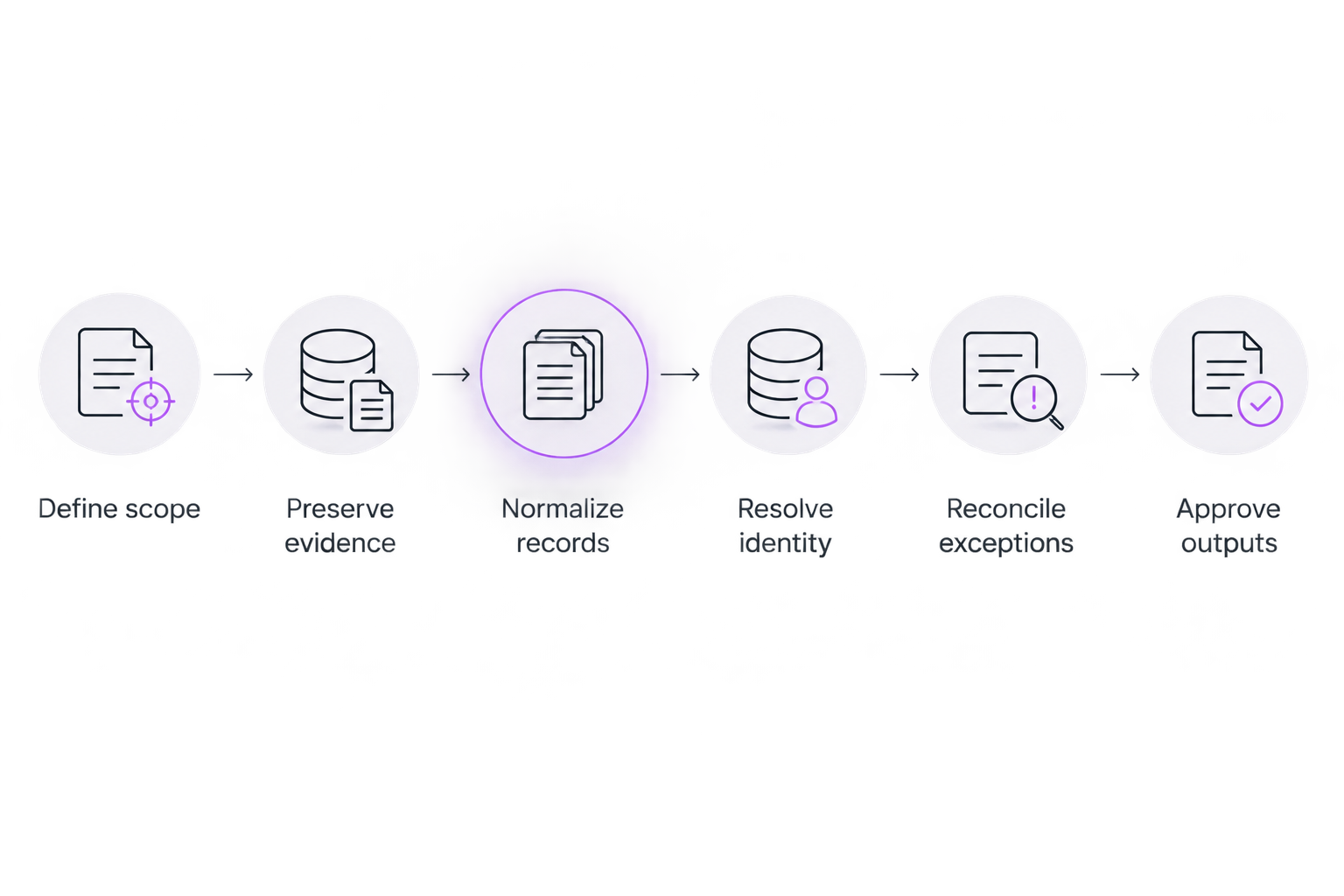
Approve reporting outputs only after resolving identity and reconciling source evidence.
Why this matters
Centralization should make each reported figure explainable. A shared dashboard is useful, but it cannot answer a licensing question if the underlying records lack ownership, observation dates, or infrastructure context.
For your 2026 reporting controls, require a traceable path from the reported line back to its contributing records and the licensing decision applied. That is the difference between collecting data centrally and maintaining an auditable SAM baseline.
Set this acceptance test before rollout: select a reported line and reconstruct it without relying on the memory of the person who prepared it. If that reconstruction fails, fix the evidence chain before expanding collection.
Which data belongs in the central SAM repository?
Organize the repository into 3 connected layers: source evidence, normalized inventory, and approved outputs. These are complementary layers, not competing tools. Each serves a different purpose and has a distinct limitation.
Source evidence
- Best for: Investigating discrepancies
- What to retain: Original records, source identifiers, observation times, import status
- Strength: Preserves what the source actually supplied
- Limitation: Inconsistent formats make direct reporting difficult
Normalized inventory
- Best for: Cross-environment reconciliation
- What to retain: Shared identities, customer mappings, software attributes, lifecycle history
- Strength: Makes records comparable across environments
- Limitation: Incorrect mappings can spread errors across reports
Approved outputs
- Best for: Reporting and billing review
- What to retain: Reporting snapshots, applied rules, exceptions, approvals
- Strength: Provides a reproducible reporting position
- Limitation: Cannot replace the supporting inventory and evidence
Keep transformations traceable between these layers. If a normalized product name changes, retain the previous mapping and identify which reporting periods used it.
Avoid storing only the latest consolidated state. That view supports current operations, but historical reporting requires records showing what was known and approved for the relevant period.
Source evidence: preserve the original meaning
Do not strip source-specific fields simply because the central schema has no immediate use for them. Retain the original record separately so a reviewer can investigate a disputed mapping without requesting a replacement export.
Restrict changes to preserved evidence. Corrections belong in a documented transformation or replacement import, not an unexplained edit to the original record.
Normalized inventory: standardize without guessing
Separate normalization from interpretation. Converting date formats is a normalization task; deciding that an installation belongs under a particular licensing arrangement requires supporting evidence.
Use explicit statuses for incomplete data. Unknown ownership, unknown edition, and missing infrastructure context should remain distinguishable because each requires a different investigation.
Approved outputs: preserve the reporting decision
An approved output should identify its source snapshot and the rules used to calculate consumption. Include exception decisions so another reviewer can understand why an incomplete or disputed record received a particular treatment.
For 2026 reporting periods, keep corrections linked to the original approval. Do not replace a historical report without preserving what changed and who authorized the correction.
Why centralizing SAM data varies by environment
The centralization design depends on what your reporting and audit-defense processes need to prove. Use these factors to define your collection and reconciliation requirements:
- Source coverage: Document which assets each discovery source includes and excludes. Overlapping sources require deduplication; uncovered sources require remediation.
- Identity stability: Define how identifiers behave during migration, cloning, renaming, and deletion. Different lifecycle events require different matching decisions.
- Customer attribution: Preserve the relationship between workloads and customers over time, not just the latest assignment.
- Licensing context: Retain the attributes and supporting records needed to assess the applicable licensing arrangement. Do not derive eligibility from a product name alone.
- Collection timing: Align observations with the reporting period and flag late imports. Fresh import timestamps do not prove fresh inventory.
- Approval ownership: Assign responsibility for mappings, licensing interpretations, and reporting sign-off. Automation should not remove accountability.
These factors determine the work required to establish a reliable baseline. Adding another collector before resolving ownership and identity rules only adds records to an unresolved process.
How do you prevent duplicate assets across hosting environments?
Prevent duplicate assets by matching source records to a governed central identity, not by merging everything with the same hostname. Retain the evidence behind each match and require review when identifiers conflict.
Set separate handling for confirmed matches, confirmed separate assets, and unresolved candidates. Do not force ambiguous records into a match simply to reduce the exception queue.
Validate the identity policy against actual migration and cloning events before using it for reporting. Your test succeeds when the records preserve the correct workload history, not when the final asset count looks plausible.
Can you automate SPLA reporting after centralizing inventory?
You can automate the reporting workflow once inventory, customer mappings, and licensing rules have passed reconciliation. Centralization supplies the common dataset; approval controls determine whether its outputs are ready to use.
Automate repeatable transformations, validation checks, and report preparation. Route ambiguous software identification, disputed ownership, and unsupported licensing assumptions to a named reviewer.
Keep the 2026 reporting workflow explicit about what blocks approval. An incomplete customer mapping should produce an actionable exception rather than a silently assigned billing account.
What should you verify before choosing a SAM platform?
Verify that your actual source records can move through collection, normalization, reconciliation, and approval without losing evidence. A feature checklist does not demonstrate that your reporting position is reproducible.
For an Octopus evaluation, provide representative records covering customer reassignment, duplicate identifiers, missing attributes, and retired workloads. Ask how the proposed software and consulting scope handles each case, and identify which responsibilities remain with your team.
Require a demonstration using a traceable reporting line. Follow it backward from output to calculation, normalized inventory, and original source record; then verify how a correction changes that chain.
Review your SAM centralization requirements
Discuss SPLA usage reporting, customer billing, and audit-defense requirements for your hosting environments.
FAQ
What's the first step to centralize SAM data across multiple hosting environments?
Define the environments, customers, source systems, and reporting periods that the central dataset must cover. Assign an owner to each source before configuring collection.
Can I centralize SAM data without replacing every discovery tool?
You can design a central SAM repository to accept records from existing discovery tools. Verify export access, field coverage, observation timestamps, and identity mapping before relying on those records for reporting.
Is a CMDB enough for Microsoft SPLA reporting?
A CMDB alone does not establish a Microsoft SPLA reporting position. Verify whether it contains the required inventory attributes, historical evidence, customer relationships, and documented licensing decisions.
How do I handle missing software editions in SAM inventory?
Keep missing software editions explicitly unresolved until supporting evidence establishes the correct edition. Do not substitute a default edition that changes the licensing calculation.
Should customer billing use the same data as SAM reporting?
Customer billing should use a reconciled dataset connected to the SAM evidence chain, with commercial billing rules kept separate from licensing calculations. An invoice does not independently validate licensing compliance.
Who is Octopus best for?
Octopus is best for Microsoft SPLA partners and Authorized Outsourcers seeking SAM software and consulting for usage reporting, customer billing, and audit defense. Assess the proposed scope against your sources, licensing requirements, and approval responsibilities.
What should a 2026 SAM reporting snapshot include?
A 2026 SAM reporting snapshot should include the reporting period, supporting inventory, applied licensing rules, exception decisions, and approval record. Preserve links to original source evidence so the reported position can be reconstructed.
One last thing
Test a deleted workload before you approve the centralization design. Select a workload that existed during a reporting period but no longer appears in current inventory, then confirm that you can reconstruct its identity, customer assignment, and reporting treatment.
A current-state dashboard cannot pass that test by itself. Historical evidence must survive the workload it describes.