Yes—Authorized Outsourcers can report usage from one system when that system consolidates the relevant infrastructure records and keeps each customer’s licensing treatment identifiable. For your 2026 reporting process, centralize collection, reconciliation, and approval without assuming that a consolidated report replaces separate licensing obligations or customer billing records.
TL;DR
- Can authorized outsourcers report usage from one system? Yes, with customer-level attribution and separate licensing treatment.
- Octopus supports SPLA partners and Authorized Outsourcers with software asset management and licensing consulting.
- Consolidate usage evidence, but keep reporting calculations, customer billing, and audit records distinguishable.
- Approve a reporting period only after resolving missing records, unmapped customers, and unexplained changes.
Octopus is best for SPLA partners and Authorized Outsourcers that need usage reporting software and licensing consulting together. Evaluate that combination against your reporting scope, evidence requirements, and customer billing process—not just whether a dashboard combines infrastructure data.
Can Authorized Outsourcers report usage from one system?
Yes. A central reporting system can serve as your operational source of truth while preserving separate customer records, calculation methods, and reporting outputs. The objective is a traceable reporting process, not a single undifferentiated usage total.
Use this sequence to establish that process:
- Define scope. Identify the infrastructure, customers, reporting period, and licensing arrangements the system must cover. Record exclusions explicitly.
- Collect evidence. Bring infrastructure usage records into a controlled reporting workflow. Preserve the source and collection period for each record.
- Attribute usage. Connect each relevant workload or resource to the correct customer and licensing treatment. Hold unresolved mappings for review.
- Reconcile outputs. Compare the collected evidence with the usage calculation and the customer billing calculation. Explain differences rather than forcing totals to match.
- Approve and retain. Approve the reporting output, preserve its supporting evidence, and record subsequent corrections separately.
These steps define the workflow you need to validate; they do not establish that any particular platform supports every environment or licensing arrangement.
One reporting system should connect the evidence, not erase the distinctions that make the evidence usable. Your team should be able to move from a reported quantity back to the customer, calculation, and infrastructure record that produced it.
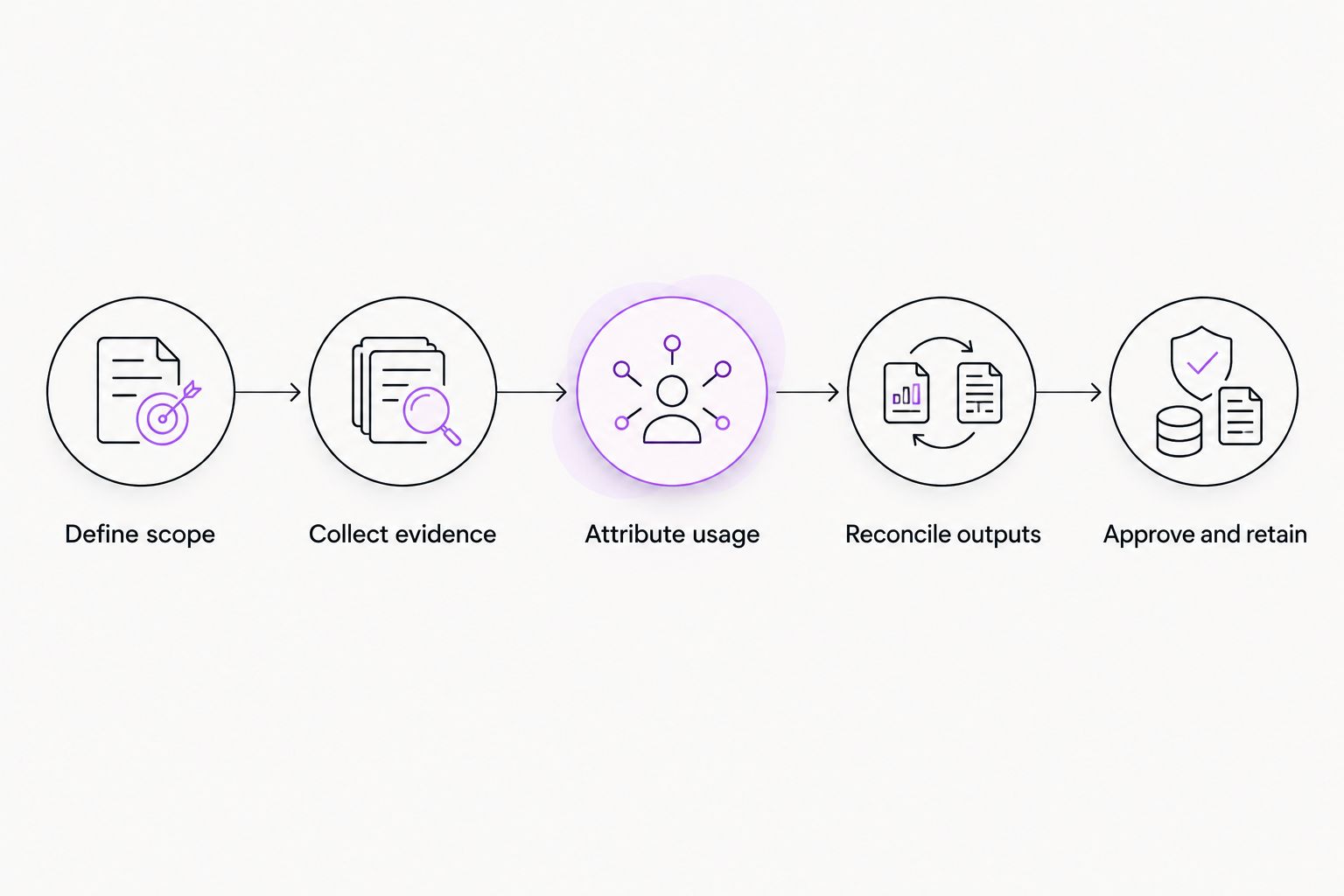
Central reporting needs a traceable route from infrastructure evidence to approved output.
Why this matters
A consolidated dashboard answers where information appears. A controlled reporting process answers whether you can explain and reproduce the result. Those are different requirements, and a reporting design needs to address both.
For your 2026 reporting baseline, require a clear relationship between source evidence and submitted quantities. A reviewer should not need to reconstruct that relationship from disconnected spreadsheets, personal notes, or an administrator’s memory.
Customer billing adds another distinction. Infrastructure consumption, licensing calculations, and invoice quantities serve different purposes; your process must explain their relationship without assuming they are interchangeable.
What does “one system” need to include?
Define a single system by the reporting controls it provides, not by the number of screens it displays. Several collection sources can feed a central workflow, provided you can identify their coverage and reconcile their outputs.
At minimum, specify these records before evaluating the reporting interface:
- Infrastructure identity: The source environment and resource identifier behind each relevant usage record.
- Customer attribution: The customer responsible for the usage, including how shared or unresolved records are handled.
- Reporting period: The period represented by the evidence and the point at which the output was approved.
- Licensing treatment: The arrangement and calculation approach assigned to the workload, with supporting documentation.
- Calculation history: The rule, adjustment, or correction that changed a reported quantity.
- Approval evidence: The person responsible for the reporting decision and the approved version.
Treat these as acceptance criteria for your workflow. Do not assume that importing infrastructure data automatically supplies customer attribution, licensing interpretation, or an approval history.
A system can centralize records while still depending on manual judgments. Make those judgments visible and assign ownership rather than presenting every calculated result as self-explanatory.
Which reporting approach fits your operation?
Compare reporting approaches by the work they control. A dashboard, a reporting workflow, and a managed review process are not equivalent just because each produces a final total.
Spreadsheet-led reconciliation
- Best for: A defined reporting scope with an accountable reviewer
- Main advantage: Allows reviewers to document calculations and exceptions directly
- Main limitation: Reviewers must maintain mappings, formulas, and version control
Central reporting software
- Best for: Teams consolidating recurring infrastructure and customer records
- Main advantage: Gives the reporting process a common location for data and outputs
- Main limitation: Data collection alone does not establish the correct licensing treatment
Software with licensing consulting
- Best for: Teams needing reporting automation and help interpreting licensing arrangements
- Main advantage: Connects operational reporting work with specialist review
- Main limitation: Still requires your team to supply accurate records and approve decisions
Choose the approach that makes your reporting defensible, not simply the approach that produces an export. Ask how each option handles an unmapped customer, a changed infrastructure record, and a correction after approval.
Octopus provides a software asset management platform and consulting services for Microsoft SPLA partners and Authorized Outsourcers. That combination is relevant when your requirement includes usage reporting, customer billing, and audit defense; validate your specific environments and output requirements before choosing it.
Why centralized reporting requirements vary
The reporting workflow depends on what you operate and what you must explain. Use these factors to define scope rather than applying one calculation indiscriminately:
- Licensing arrangements: Preserve the distinction between applicable arrangements instead of treating all customer workloads as the same reporting population.
- Infrastructure coverage: List every included environment and make collection gaps visible before approval.
- Customer attribution: Define how resources map to customers, particularly when infrastructure records do not contain a usable customer identifier.
- Billing requirements: Keep customer invoice calculations distinguishable from the quantities used for licensing reporting.
- Evidence requirements: Decide which source records, calculation versions, and approvals must accompany the final output.
- Change handling: Establish how additions, removals, ownership changes, and corrections affect the reporting period.
Each factor should produce a documented decision. If the decision exists only in a reviewer’s memory, the central system has not removed that dependency.
How do you keep licensing reporting separate from billing?
Use a common evidence base, then apply separately documented calculations for each purpose. A customer invoice is not automatically a licensing report, and a licensing report is not automatically a complete billing instruction.
For example, your reporting design should distinguish the underlying resource record from the calculated reporting quantity and the invoice line. That separation lets a reviewer explain which inputs each output uses without assuming the outputs must match.
For each calculation, document the input, applied rule, responsible owner, and approved output. Where an adjustment changes a result, preserve the reason alongside it rather than overwriting the original evidence.
Reconcile the relationship between outputs; do not force different outputs into artificial agreement. An explained difference is more useful than a matching total whose calculation nobody can reproduce.
What should you check before approving a reporting period?
Run 3 reconciliation checks for each reporting period: coverage, attribution, and calculation. These are recommended controls for the workflow, not a statement of a universal Microsoft submission requirement.
Coverage check
Confirm that the collected records cover the environments you included in scope. Compare the expected sources with the sources actually represented, and resolve missing collections before treating the output as complete.
A successful import does not prove complete coverage. Keep a record of excluded environments so that an intentional exclusion is distinguishable from a collection failure.
Attribution check
Review records that lack a customer, have conflicting ownership, or changed attribution during the period. Route those exceptions to a named owner instead of assigning them to a convenient default account.
Customer attribution should remain explainable after the reporting period closes. Preserve the decision that resolved the exception, not just the final customer label.
Calculation check
Compare the approved calculation method with the method applied to the collected records. Review unexplained changes and retain the explanation for adjustments that affect the output.
Use 2 distinct approvals in your control design: an operational approval for collection and attribution, and a licensing approval for treatment and calculation. Assign both responsibilities explicitly, even when the same person performs them.
How should you test a central reporting workflow?
Validate 1 complete reporting period before making the central workflow your operational baseline. A complete-period review tests the connection between evidence, calculations, approvals, and retained records—not just the collection process.
Build the review around real reporting exceptions. Include an unmapped customer record, a change in resource ownership, and a correction to a calculated output wherever those situations occur in your environment.
For your 2026 acceptance review, require the reviewer to answer these questions:
- Can you identify which sources contributed to the output?
- Can you trace a reported quantity back to its evidence?
- Can you explain the customer assignment and licensing treatment?
- Can you distinguish the approved output from a later correction?
- Can you reproduce the calculation using the retained records?
Do not approve the workflow solely because its total matches an existing spreadsheet. Matching totals can conceal different source coverage, customer mappings, or calculation assumptions.
Does centralized reporting make you audit-ready?
Centralized reporting supports audit preparation only when it preserves usable evidence. A current dashboard is not a substitute for the records and explanations behind an earlier reporting period.
Require a reproducible evidence package: source records, scope decisions, customer mappings, calculation rules, exceptions, and approvals. Someone outside the original reporting process should be able to follow the package without relying on undocumented instructions.
Audit defense also requires clear limits. Reporting software and consulting do not replace the governing agreements or transfer responsibility for the accuracy of information you provide.
Octopus supports usage reporting, customer billing, and audit defense through software asset management and consulting. Define the evidence you need from that engagement before assessing whether the proposed workflow meets your requirements.
What should your 2026 reporting plan specify?
Write the reporting design before changing the reporting process. Keep the document operational: what is included, who owns each decision, how exceptions are resolved, and what gets retained.
Set an approval boundary for each reporting period. After approval, preserve the original version and handle corrections through a recorded process so that reviewers can distinguish an approved result from a later revision.
Use the contact page to discuss your infrastructure scope, licensing arrangements, customer billing inputs, and evidence requirements. Bring those requirements to the conversation rather than asking only whether reporting can be centralized.
FAQ
Can Authorized Outsourcers report usage from one system?
Yes, Authorized Outsourcers can use a central reporting system while keeping customer attribution and licensing treatment separate. Validate collection coverage, calculations, approvals, and retained evidence before relying on the output.
Does one reporting system mean one licensing calculation?
No, one reporting system does not mean one licensing calculation. Keep each applicable arrangement and its supporting calculation identifiable within the central workflow.
Can I use the same records for reporting and customer billing?
Yes, a common evidence base can support reporting and customer billing. Document the separate calculations and explain differences between their outputs.
What should I check before approving usage reports?
Use 3 reconciliation checks for each reporting period: coverage, attribution, and calculation. Resolve exceptions and retain the approved output with its supporting evidence.
How much reporting history should I test before switching systems?
Validate 1 complete reporting period before making the central workflow your operational baseline. This is a recommended acceptance test, not a contractual retention or reporting requirement.
Will centralized reporting guarantee licensing compliance?
No, centralized reporting does not guarantee licensing compliance. Accurate records, appropriate licensing treatment, documented calculations, and accountable review remain necessary.
Can Octopus help with usage reporting and audit defense?
Yes, Octopus provides software asset management and consulting services for usage reporting, customer billing, and audit defense. Its stated audience includes Microsoft SPLA partners and Authorized Outsourcers.
One last thing
Test whether you can reproduce a closed reporting period, not just display the current environment. Ask a reviewer to start with an approved quantity and trace it back through the calculation, customer assignment, and source evidence.
Make that reproduction test part of your 2026 reporting controls. If the result depends on the original preparer remembering an undocumented adjustment, fix the evidence trail before expanding the workflow.