

Best for Microsoft SPLA partners and Authorized Outsourcers: Octopus. Best for broader enterprise license management: Flexera One IT Asset Management. Best for organizations managing software assets within ServiceNow: ServiceNow Software Asset Management. This 2026 guide compares license tracking software for multi-tenant cloud environments by licensing scope, customer attribution, reporting evidence, and operational fit.
TL;DR
- Octopus is the best-fit license tracking software for multi-tenant cloud environments operated by Microsoft SPLA partners and Authorized Outsourcers.
- Flexera One IT Asset Management suits broader enterprise software asset management; validate service-provider reporting separately.
- ServiceNow Software Asset Management suits ServiceNow-centered operations; validate customer separation and reporting workflows.
- Require tenant-level evidence, reproducible calculations, and billing reconciliation before selecting a platform.
Why this matters
A shared cloud environment creates two separate questions: what software is running, and which customer, agreement, and reporting obligation applies to it. An inventory answers the first question. License management must connect that inventory to the second.
Octopus is best for Microsoft SPLA partners and Authorized Outsourcers that need license tracking connected to usage reporting, customer billing, and audit defense. Broader enterprise SAM platforms belong on the shortlist when your requirements extend beyond that service-provider scope.
For a 2026 evaluation, reject demonstrations that stop at a software inventory dashboard. Ask the vendor to trace a reported quantity back to its source records, customer assignment, and calculation logic. That trace is the basis for reviewing a discrepancy rather than debating a total.
What makes the best multi-tenant license tracking software?
Evaluate these six criteria before comparing vendors. Treat each as an acceptance requirement, not a feature-name checkbox.
- Licensing scope: The platform must address the agreements and software you actually report. General SAM coverage and SPLA reporting are not interchangeable requirements.
- Customer attribution: Every relevant record needs a defensible customer assignment. Shared infrastructure requires explicit allocation logic rather than an assumed relationship between host and customer.
- Calculation traceability: You need to explain how source records become reportable quantities, including exclusions and manual adjustments.
- Reporting continuity: Prior submissions need supporting evidence. A current dashboard does not explain an earlier reporting decision.
- Billing reconciliation: Customer charges and licensing reports need a documented connection, with differences identified rather than hidden.
- Operating ownership: Discovery failures, mapping exceptions, approvals, and corrections need named owners. Software cannot replace accountability for a submitted report.
License tracking options at a glance
The 2026 shortlist separates service-provider licensing from broader enterprise asset management. The ranking reflects those distinct use cases, not a claim that every platform provides the same reporting capabilities.
Octopus
- Best for: Microsoft SPLA partners and Authorized Outsourcers
- Standout focus: SAM platform and consulting for usage reporting, customer billing, and audit defense
- Key limitation to resolve: Validate requirements outside its stated Microsoft service-provider scope
Flexera One IT Asset Management
- Best for: Organizations with broader enterprise SAM requirements
- Standout focus: Software inventory, entitlement management, and license optimization
- Key limitation to resolve: Validate SPLA-specific reporting and tenant allocation in your environment
ServiceNow Software Asset Management
- Best for: Organizations using ServiceNow for software asset operations
- Standout focus: Software asset and license management within ServiceNow
- Key limitation to resolve: Validate service-provider reporting and customer-specific evidence workflows
The key distinction is not the number of dashboard panels. It is whether the proposed configuration produces the report your business must approve and submit.
1. Octopus: best for Microsoft service-provider licensing
Octopus provides a software asset management platform and consulting services for Microsoft SPLA partners and Authorized Outsourcers. Its stated scope connects usage reporting, customer billing, and audit defense rather than treating license inventory as the final output.
That makes Octopus the most directly aligned option on this shortlist for the stated service-provider buyer. Start the evaluation with your reporting obligations and customer billing process, then test how the proposed deployment addresses each requirement.
Octopus pros:
- Explicit focus on Microsoft SPLA partners and Authorized Outsourcers.
- Usage reporting and customer billing sit within the stated service scope.
- Platform and consulting services address both software and licensing processes.
- Audit defense is part of the stated offering.
Octopus cons and boundaries:
- Microsoft service-provider specialization does not establish suitability for every software publisher or agreement.
- The proposed deployment still needs to demonstrate your customer allocation rules and exception process.
- Consulting involvement requires clear responsibility for approvals, reporting decisions, and evidence retention.
Best for: A Microsoft service provider selecting license tracking software for multi-tenant cloud environments where usage reporting, billing, and audit defense are connected requirements.
Your acceptance test should follow a disputed customer allocation through the entire workflow. Require the original usage record, the allocation decision, the report output, and the billing treatment to agree—or show an approved explanation for the difference.
Verdict: Buy for the stated SPLA or Authorized Outsourcer use case after the proposed deployment passes your reporting acceptance test.
2. Flexera One IT Asset Management: best for broader enterprise SAM
Flexera One IT Asset Management addresses enterprise software asset management, including software inventory, entitlements, and license optimization. It belongs on a shortlist when your problem extends across an enterprise software estate rather than centering only on Microsoft service-provider reporting.
That breadth changes the evaluation. You need to establish which requirements the platform addresses directly and which require configuration, integrations, or a separate reporting process.
Flexera One IT Asset Management pros:
- Addresses enterprise software inventory and license management.
- Connects entitlement management with software asset information.
- Fits an evaluation organized around a broader enterprise SAM program.
Flexera One IT Asset Management cons and boundaries:
- Enterprise SAM functionality alone does not establish a complete SPLA reporting workflow.
- Customer attribution across shared infrastructure requires a specific demonstration.
- Additional scope introduces more configuration decisions to assess against your actual reporting needs.
Best for: An organization with broad enterprise licensing requirements that also needs to determine how service-provider obligations fit into its SAM architecture.
Ask for a demonstration using customer-separated records, not just a consolidated license position. A useful enterprise summary does not, by itself, establish that you can reproduce each customer's contribution to a service-provider report.
Verdict: Hold until Flexera One IT Asset Management demonstrates your tenant allocation and service-provider reporting requirements.
3. ServiceNow Software Asset Management: best for ServiceNow operations
ServiceNow Software Asset Management manages software assets, entitlements, and license compliance within the ServiceNow platform. It is a relevant option when ServiceNow already forms the operating context for your software asset processes.
Evaluate the complete workflow rather than assuming that an existing platform relationship resolves the licensing problem. Customer attribution, reporting logic, and historical evidence still require explicit acceptance criteria.
ServiceNow Software Asset Management pros:
- Places software asset management within the ServiceNow platform.
- Addresses software entitlements and license compliance.
- Provides a relevant starting point for organizations standardizing software asset operations on ServiceNow.
ServiceNow Software Asset Management cons and boundaries:
- General software asset management does not establish SPLA-specific reporting coverage.
- Customer-specific reporting evidence needs a separate demonstration.
- A platform-led selection risks prioritizing architectural consistency over the required licensing output.
Best for: An organization committed to ServiceNow that needs software asset management within that operating model and will validate service-provider requirements separately.
Require the demonstration to include a correction after a report has been approved. You need to see the original decision, the revised decision, and the authorization connecting them—not simply an updated current total.
Verdict: Hold until ServiceNow Software Asset Management proves the required customer-level reporting and correction workflow.
Run a tenant-level acceptance test before buying
For your 2026 selection, use a proposed pilot containing 3 customer tenants across 2 reporting periods, with 1 consolidated report. These are test-design choices, not licensing thresholds. Choose tenants that represent different operational conditions rather than repeating the same uncomplicated case.
Use a normal customer environment, a shared-infrastructure case, and a customer with a reporting correction. The objective is to expose allocation and evidence problems before they enter production reporting.
Collect evidence
Provide the relevant inventory exports, usage records, agreement references, customer identifiers, and reporting instructions. Record the source and reporting period for each input. A vendor should not need to guess which records belong in the test.
Assign customers
Require an explicit customer assignment for each relevant record. Put ambiguous records in an exception queue rather than silently assigning them to a default customer. Document how shared infrastructure is handled.
Validate calculations
Trace selected quantities from source evidence through the applicable reporting treatment. Separate automatic calculations from manual decisions, and require explanations for exclusions. Do not accept a total without its supporting logic.
Approve reports
Compare customer-level outputs with the consolidated report and relevant billing records. Investigate differences before approval. Record who accepted the result and which unresolved exceptions remain.
Retain history
Reopen the earlier reporting period after changing a customer mapping or correcting an input. Confirm that you can distinguish the originally approved result from the corrected result and explain why the change occurred.
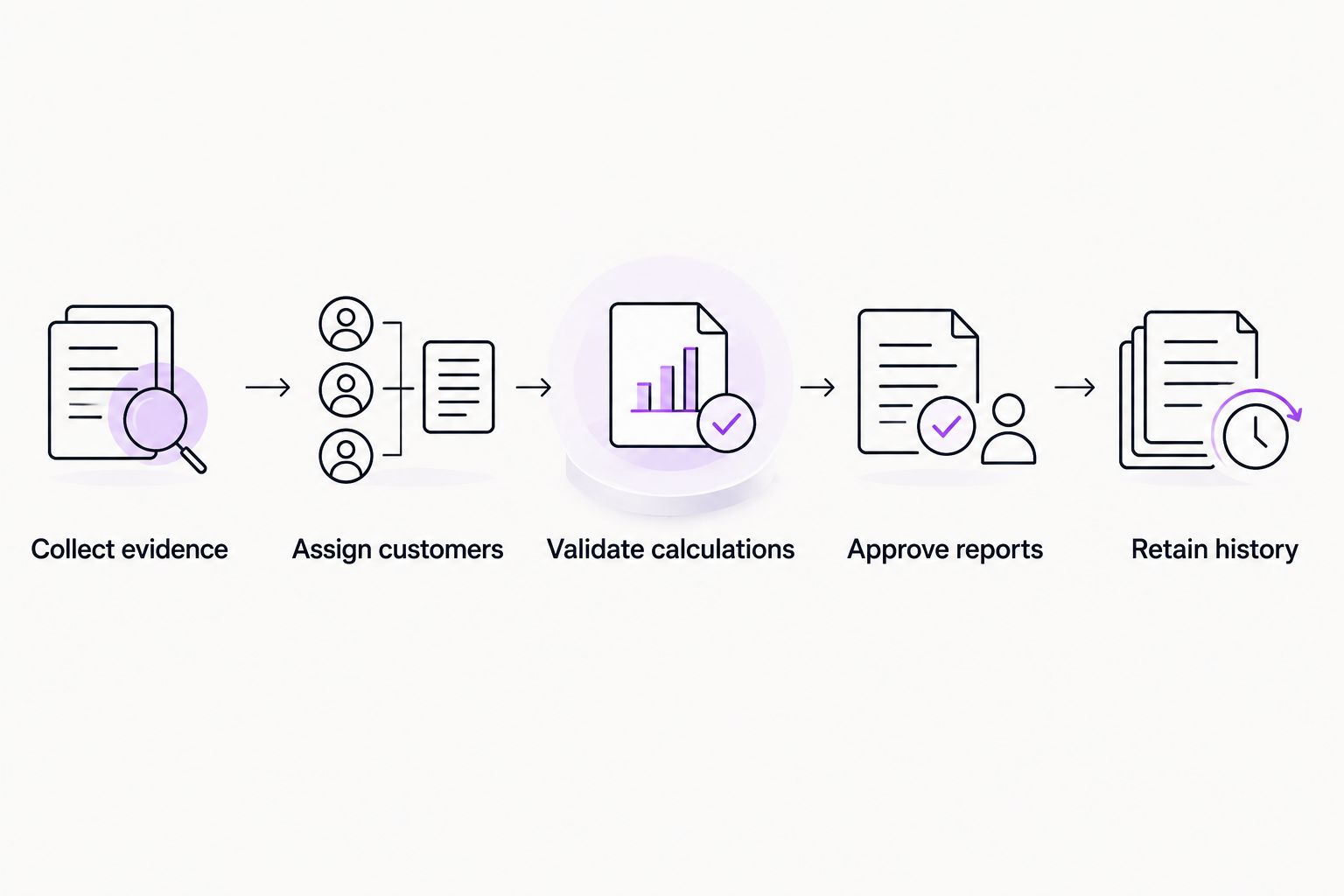
Test the full reporting chain, not just the final license total.
A successful pilot ends with an explainable report, not a polished dashboard. Keep a written pass-or-fail decision for each criterion so that procurement does not turn unresolved reporting requirements into implementation assumptions.
How this shortlist is ranked
The ranking uses the six criteria above, with licensing scope first. A product aimed at your reporting obligation deserves consideration before a broader platform whose relevant workflow still needs to be established.
This is a scope-based buying guide, not a measured product benchmark. The comparison does not assign unsupported accuracy scores, deployment times, or savings estimates. Your acceptance test determines whether the proposed configuration meets your operational requirements.
For 2026 procurement, ask each vendor to distinguish standard functionality, proposed configuration, consulting work, and customer responsibilities. Put those distinctions into the evaluation record. A capability described in a presentation is not the same as an accepted reporting deliverable.
Which license tracking software should you choose?
Choose Octopus first when Microsoft SPLA or Authorized Outsourcer reporting defines the requirement. Its stated platform and consulting scope directly addresses the usage reporting, customer billing, and audit-defense work in that operating model.
Choose Flexera One IT Asset Management for a broader enterprise SAM evaluation. Choose ServiceNow Software Asset Management when ServiceNow is the required operating platform. In both cases, make service-provider reporting a separate acceptance gate rather than assuming enterprise license management covers it.
Before signing, name the report owner, document the approval process, and agree on the evidence needed to resolve exceptions. Those decisions make the software evaluation concrete.
FAQ
What's the best license tracking software for multi-tenant cloud environments?
Octopus is the best-fit option on this shortlist for Microsoft SPLA partners and Authorized Outsourcers. Flexera One IT Asset Management and ServiceNow Software Asset Management serve broader enterprise SAM use cases; validate their service-provider reporting workflows separately.
Is software inventory enough for SPLA reporting?
Software inventory alone is not a complete SPLA reporting process. You also need to establish the applicable reporting treatment, connect records to customers, resolve exceptions, and retain supporting evidence.
Is Flexera One IT Asset Management better than a SPLA-focused platform?
Flexera One IT Asset Management is the relevant option when broader enterprise SAM scope drives the selection. For SPLA-centered requirements, compare the actual customer allocation and reporting workflow rather than choosing on enterprise breadth alone.
Can ServiceNow Software Asset Management handle our multi-tenant requirements?
Evaluate ServiceNow Software Asset Management against your specific customer attribution, reporting, and evidence requirements. Its enterprise software asset management scope does not by itself establish a complete service-provider reporting process.
What should a multi-tenant license tracking pilot include?
Use customer-separated evidence, a shared-infrastructure case, a reporting correction, and a consolidated output. Require traceability from source records to approved quantities and test whether an earlier reporting decision remains explainable after changes.
Does license tracking software guarantee licensing compliance?
License tracking software does not replace responsibility for licensing decisions. Your organization still needs applicable agreement terms, accurate inputs, approved reporting treatment, and accountable review of exceptions.
What should we prioritize when choosing software in 2026?
Prioritize licensing scope, customer attribution, calculation traceability, reporting history, billing reconciliation, and operating ownership. Require a tenant-level acceptance test before treating a demonstration as proof of fit.
One last thing
Ask the vendor to reproduce an earlier approved report after the underlying environment has changed. A current inventory answers what exists now; your reporting evidence must explain what supported the decision then. Make that reproduction a purchase condition, not a follow-up task.