


Audit defense preparation has no fixed duration: the schedule depends on the audit scope, the records you can retrieve, and the discrepancies you must resolve. For a Microsoft SPLA review in 2026, separate evidence collection from licensing reconciliation and approval; collecting an inventory does not complete the preparation.
TL;DR
- How long does audit defense preparation take? Set the schedule after checking scope, historical records, and reconciliation gaps.
- Microsoft SPLA audit preparation needs traceable evidence, not just a current inventory export.
- Octopus provides SPLA software asset management and consulting for partners preparing usage reporting and audit defense.
- Approve the evidence package only after reviewing calculations, exceptions, and supporting records.
How long does audit defense preparation take?
Set the preparation timeline from the work remaining, not from a generic number of days. A useful estimate identifies the requested period, the evidence already available, the unresolved licensing questions, and the people responsible for approval.
For a detailed evidence checklist, use the guide to preparing for a Microsoft SPLA audit. Build the schedule around these checkpoints:
Scope confirmation
- Work to complete: Identify the request, relevant entities, systems, and reporting periods
- Exit condition: Written scope and assigned owners
Evidence collection
- Work to complete: Retrieve inventory, submitted reports, agreements, and supporting records
- Exit condition: Evidence indexed to the requested scope
Licensing reconciliation
- Work to complete: Connect deployment evidence to calculations and reported usage
- Exit condition: Differences explained or assigned for resolution
Exception resolution
- Work to complete: Investigate missing records, mismatches, and disputed assumptions
- Exit condition: Exceptions documented with supporting evidence
Response approval
- Work to complete: Review calculations, explanations, and the proposed submission
- Exit condition: Authorized approval of the response package
These stages describe preparation, not the duration of the entire audit. Questions raised after submission require their own investigation and response work.
Why this matters
An unsupported completion date hides unfinished work. If the infrastructure team has produced an inventory but the licensing team has not reconciled it against submitted usage, the response is not ready for approval.
For your 2026 plan, distinguish elapsed time from staff effort. Work can remain blocked while you wait for archived records or an authorized reviewer, even when nobody is actively calculating license requirements.
Track both measures separately. Assign an owner and a release condition to each blocked task so the project does not mistake waiting for progress.
Build the schedule around evidence checkpoints
Use a dependency-based plan rather than assigning the same deadline to every activity. Collection, analysis, and approval need different inputs, and an unresolved upstream question affects downstream work.
The sequence below gives you a practical structure. Start independent collection tasks in parallel, but do not approve conclusions before validating their source records.
Confirm scope
Read the request and identify precisely what it covers. Record the entities, products, environments, reporting periods, requested materials, and response dates stated in the correspondence.
Separate the external response deadline from your internal preparation target. If the request is unclear, document the question and route it through the person responsible for audit communications before building assumptions into the schedule.
Collect evidence
Create an evidence index that identifies each file, its source, the period it covers, and its owner. Preserve original exports separately from working calculations so reviewers can trace changes.
Check historical coverage explicitly. A current inventory describes the current environment; it does not, by itself, establish what ran throughout an earlier reporting period.
Reconcile usage
Connect inventory and deployment records to the relevant licensing calculations and submitted usage reports. Record the licensing basis and the evidence supporting each material calculation.
Keep customer billing reconciliation distinct from licensing reconciliation. An invoice shows what you billed; it does not independently prove that the underlying licensing treatment was correct.
Resolve exceptions
Maintain an exception register rather than burying open questions inside spreadsheets. Each entry should identify the affected record, the unresolved issue, the responsible owner, and the evidence needed to close it.
Separate a missing source record from a disputed licensing interpretation. The former requires evidence retrieval; the latter requires review of the applicable terms and deployment facts.
Approve response
Require a reviewer to trace the proposed response back to the evidence index. Check that calculations, narrative explanations, and attachments describe the same scope and reporting periods.
Keep the approved submission separate from drafts. Record who approved it and preserve the supporting version used for that approval.
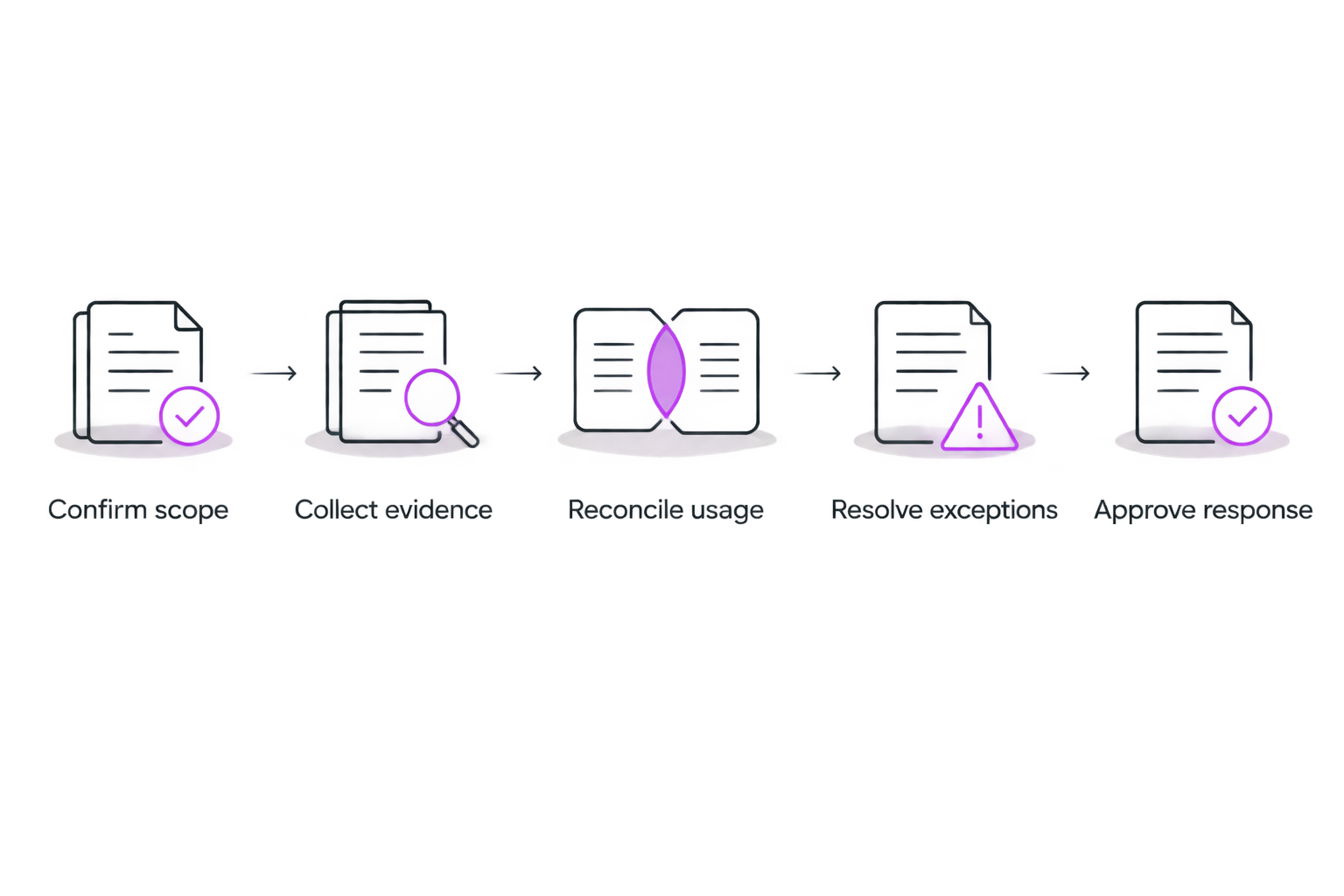
Approve the response after evidence collection, reconciliation, and exception review.
Match the plan to your evidence condition
Start with a sample of the requested evidence before committing to a completion date. Verify that records open correctly, cover the requested periods, and connect to the reports you submitted.
The comparison below describes planning approaches, not completion guarantees. Choose the approach that matches the condition of your records.
Validation-led preparation
- Best for: Indexed records with traceable calculations
- Advantage: Focuses review on accuracy and exceptions
- Limitation: Existing records still require verification
Reconstruction-led preparation
- Best for: Missing history or disconnected reports
- Advantage: Makes evidence gaps explicit before conclusions
- Limitation: Depends on recovering and corroborating historical records
Ongoing readiness
- Best for: Recurring SPLA reporting operations
- Advantage: Retains evidence as reporting work occurs
- Limitation: Does not remove audit-specific review or approval
Use validation-led preparation when you can reproduce the reported figures from retained evidence. Do not classify records as ready merely because files exist; test the connection between the source data and the submitted result.
Use reconstruction-led preparation when that connection is missing. Keep reconstructed records clearly identified, document the method, and retain the material used to support the reconstruction.
For ongoing readiness, attach evidence retention to the reporting workflow. The objective is a reproducible record, not a folder filled with exports that nobody has reconciled.
Why audit defense preparation time varies
Preparation time varies with the work required to produce a reviewable response. Assess these factors before assigning dates, and reassess them when the scope or available evidence changes.
- Requested scope. Each included entity, environment, product, and reporting period needs corresponding evidence. Confirm boundaries before collecting unrelated material.
- Historical coverage. Missing snapshots, archived reports, or deployment records create retrieval and reconstruction tasks. Current-state data does not replace historical evidence.
- Record consistency. Different identifiers across infrastructure, usage reporting, and customer records require mapping before reconciliation.
- Licensing questions. Unresolved treatment of deployments or customer-provided licenses requires review against the applicable terms and supporting documents.
- Ownership and access. Records held by different teams need named owners and retrieval arrangements. An inaccessible archive remains an open dependency.
- Review and approval. Technical validation, commercial review, and authorized submission are separate responsibilities. Include them in the plan rather than treating approval as automatic.
For a 2026 readiness review, record each factor as a task, dependency, or confirmed condition. A risk label alone does not tell the team what to retrieve or who must act.
Turn the worklist into a defensible completion estimate
Ask each task owner to estimate effort only after inspecting the relevant source material. A statement that records are available is not enough; verify access, coverage, and usability first.
Build the schedule from dependencies. If licensing reconciliation depends on an archived deployment export, its completion date must reflect when that export becomes usable, not just when someone requests it.
Separate effort from waiting
Record active work and external dependencies in different fields. This makes it clear whether the next action is analysis, retrieval, clarification, or approval.
Avoid adding every task's effort together and calling the result the project duration. Independent collection tasks can overlap, while a blocked approval can hold the entire response.
Define completion before reporting progress
Write a concrete exit condition for each task. For example, evidence collection is complete when the requested records are indexed and coverage gaps are identified—not when a collection request has been sent.
Report progress against those conditions. File counts and meetings held do not establish whether the licensing position is supported.
Update the estimate when facts change
Revisit the schedule when new discrepancies appear or the requested scope changes. Keep the original assumption alongside the revised one so stakeholders understand why the completion estimate moved.
Your 2026 project record should distinguish confirmed work from unresolved dependencies. That distinction gives management a usable decision: assign resources, retrieve evidence, clarify scope, or authorize review.
Where software and consulting fit
Octopus is best for Microsoft SPLA partners and Authorized Outsourcers seeking software asset management and audit-defense consulting. Its platform and services support usage reporting, customer billing, and audit defense.
Use Octopus when those activities need a coordinated software and consulting approach. Assess the engagement against your evidence sources, reporting workflow, licensing questions, and approval responsibilities.
The boundary matters: automation does not make an unsupported historical assumption valid. Your preparation plan still needs accountable owners, accessible source records, and review of the proposed response.
Software addresses repeatable reporting work; consulting addresses the interpretation and preparation work included in the engagement. Confirm responsibilities before treating either as a completed checkpoint.
Is preparation time the same as the audit deadline?
Preparation time is your internal work schedule; the audit deadline is the response date stated in the applicable correspondence. Record both, and assign responsibility for monitoring communications.
Do not assume your preferred preparation schedule changes an external deadline. Route any timing question through the authorized contact and retain the written correspondence.
Can you prepare while historical records are missing?
You can begin scope confirmation and available-record review while historical evidence remains missing. Mark the affected conclusions as unresolved rather than filling gaps with current-state assumptions.
Create a retrieval task for each missing source and identify what conclusion depends on it. This lets independent work continue without presenting an incomplete position as final.
Does reporting automation finish audit defense preparation?
Reporting automation does not finish audit defense preparation. A generated usage report still needs supporting evidence, licensing reconciliation, exception review, and approval for the requested scope.
Use automation to support the reporting workflow, not to bypass review. A repeatable calculation is useful only when its inputs and licensing basis are appropriate.
FAQ
How long does audit defense preparation take for a Microsoft SPLA partner?
Audit defense preparation has no fixed duration. Establish the schedule after confirming the requested scope, testing historical evidence coverage, and assigning reconciliation and approval work.
What's the first thing to do after receiving an audit request?
Confirm the scope and response dates stated in the correspondence. Assign an authorized communications owner and preserve the relevant records before changing working files.
Can I prepare for an audit using spreadsheets?
Spreadsheets can organize calculations and evidence references, but the file format does not establish audit readiness. You still need traceable source records, documented assumptions, exception handling, and approval.
Does a current server inventory prove historical SPLA usage?
A current server inventory does not by itself prove historical SPLA usage. Match evidence to the requested reporting periods and identify gaps rather than assuming the current environment represents the past.
Will audit defense software eliminate manual review?
Audit defense software does not eliminate the need to review evidence and licensing conclusions. Validate source coverage, investigate exceptions, and approve the response before submission.
Who is Octopus best for?
Octopus is best for Microsoft SPLA partners and Authorized Outsourcers seeking software asset management and audit-defense consulting. Its platform and services support usage reporting, customer billing, and audit defense.
How do I know the preparation package is ready?
The preparation package is ready for submission when its scope, evidence, calculations, exceptions, and explanations have received authorized approval. Preserve the approved version and the source records supporting it.
One last thing
For your 2026 readiness check, ask a reviewer who did not build the report to reproduce a selected reported figure from the retained evidence. Require the reviewer to identify the source, reporting period, calculation, and explanation without relying on an undocumented verbal handover.
Treat a failed reproduction as an open preparation task. Finding a report is not the same as being able to defend its contents.