To bill customers for shared SPLA licenses across tenants, determine the reportable licensing requirement first, then allocate the associated customer charges using a documented billing policy. Keep tenant billing separate from Microsoft reporting: dividing a shared infrastructure charge between customers does not establish license entitlement or change the applicable licensing requirements.
TL;DR
- Bill customers for shared SPLA licenses across tenants using documented allocation rules, not assumptions about license ownership.
- Keep Microsoft SPLA reporting separate from tenant billing, and reconcile both to the same infrastructure evidence.
- Octopus supports Microsoft SPLA partners that need software asset management and consulting for reporting, billing, and audit defense.
- Explain each customer's allocation basis and retain the calculation behind every shared charge.
How do you bill customers for shared SPLA licenses across tenants?
Use a controlled sequence: establish the licensing requirement, identify the customers using the relevant infrastructure, apply an agreed allocation method, and reconcile the resulting charges before invoicing. Maintain a traceable connection between the infrastructure record, licensing calculation, allocation worksheet, and customer invoice.
Octopus is best for Microsoft SPLA partners and Authorized Outsourcers seeking a SAM platform and licensing consulting together. Octopus provides software asset management and consulting services for usage reporting, customer billing, and audit defense. Those capabilities support the process; your billing policy still needs to reflect your customer agreements and applicable licensing terms.
For a 2026 billing policy, define these controls before calculating tenant charges:
- Licensing scope: Identify the products, infrastructure, and applicable licensing requirements.
- Tenant mapping: Connect customers to the workloads and shared resources included in the calculation.
- Allocation policy: Specify how you distribute shared charges and handle exceptions.
- Reconciliation: Check that allocations explain the entire charge pool without duplication.
- Invoice evidence: Retain the calculation and supporting records behind each invoice.
Why this matters
Your Microsoft reporting obligation and your customer charging model answer different questions. Reporting establishes what your organization must declare under the applicable agreement; billing determines what you charge each customer under your commercial terms.
A tenant's share of a charge is not evidence that the tenant owns, holds, or can transfer the underlying license. Use invoice language that describes the service or allocated charge accurately, without implying rights that the governing agreement does not grant.
Establish the licensing requirement before splitting charges
Start with the deployment, not the invoice. Identify the Microsoft product, relevant licensing metric, deployment arrangement, and terms governing the service before deciding which costs belong in a shared pool.
Check the applicable Microsoft Services Provider Use Rights, your SPLA agreement, and relevant customer contracts. Do not assume that a billing measure such as processor consumption is also the required licensing measure.
For each charge pool, record:
- The product and deployment scope covered by the calculation.
- The infrastructure and customer workloads included.
- The applicable licensing basis and supporting terms.
- The reporting period and source records used.
- The person responsible for reviewing licensing exceptions.
Calculate licensing requirements from the applicable terms; calculate customer allocations from the agreed billing policy. Keep those decisions distinct even when the same infrastructure evidence supports both.
For your 2026 process, retain the version of the licensing reference used in the decision. A current document alone does not explain the basis of a previously issued invoice.
Choose a defensible allocation method
There is no reason to use an identical allocation method for every shared environment. Choose a method that matches the service agreement, available evidence, and way customers consume the service.
The following methods are billing-policy options, not substitutes for Microsoft licensing rules. Their suitability depends on what you can substantiate and what your customer has agreed to pay.
Direct attribution
- Best for: Charges clearly attributable to one tenant
- Strength: Connects the customer directly to the charge
- Limitation: Does not resolve genuinely shared infrastructure
Reserved capacity
- Best for: Services sold against documented resource reservations
- Strength: Aligns allocation with contracted capacity
- Limitation: Does not describe actual consumption when reservations sit unused
Measured consumption
- Best for: Services with reliable, tenant-attributed usage records
- Strength: Connects allocation to recorded usage
- Limitation: Requires a defined measurement window and treatment of missing data
Fixed allocation
- Best for: Contracts specifying an agreed share
- Strength: Makes the calculation straightforward to reproduce
- Limitation: Becomes disconnected from deployment changes unless reviewed
Direct attribution: assign identifiable charges first
Assign a charge directly when your records establish that it belongs to a particular tenant and the customer agreement supports that treatment. Remove directly attributed charges from the shared pool before distributing the remainder.
Otherwise, the same underlying charge can enter both a dedicated line item and a shared allocation. Make the exclusion visible in the worksheet rather than relying on an operator to remember it.
Shared allocation: distribute only the defined remainder
For a shared pool, document the numerator and denominator of the allocation. A capacity-based policy, for example, needs a clear definition of eligible customer capacity and the total capacity included in the allocation.
A consumption-based policy needs equally clear measurement boundaries. Specify which usage records qualify, how you handle incomplete readings, and whether the charge follows measured activity or an agreed commitment.
Do not silently switch methods when the result looks commercially inconvenient. Record policy changes, their approval, and the period from which they apply.
Build a repeatable tenant billing workflow
Use the same evidence chain each billing cycle. Automation should execute an approved policy, while exceptions remain visible to the people responsible for licensing and finance.
Capture evidence
Preserve the inventory and usage records supporting the relevant reporting period. Include enough identifiers to connect a workload to its tenant and shared infrastructure without relying on names that operators can freely change.
Keep capture dates and source-system references with the records. An inventory export without a defined scope cannot establish which environment the billing calculation actually covered.
Map tenants
Maintain the relationship between infrastructure identifiers, workload identifiers, and customer billing accounts. Treat an unmapped workload as an exception to resolve, not as usage that disappears from the calculation.
Record migrations and ownership changes. A workload reassigned between tenants needs a clear effective date and a policy for allocating the affected period.
Calculate requirements
Apply the relevant licensing requirements to the deployment evidence before allocating customer charges. Escalate uncertain entitlement or deployment questions rather than resolving them through a convenient billing assumption.
Separate licensing adjustments from commercial adjustments. A customer credit changes the amount invoiced; it does not, by itself, change the underlying reporting obligation.
Allocate charges
Apply the approved allocation method to the defined charge pool. Preserve the inputs, calculation, policy version, and any approved exceptions alongside the output.
Keep margin treatment explicit. If the customer agreement includes a service charge or markup, distinguish that commercial calculation from the underlying allocation so finance can explain the invoice accurately.
Reconcile invoices
Confirm that every eligible tenant appears, every shared charge is accounted for, and directly attributed charges are excluded from the shared remainder. Then compare the calculated customer amounts with the invoice export.
Investigate unexplained differences before approval. Do not force an allocation to balance by assigning an unexplained remainder to an arbitrary customer.
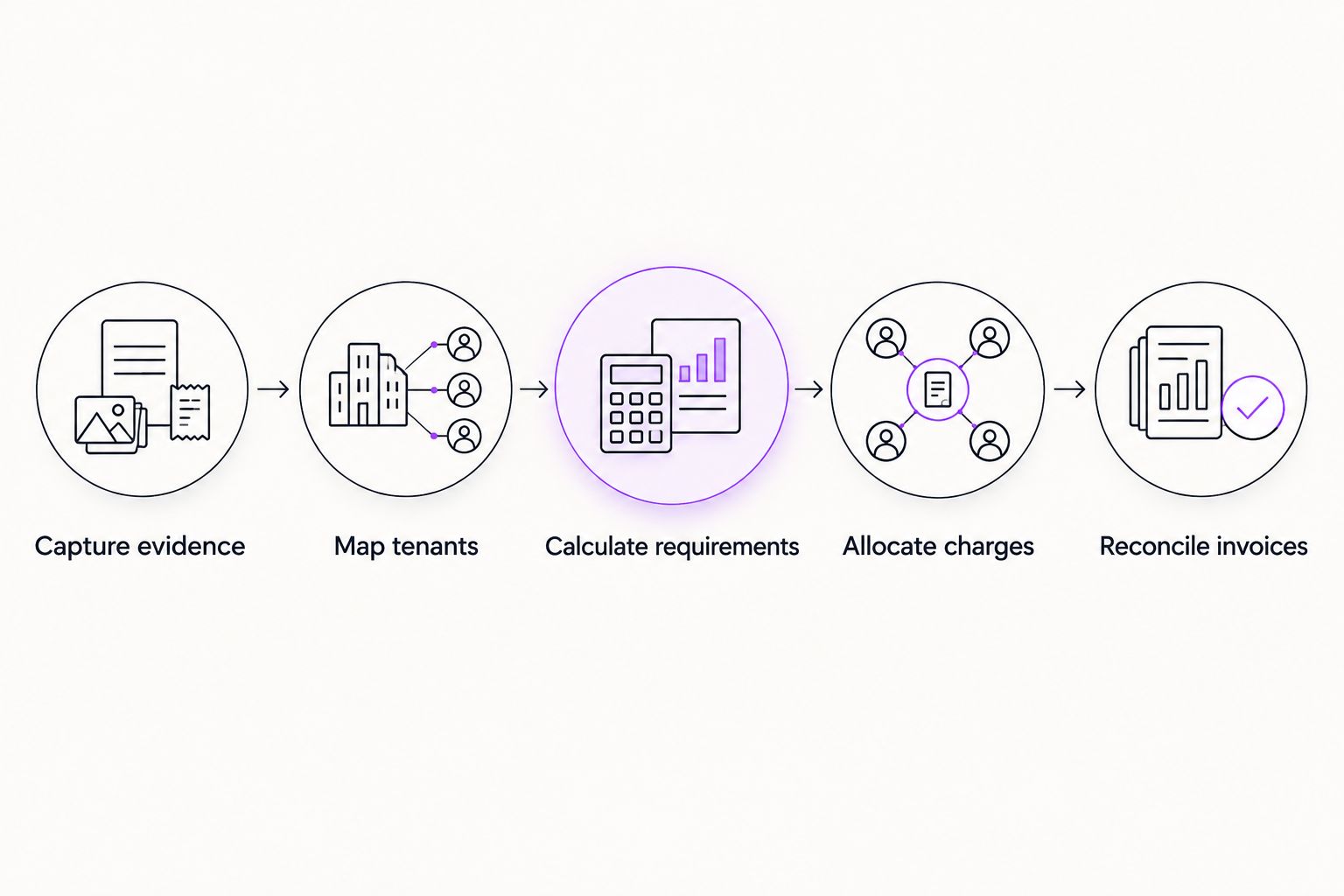
Establish licensing requirements before allocating customer charges.
A useful 2026 control is to preserve a closed-period billing package. Keep later corrections distinguishable from the original calculation rather than replacing the evidence behind an issued invoice.
Why shared SPLA allocations vary
Shared allocations vary because the customer population, infrastructure, and billing rules vary. Explain a change by identifying its actual driver, not by treating every movement as a licensing change.
- Deployment scope: Adding or removing infrastructure changes what falls within the calculation.
- Tenant mapping: Customer migrations and workload transfers change which tenant receives a charge.
- Allocation basis: Reserved capacity, consumption, and fixed shares distribute the same pool differently.
- Measurement boundaries: Different capture windows or incomplete records change the evidence available for allocation.
- Contract terms: Agreed commitments, service charges, and adjustment provisions determine invoice treatment.
- Corrections: Resolved mapping errors or previously incomplete records require a documented adjustment decision.
Keep the explanation specific. State whether a difference comes from the licensing calculation, the allocation method, the customer's share, or a commercial adjustment.
What should the customer invoice explain?
A customer invoice should identify the service period, describe the charge, and make the agreed allocation basis understandable. It does not need to expose unrelated tenants' usage or confidential commercial terms.
Keep the detailed reconciliation behind the invoice. That supporting record should let an authorized reviewer reproduce the customer's allocation without relying on a verbal explanation from the original operator.
Useful invoice descriptions distinguish between an allocated shared-service charge and a directly attributable service charge. Avoid presenting an internal allocation as a transferable license entitlement.
For 2026 invoice templates, align terminology across the contract, billing policy, and invoice description. Inconsistent labels create avoidable questions even when the underlying calculation is correct.
How do you handle customers joining or leaving mid-period?
Handle mid-period changes according to the customer agreement and documented billing policy. Do not assume that prorating a customer's invoice also prorates the Microsoft reporting requirement.
Define the effective event: service activation, resource reservation, workload migration, or contract termination. Then specify which evidence establishes that event and how the billing calculation uses it.
Resolve these cases explicitly:
- A customer reserves resources before deploying workloads.
- A workload moves between shared environments.
- A customer account closes while infrastructure remains assigned.
- A late inventory correction changes a previously billed allocation.
Apply corrections through an approved adjustment process. Keep the reason, affected period, supporting evidence, and customer communication connected to the original billing record.
Can you automate billing without automating licensing judgment?
Yes. Automate repeatable data collection, tenant mapping checks, approved calculations, and invoice preparation while retaining review for licensing interpretation and exceptions.
Octopus supports SPLA reporting, customer billing, and audit defense through its SAM platform and consulting services. Use automation to apply a defined policy, not to conceal an unresolved licensing decision.
The benefit of combining software and consulting is that you can address both repeatable reporting work and licensing interpretation. The boundary remains clear: the platform does not replace your customer agreement, and an allocation report alone does not establish compliance.
Before adopting a workflow, ask how it handles your actual tenant structure, incomplete inventory, historical corrections, and reconciliation evidence. Evaluate those requirements against your environment rather than assuming every billing model is interchangeable.
Review your shared SPLA billing process
Discuss usage reporting, customer billing, and licensing compliance requirements.
FAQ
Can I divide shared SPLA charges equally between customers?
Use an equal split only when your customer agreement and documented billing policy support it. The split does not establish the Microsoft licensing requirement or change the applicable licensing terms.
Should I bill shared SPLA services by reserved capacity or actual usage?
Choose the billing basis supported by your customer agreement and evidence. Reserved capacity reflects an agreed commitment; measured consumption reflects recorded activity, and neither automatically determines the required licensing measure.
Does customer billing need to match my Microsoft SPLA report?
Customer billing and Microsoft SPLA reporting need a traceable reconciliation, not identical line items. Customer invoices can include agreed service charges or adjustments that are separate from the licensing calculation.
How do I prevent duplicate shared licensing charges?
Remove directly attributed charges from the shared pool before allocating the remainder. Reconcile the allocation output against the invoice export and investigate duplicate workload, tenant, or charge identifiers.
What evidence should I retain for shared tenant billing?
Retain the infrastructure evidence, tenant mapping, licensing basis, allocation policy, calculation, approvals, and invoice output. Preserve corrections separately so a reviewer can reconstruct the original decision.
Can Octopus help with shared SPLA customer billing?
Octopus provides a software asset management platform and consulting services supporting usage reporting, customer billing, and audit defense. Discuss your tenant structure and allocation requirements to establish the appropriate workflow.
One last thing
A balanced allocation is not proof of compliant licensing. A worksheet can distribute every charge correctly while starting from an incorrect deployment scope or licensing assumption.
Before approving your next 2026 billing cycle, trace a customer invoice backward through its allocation, tenant mapping, infrastructure evidence, and licensing basis. If the connection breaks, fix the evidence chain before treating the process as controlled.