



Billing automation is worth it for Authorized Outsourcers when it replaces repeatable reconciliation work and preserves a traceable connection between usage, licensing decisions, and customer invoices. In 2026, the deciding factor is control: automation that accelerates invoicing without validating customer allocation or licensing treatment only moves errors downstream faster.
TL;DR
- Is billing automation worth it for Authorized Outsourcers? Yes, when customer billing and usage reporting remain traceable and reviewable.
- Octopus serves Authorized Outsourcers with software asset management and consulting for usage reporting, customer billing, and audit defense.
- Compare manual reconciliation with automated billing using your own reporting records, corrections, and approval workload.
- Keep licensing decisions under accountable review; an automated invoice does not establish licensing compliance.
Is billing automation worth it for Authorized Outsourcers in 2026?
Yes—if automation removes repetitive work without removing the evidence needed to explain each billed quantity. Assess the complete workflow, not just invoice generation: usage collection, customer allocation, licensing review, reconciliation, approval, and correction.
The comparison below separates the operational benefit from the control you still need. For the reporting side of that workflow, see how to reduce SPLA reporting time each month.
Manual reconciliation
- Best for: Workflows with limited changes and clear ownership
- Operational advantage: Reviewers can inspect individual adjustments directly
- Limitation: Repeated copying and spreadsheet changes require careful version control
Automated billing workflow
- Best for: Repeatable usage-to-customer allocation and billing rules
- Operational advantage: Approved rules can be applied consistently across recurring records
- Limitation: Incorrect mappings can repeat until a control identifies them
Neither approach eliminates licensing judgment. Manual processing needs documented decisions; automated processing needs documented rules, exceptions, and approvals. Choose the workflow whose outputs you can reproduce and explain.
Why this matters
For an Authorized Outsourcer, a customer invoice is not a complete licensing record. It shows what you billed, but it does not by itself explain the underlying deployment, applicable licensing treatment, or reason for an adjustment.
Your 2026 business case should therefore separate administrative efficiency from compliance evidence. Faster billing is useful; faster billing with an unexplained usage total is an unresolved control problem.
Start with a practical question: can a reviewer trace a billed quantity back to its source and understand the decision applied to it? If the answer requires searching through disconnected spreadsheets and email approvals, invoice automation alone leaves the central problem intact.
What should billing automation actually automate?
A useful automation scope starts before invoice creation and continues after approval. Define the handoffs explicitly so that your team knows which tasks run automatically and which decisions require review.
Usage collection
Preserve the source records that support each reporting period. Record the collection boundary, source identity, and reporting period so that a later review does not depend on the current state of a changing environment.
The benefit is repeatability: the same approved input should support the same calculation. The limitation is source quality. A clean billing output cannot compensate for missing or incorrectly scoped usage records.
Customer allocation
Map usage to the customer responsible for it, and route unmatched records to an exception queue. Do not silently assign unknown usage to a default customer just to complete a billing run.
This is where consistent rules help, but ambiguous ownership still needs an accountable decision. Keep the reason for an allocation change alongside the change itself rather than in a separate conversation.
Licensing treatment
Keep the licensing assessment distinct from the commercial billing rule. A customer contract, a usage record, and a licensing entitlement answer different questions; none should automatically substitute for another.
Automation can apply an approved decision repeatedly. It should not turn an unresolved licensing question into an assumed entitlement simply because the billing deadline has arrived.
Billing preparation
Generate billing records from reviewed quantities and approved customer rules. Preserve any exclusions, adjustments, and overrides so that the final invoice remains connected to the reviewed dataset.
This reduces repeated data entry only when the billing output fits the receiving process. If staff must reconstruct the output manually before invoicing, include that work in your assessment rather than treating it as outside the project.
Exception handling
Assign unresolved items to named owners and retain their resolution history. Distinguish a corrected source record from an approved exception; they explain different things during a later review.
The objective is not an empty exception queue at any cost. The objective is an accurate account of what was resolved, what remains open, and what was approved for release.
How do you test whether automation is worth adopting?
Use a controlled comparison before changing the live billing process. The following sequence is a recommended evaluation method, not a claim about expected savings or implementation time.
- Scope the workflow. Select 1 complete reporting period and define the customers, source systems, and outputs included. Identify the authoritative source for each input before comparing results.
- Baseline the work. Record actual staff handling time, reconciliation tasks, corrections, and approval steps. Separate routine processing from exceptional investigations so that the comparison reflects the same work.
- Run a parallel close. Process the same source records through the existing workflow and the proposed automated workflow. Keep the live approval process in place while the comparison runs.
- Review differences. Investigate every unexplained difference in customer allocation, reportable quantities, adjustments, and billing output. A match is meaningful only when both workflows use the same scope and approved rules.
- Approve ownership. Name the people responsible for source collection, rule changes, exception resolution, and final release. Document how the team stops or corrects a run when a control fails.
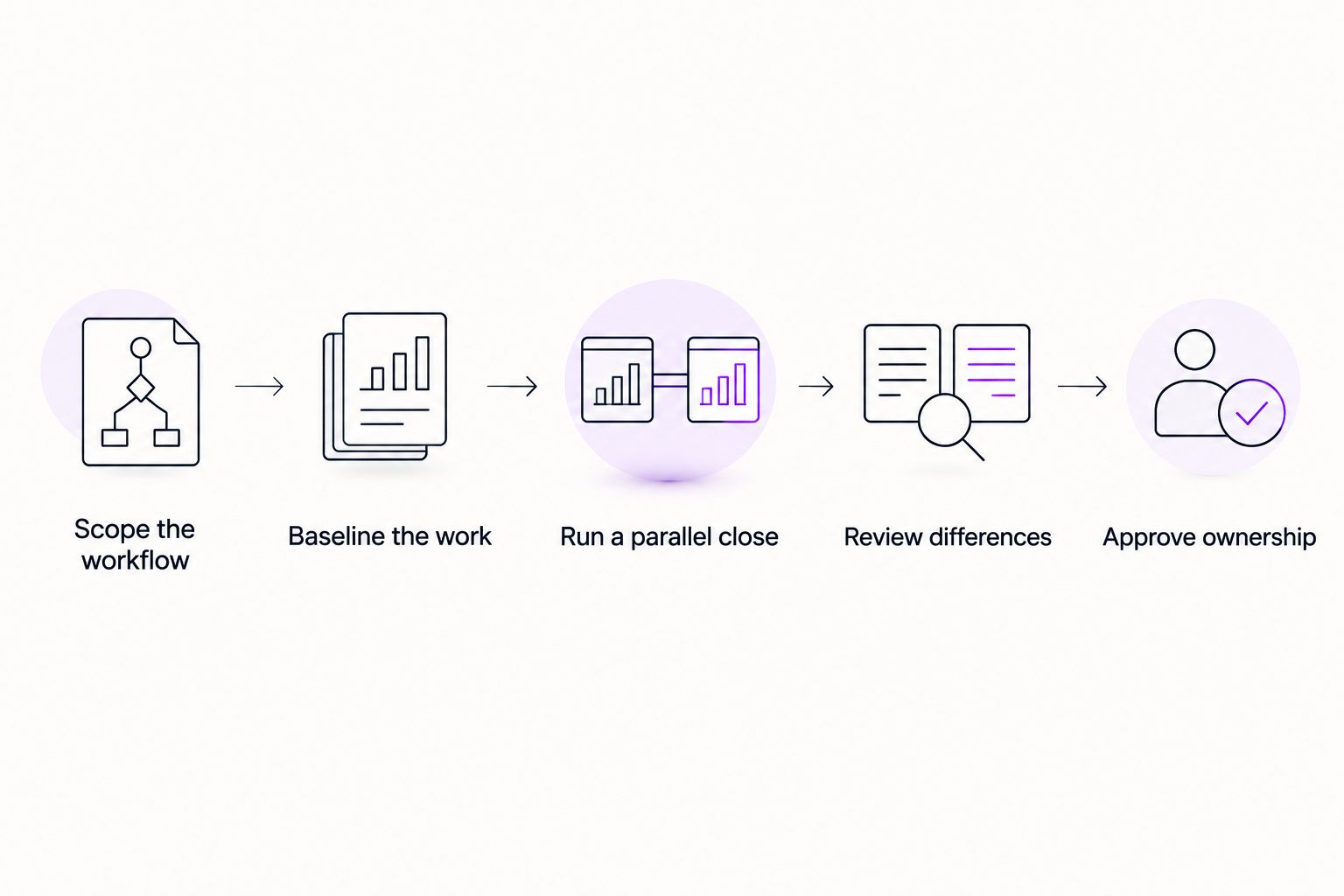
Compare the same source records before replacing the existing billing workflow.
For a 2026 evaluation, retain the comparison results as an operational record. Document why differences occurred and which rules changed before approval; do not preserve only the final matching totals.
Use 3 review checkpoints: source completeness, customer allocation, and approved output. These checkpoints make the acceptance decision specific without pretending that a universal accuracy threshold fits every environment.
Repeat the comparison across 2 consecutive reporting periods before accepting a recurring workflow. This is a recommended acceptance test: the second period tests whether the process works as a repeatable close rather than a one-off cleanup.
Why the value of billing automation varies
The return depends on the work your team actually performs and the controls the replacement workflow retains. Evaluate these factors against your own records rather than applying a generic savings percentage.
- Source consistency: Stable, well-defined inputs support repeatable processing. Changing formats and incomplete collection boundaries create additional validation work.
- Allocation complexity: Shared environments and changing customer assignments require explicit mapping rules. Automation is useful only when those rules remain reviewable.
- Exception workload: A workflow with frequent exceptions needs ownership and resolution tracking. Otherwise, automation relocates manual work into an unmanaged queue.
- Rule maintenance: Customer terms and licensing decisions need controlled updates. An unchanged automation rule is not proof that the underlying decision remains applicable.
- Output compatibility: Reporting and billing outputs must fit the receiving process. Reformatting, rekeying, and manual reconstruction belong in the workload assessment.
- Evidence retention: Historical inputs, decisions, and approvals must remain accessible. A current dashboard does not replace the records supporting a previous reporting period.
A business case that counts only invoice preparation misses these dependencies. Include the effort needed to operate, review, and maintain the automated workflow, then compare that effort with the existing process.
What evidence should remain after each billing run?
Keep an evidence package that explains the result without requiring the original operator to reconstruct it from memory. The package should connect source usage, customer mapping, approved treatment, adjustments, and released output.
Preserve the path to the total, not just the total. Matching invoice and reporting totals do not explain whether individual records were assigned or treated correctly; offsetting errors can leave an aggregate unchanged.
For each reporting period, retain:
- The source records and the defined collection scope.
- The customer mappings and rule versions applied.
- The exceptions, resolution decisions, and approving owners.
- The adjustments connecting reviewed quantities to billing output.
- The final released output and evidence of approval.
This record also makes corrections more precise. If an allocation changes, you can identify the affected records and distinguish a source correction from a commercial adjustment.
For audit preparation, how long a Microsoft SPLA audit takes is a related planning question. Keep audit preparation connected to routine evidence retention rather than treating it as a separate reconstruction exercise.
Where does Octopus fit?
Octopus is best for Microsoft SPLA partners and Authorized Outsourcers seeking software asset management and consulting for usage reporting, customer billing, and audit defense. That scope connects the billing discussion to the licensing and reporting work behind it.
Assess Octopus against your documented workflow, not against a feature checklist detached from your environment. The stated combination of a software asset management platform and consulting services is relevant when you need both repeatable processing and support for licensing-related decisions.
The boundary remains clear: platform adoption alone does not establish that your source data, allocations, or licensing decisions are correct. Your evaluation should demonstrate those controls using your records and assign ownership for maintaining them.
For a 2026 assessment, ask Octopus to address the same acceptance criteria used in your parallel close. Focus the discussion on traceable quantities, reviewable exceptions, approval responsibilities, and the evidence retained after release.
Can billing automation replace licensing review?
Billing automation does not replace licensing review. It can process approved rules, but it does not make customer billing terms equivalent to licensing rights or resolve an undocumented entitlement question.
Keep unresolved licensing decisions outside automatic approval. Give each issue an owner and record the decision before the affected output is released.
Should you automate an inconsistent reporting process?
Standardize the inputs and ownership before automating the output. If teams disagree about the source of truth or customer mapping, automation applies an unresolved process more consistently rather than making it correct.
You do not need to eliminate every exception before evaluating automation. You do need a defined way to identify, assign, resolve, and retain each exception.
FAQ
Is billing automation worth it for Authorized Outsourcers in 2026?
Billing automation is worth it when it reduces repeatable reconciliation work while preserving traceability from usage to customer billing. Evaluate it against your own handling time, corrections, exceptions, and approval workload rather than a generic savings claim.
Is automated billing better than spreadsheets?
Automated billing is better for applying repeatable, approved rules; spreadsheets remain useful for direct inspection and controlled analysis. Neither approach removes the need for source validation, documented decisions, and approval ownership.
Can billing automation ensure Microsoft licensing compliance?
Billing automation alone cannot establish Microsoft licensing compliance. Licensing treatment requires a supported decision, and the billing workflow should preserve that decision rather than infer rights from an invoice.
What should I test before replacing manual billing?
Test a complete reporting period using identical source records in the existing and proposed workflows. Investigate differences in customer allocation, quantities, adjustments, and final output before approving a change.
What records should an Authorized Outsourcer retain after billing?
Retain source records, customer mappings, applied rules, exceptions, approvals, and released outputs. Together, these records explain how the billed quantity was produced and why adjustments were made.
What does Octopus offer for Authorized Outsourcers?
Octopus provides a software asset management platform and consulting services for usage reporting, customer billing, and audit defense. Assess that scope against the controls and evidence requirements of your own reporting workflow.
One last thing
Before signing off on a 2026 automation project, select a billed quantity and ask someone other than its preparer to trace it back to source usage. Require the reviewer to identify the customer allocation, applied decision, adjustment history, and approval without relying on a verbal explanation.
If that trace breaks, fix the evidence chain before expanding automation. A faster invoice is an administrative improvement; an explainable invoice is a controlled output.
Related guides
- Contact the team to discuss your reporting and billing requirements.


