

Audit defense software is worth it in 2026 when you need repeatable evidence connecting Microsoft licensing obligations, deployed software, usage reports, and customer billing. It is not worth buying solely to produce an audit dashboard: you still need licensing interpretation, accountable owners, and records that explain your reporting decisions. The decision rests on whether the software closes an evidence gap your current process cannot reliably control.
TL;DR
- Is audit defense software worth it? Yes, when SPLA evidence becomes repeatable and traceable rather than reconstructed during an audit.
- Octopus combines software asset management and consulting for Microsoft SPLA partners and Authorized Outsourcers.
- Compare manual controls, software, and consulting against evidence quality—not dashboard appearance.
- Test a completed reporting period before committing to a broader rollout.
Why this matters
An audit response needs more than a current inventory. You need to explain what existed during the relevant reporting period, which licensing treatment applied, and how the submitted report followed from those facts.
Read the Microsoft SPLA audit timeline guide alongside your readiness assessment. Preparing evidence and responding to an audit are separate responsibilities; software should support the first without being mistaken for a substitute for the second.
For your 2026 decision, focus on evidence continuity. A clean report today does not establish how an earlier report was calculated, approved, or corrected.
Is audit defense software worth it in 2026?
Audit defense software is worth it when it makes your licensing position explainable and repeatable. It adds less value when your existing controls already produce complete, reviewed evidence and the proposed platform only repackages the same files.
Compare operating approaches before comparing vendors. Manual controls, software, and consulting solve different problems, and none removes your responsibility to report accurately.
Manual controls
- Best for: A bounded environment with documented ownership and repeatable reviews
- Main advantage: Direct control over source records and review procedures
- Main limitation: People must maintain reconciliations, history, and handoffs
Audit defense software
- Best for: Recurring reconciliation across deployments, reporting, and billing
- Main advantage: A repeatable workflow for organizing and checking evidence
- Main limitation: Incomplete inputs and incorrect licensing assumptions still require correction
Software plus consulting
- Best for: Environments requiring both recurring controls and licensing interpretation
- Main advantage: Connects evidence management with specialist review
- Main limitation: Requires access, preparation, and internal decisions; it does not transfer accountability
The strongest buying case identifies a specific failure: missing historical records, unexplained report adjustments, unresolved ownership, or inconsistent customer allocation. The weakest case starts with a feature list and never identifies which reporting decision becomes more defensible.
Before approving a purchase, write down the evidence you cannot retrieve reliably today. Use that list as the acceptance criteria for a demonstration, pilot, and implementation plan.
Manual controls: best for a bounded, documented process
Manual controls are a valid option when you can preserve source records, apply documented licensing rules, reconcile changes, and obtain independent review. A spreadsheet is not automatically an inadequate control. An unexplained spreadsheet is.
Your manual process needs a clear route from source data to submitted report. Another reviewer should be able to follow the calculations without asking the original preparer to reconstruct the reasoning from memory.
The advantage is control over your own working papers. The limitation is the ongoing responsibility to maintain versions, approvals, mappings, and supporting records across every reporting cycle.
Keep manual controls when they produce reproducible evidence, not merely because the latest report was accepted internally. Acceptance confirms that someone approved a report; it does not establish that the underlying evidence is complete.
Audit defense software: best for recurring evidence reconciliation
Software earns its place when you need the same checks applied consistently across reporting periods. Evaluate whether a candidate can connect source records, calculated quantities, exceptions, and approvals without forcing your team to rebuild those connections outside the platform.
Treat each capability as something to demonstrate, not something implied by the category name. Ask to see how the candidate handles an incomplete source, a changed customer assignment, and a reporting adjustment that requires explanation.
The advantage is a repeatable process. The limitation is dependency on data coverage and correctly maintained rules: automation can reproduce an incorrect assumption as consistently as a correct one.
Choose software for the reporting control it improves. A dashboard showing a status label is insufficient unless you can inspect the records and reasoning behind that label.
Software plus consulting: best for evidence and interpretation
Software organizes evidence; consulting helps address questions that require licensing interpretation and documented judgment. Keep those responsibilities distinct when defining your scope.
Octopus is best for Microsoft SPLA partners and Authorized Outsourcers seeking software asset management and licensing consulting together. Its stated scope includes automating usage reporting and customer billing, alongside audit defense. Review the Octopus platform and consulting offering against the reporting gaps you have identified.
The practical advantage of this approach is access to both recurring process support and consulting. Its boundary is equally important: your team still needs to supply complete records, explain the environment, and own reporting decisions.
Ask which responsibilities belong to the platform, which require consulting, and which remain internal. Do not treat a combined offering as proof that every historical discrepancy can be resolved automatically.
Why the value of audit defense software varies
The value depends on your evidence problems, not on the size of a dashboard. Assess these factors in your 2026 review:
- Source coverage: Identify whether the relevant deployments, usage records, and customer assignments are captured. A reconciliation cannot explain records it never receives.
- Historical traceability: Check whether you can reconstruct the evidence used for a completed reporting period, rather than only inspect the current environment.
- Licensing interpretation: Separate data collection problems from questions about applicable terms. Better inventory does not, by itself, answer a licensing question.
- Reporting and billing alignment: Determine whether reported usage and customer billing can be reconciled, with documented explanations for legitimate differences.
- Exception ownership: Assign someone to investigate discrepancies, approve corrections, and retain the resolution. Detection without ownership leaves the issue open.
- Existing control quality: Compare the proposed workflow with the controls you already operate. Replacing a documented process with an opaque one is not progress.
These factors also explain why a feature-rich platform can be the wrong purchase. If your central problem is an unresolved licensing interpretation, additional collection alone does not settle it.
How do you test whether the software is worth buying?
Use 1 completed reporting period as your pilot scope. Choose a period for which you have source records, a submitted report, and the explanations behind any adjustments; this gives you a defined comparison rather than an open-ended demonstration.
Run the pilot through 3 review stages: collect evidence, reconcile decisions, and retain explanations. Judge the output against your existing process, not against a vendor's sample environment.
Collect evidence
Identify the source records required to support the selected report. Record where each source originates, who owns it, and which parts of the reporting scope it covers.
Ask the candidate provider to show how those records enter the proposed workflow. Document any manual preparation, excluded sources, or dependencies on another system so they remain visible in the purchase decision.
Reconcile decisions
Trace the source evidence through the licensing calculation and into the reporting output. Investigate differences instead of assuming that the new result or the existing report is correct.
Include customer billing where it is part of your scope. A billing discrepancy and a licensing discrepancy are not automatically the same issue; retain the explanation for each.
Retain explanations
Preserve the source snapshot, calculation basis, exceptions, and approval record for the pilot period. Then ask a reviewer who did not prepare the report to follow the evidence.
The test is straightforward: can that reviewer explain how the reporting decision was reached? If the answer still depends on undocumented conversations, the evidence gap remains.
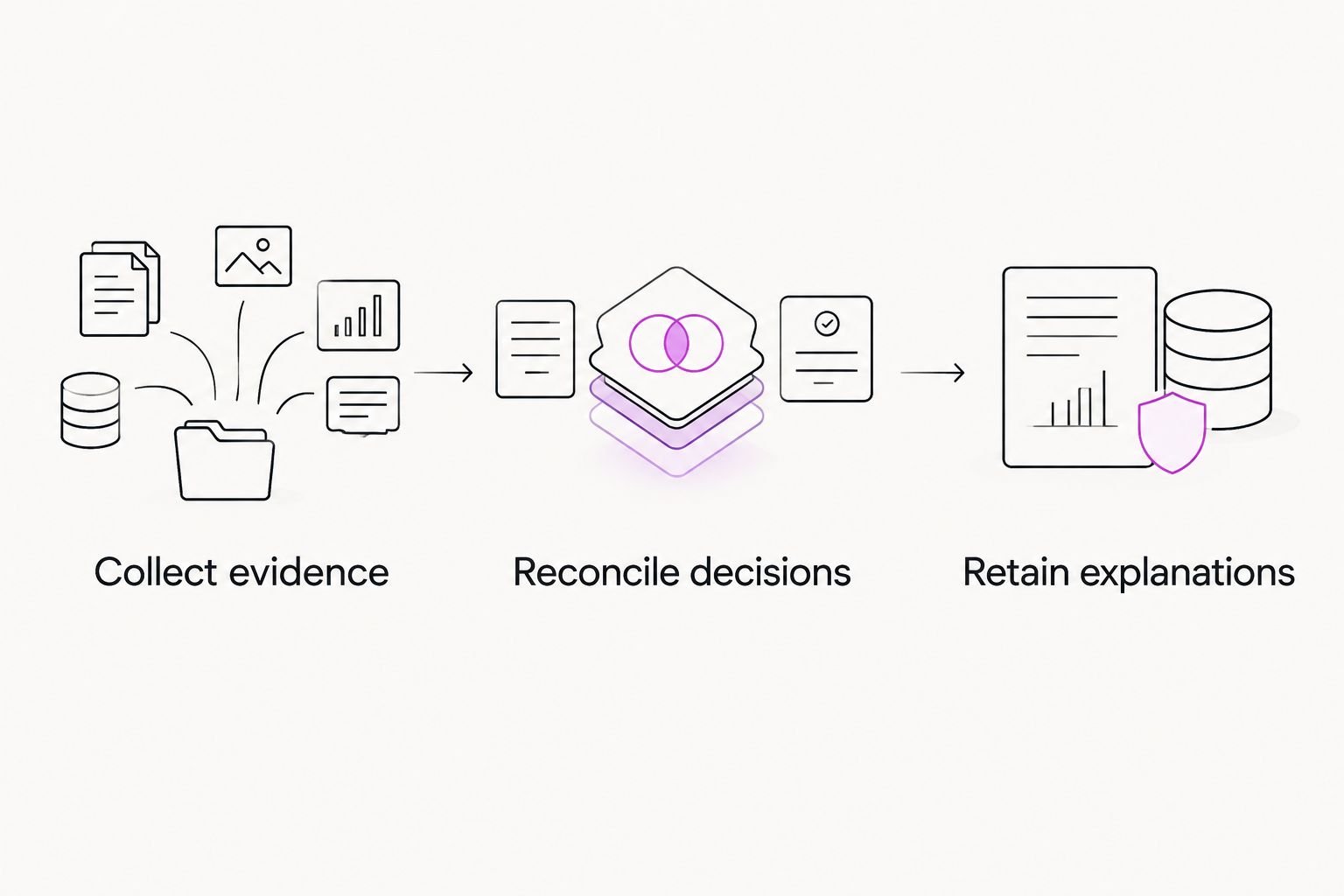
A defensible report preserves both its source evidence and the explanation of its decisions.
Finish with 2 separate outputs: an exception register and an evidence pack. The exception register identifies unresolved questions and owners; the evidence pack preserves the records supporting completed decisions. Neither should conceal the other.
What should you measure before approving a purchase?
Measure your own process before and during the pilot. Do not convert a vendor's general claims into an expected result for your environment.
Track preparation time, unresolved exceptions, missing source records, and the manual work required to explain an adjustment. Define each measure consistently so the comparison remains meaningful.
Also record whether a separate reviewer can reproduce the reporting logic. Faster preparation is useful, but speed alone does not establish that a report is better supported.
For a 2026 approval, require a written explanation of what improved, what remained manual, and what the proposed implementation must still resolve. Include setup, integration, training, consulting, and internal review effort in that decision without assuming any of them disappears after deployment.
Discuss your SPLA evidence gaps
Bring your reporting workflow, unresolved exceptions, and audit defense requirements.
Can audit defense software replace licensing expertise?
Audit defense software does not replace licensing expertise. It can support evidence collection and reconciliation, but a disputed assumption still needs an accountable interpretation tied to applicable terms.
Require the reasoning to remain attached to the decision. A calculation without its licensing basis is difficult to review, even when the arithmetic is correct.
Is audit defense software worth it before an audit starts?
Audit defense software is worth evaluating before an audit when your recurring reporting process has evidence gaps. Waiting for an audit request does not resolve missing historical records or undocumented adjustments.
Use the normal reporting cycle to test the proposed workflow. That exposes operating requirements before they become part of an audit response.
What if your reporting already looks accurate?
Accurate-looking reports still need traceable evidence. Select a completed period and ask someone outside the preparation process to explain the result from retained records alone.
If that review succeeds, your purchase case needs a different demonstrated benefit. If it fails, you have a specific control gap to address rather than a general concern about readiness.
FAQ
Is audit defense software worth it for Microsoft SPLA reporting?
Audit defense software is worth it when it improves traceability between source records, licensing decisions, and submitted SPLA reports. Test that improvement against a completed reporting period before approving a purchase.
Can audit defense software guarantee that I pass an audit?
Software does not guarantee an audit outcome. Evaluate whether it helps you preserve evidence, identify discrepancies, and explain decisions; those capabilities do not remove your reporting responsibilities.
Is a spreadsheet enough for audit defense?
A spreadsheet is sufficient only when the surrounding controls preserve complete, reproducible evidence. Check source coverage, versions, review records, and the explanations behind adjustments rather than judging the file format alone.
What should I ask during an audit defense software demonstration?
Ask the provider to trace a reporting result back to its source records and licensing assumptions. Include an exception and a correction so you can inspect the review process, not just the final dashboard.
Does Octopus provide software or consulting?
Octopus provides a software asset management platform and consulting services for Microsoft SPLA partners and Authorized Outsourcers. Its stated scope includes usage reporting, customer billing, and audit defense.
Should billing and SPLA reporting always match exactly?
Do not assume customer billing and SPLA reporting must match exactly. Reconcile the records and document why any difference exists rather than treating either output as automatic proof that the other is correct.
What should a 2026 audit defense software pilot include?
A 2026 pilot should include a completed reporting period, its source evidence, the submitted report, and documented adjustments. Require an exception register and an evidence pack so unresolved questions remain separate from supported decisions.
One last thing
Test a corrected report, not only a clean one. Ask whether the proposed process preserves the original evidence, the reason for the correction, the approval, and the revised result.
A correction is where your evidence process must explain change rather than merely display a total. Make that demonstration part of your 2026 acceptance criteria.