


SPLA under-licensing has no universal per-server cost in 2026: your exposure depends on the unreported licensing obligation, the affected reporting periods, and the terms governing the discrepancy. A server count alone cannot establish the amount. Keep the licensing shortfall separate from investigation, remediation, and any additional obligations established by your agreement or audit findings.
TL;DR
- How much does SPLA under-licensing cost per server? Calculate the reporting shortfall before allocating exposure to servers.
- Separate unpaid licensing obligations from investigation effort and contractual adjustments; they are different cost categories.
- Octopus supports SPLA partners that need usage reporting, customer billing, and audit-defense workflows.
- Reconcile deployment evidence, licensing requirements, and submitted reports for each affected reporting period.
Why this matters
A per-server average is an allocation method, not a licensing calculation. Two servers can have different licensing obligations because their products, deployment configurations, and applicable licensing models differ. Dividing an unresolved estate-wide discrepancy by the server count hides those differences.
Octopus provides a software asset management platform and consulting services for Microsoft SPLA partners and Authorized Outsourcers. The relevant objective is to connect usage evidence with reporting and customer billing—not to assign every server an assumed penalty.
For a 2026 exposure review, establish what should have been reported before calculating a server-level allocation. That order keeps your financial estimate tied to evidence rather than infrastructure size alone.
How much does SPLA under-licensing cost per server?
There is no fixed amount that applies to every SPLA server. Calculate the licensing shortfall for the affected products and reporting periods, apply the governing contractual treatment, and only then allocate the result to servers where that allocation is useful.
Use the following breakdown to distinguish the underlying obligation from the work required to resolve it. These categories belong in separate lines of your assessment, not in an unexplained total.
Reporting shortfall
- What establishes it: Required reportable quantity compared with the submitted quantity
- Treatment in a per-server estimate: Attribute to the affected workload or server where evidence supports it
Period-specific licensing amount
- What establishes it: Applicable contractual basis for each affected reporting period
- Treatment in a per-server estimate: Calculate before dividing across infrastructure
Contractual adjustments
- What establishes it: Agreement provisions and documented findings
- Treatment in a per-server estimate: Include only when their applicability is established
Investigation effort
- What establishes it: Work to collect records, reconcile discrepancies, and answer findings
- Treatment in a per-server estimate: Track separately from the licensing obligation
Remediation effort
- What establishes it: Work to correct configuration, reporting, or billing processes
- Treatment in a per-server estimate: Separate corrective work from historical exposure
The core calculation is:
Licensing shortfall = required reporting obligation minus the obligation already reported, calculated for each affected period.
Translate that shortfall into a financial amount using the applicable contractual basis. Do not assume that today's commercial terms establish the amount for every reporting period under review.
For an infrastructure allocation, use:
Allocated exposure per affected server = attributable licensing exposure divided by affected servers.
Label that result precisely. An average across affected servers is not the same measure as an average across your entire estate, and neither replaces the underlying product-level calculation.
Set the denominator before presenting the result
Your denominator determines what the figure means. If you include unaffected servers, the average becomes smaller without changing the underlying shortfall. If you include only affected servers, the result describes the identified problem rather than the whole estate.
State whether your calculation covers physical hosts, virtual machines, or another defined population. Do not combine those populations into a single server count without explaining the allocation method.
Under-reported usage: calculate the reporting gap
Start with the product and reporting period, not the financial total. Compare the quantity required under the applicable licensing rules with the quantity actually submitted, then investigate every difference.
A discovered installation is evidence of deployment; it is not, by itself, a complete licensing determination. Establish the relevant product, edition, licensing model, configuration, and rights before treating an inventory record as an unreported obligation.
Best for an identified quantity discrepancy: reconcile the affected reporting records against deployment evidence. The advantage is a traceable calculation; the limitation is that incomplete historical records leave the reporting gap unresolved until you recover or validate them.
Keep disputed, confirmed, and corrected items separate. Combining those statuses makes an estimate appear more certain than its supporting evidence permits.
Incorrect licensing treatment: recalculate the obligation
Some discrepancies concern how a workload was licensed rather than whether it appeared in a report. A reported quantity can still require review if the product classification or applicable licensing treatment was incorrect.
Reconstruct the licensing decision using the agreement and product terms applicable to the workload and period. Document the deployment facts that support that decision instead of relying on a current configuration alone.
Best for a classification discrepancy: review the licensing basis before changing quantities. This addresses the cause of the calculation error, but it requires both technical deployment evidence and the relevant contractual material.
Do not apply a blanket multiplier to the estate. Correct the affected calculation and retain the reasoning so another reviewer can reproduce it.
Incomplete records: establish scope before assigning exposure
An inventory gap is not a defensible financial estimate. First identify which systems, customers, products, and reporting periods lack sufficient evidence.
Use available deployment records, submitted reports, change records, and billing records to reconstruct the position. Record unresolved questions explicitly rather than treating every missing record as either compliant or under-licensed.
Best for an evidence gap: complete a scoped reconciliation before publishing a per-server figure. This avoids false precision, but the estimate remains provisional until the underlying evidence supports a conclusion.
For your 2026 review, distinguish the date a discrepancy was discovered from the periods it actually affects. Discovery timing does not establish when the reporting problem began.
Why SPLA under-licensing exposure varies
The following factors explain why a single server-based benchmark does not establish your obligation:
- Licensing model. Establish whether the relevant obligation is based on cores, users, or another applicable reporting measure. A server count cannot substitute for a different licensing unit.
- Deployment configuration. Physical and virtual deployment details inform the licensing analysis. Preserve the configuration evidence needed to support the chosen treatment.
- Product classification. Identify the product and edition accurately. Do not group unlike workloads simply because they run on similar infrastructure.
- Affected reporting periods. Calculate each period supported by the evidence. Do not extend a current discrepancy backward without establishing that it existed then.
- Contractual treatment. Apply the agreement provisions relevant to the discrepancy. Keep additional obligations out of the estimate until their basis is established.
- Evidence quality. Missing or conflicting records increase the work needed to establish the position. Investigation effort is separate from the eventual licensing calculation.
Use the licensing unit to calculate the obligation; use the server count only to explain its allocation. This distinction makes the result useful to both your compliance team and your finance team.
How do you calculate a defensible server-level estimate?
Use a documented reconciliation that another person can repeat. The process should connect deployment facts to a licensing decision, then connect that decision to the submitted report.
- Define scope. List the systems, products, customers, and reporting periods included. State what remains outside the review.
- Collect evidence. Retain deployment records and submitted reporting records together. Identify missing periods before calculating totals.
- Validate rules. Confirm the applicable licensing treatment against the relevant agreement and product terms. Record the basis for exceptions.
- Reconcile reports. Compare required reporting with submitted reporting for each period. Separate confirmed differences from unresolved items.
- Allocate exposure. Calculate attributable licensing exposure, then divide by a clearly defined server population if a per-server result is needed.
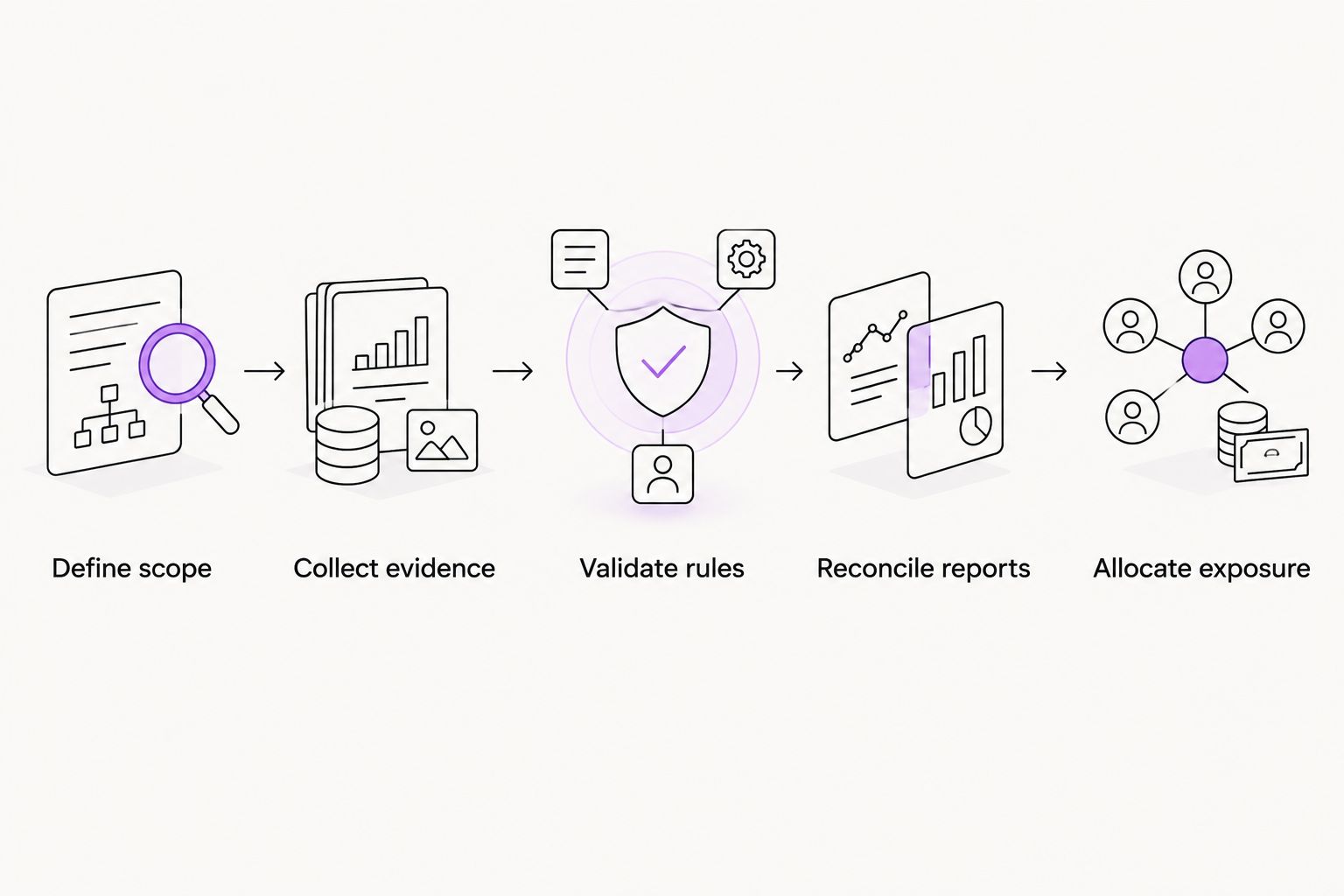
Calculate the reporting discrepancy before allocating exposure to servers.
For a defined 12-month review, reconcile all 12 reporting months individually rather than multiplying one month's discrepancy across the period. Configuration and usage evidence must support each month's conclusion.
Use 2 distinct totals: the licensing exposure and the internal cost of investigating and correcting it. Finance can combine them for planning, but compliance should retain the distinction in the underlying schedule.
Keep 1 evidence record for each adjustment, with its reporting period, source, rationale, and status. This is a recommended control structure—not a claim about a required Microsoft record format.
How should you report the result to finance?
Present the confirmed amount, the unresolved scope, and the calculation basis separately. An unexplained per-server figure makes it difficult to distinguish a licensing obligation from a planning allowance.
Your summary should state:
- Which products and reporting periods the review covers.
- Which discrepancies are confirmed and which remain unresolved.
- Which server population appears in the denominator.
- Which contractual adjustments are included and why.
- Which investigation and remediation costs sit outside the licensing total.
For the 2026 management report, preserve both the total exposure and its allocation. A change in server count can move the average even when the underlying obligation has not changed.
Do not use a lower per-server average as evidence that a discrepancy has been corrected. Closure requires a resolved licensing position and the appropriate reporting or remediation action.
When should you use software and specialist support?
Use software to maintain repeatable evidence and reporting workflows; use licensing expertise to resolve questions about the applicable treatment. A reporting workflow and a contractual interpretation solve different problems.
Octopus is best for SPLA partners and Authorized Outsourcers seeking software and consulting support for reporting, billing, and audit defense. Its relevance is the connection between software asset management and the operational records needed for licensing compliance.
The limitation is fundamental: automation does not turn an unsupported assumption into a defensible licensing decision. You still need an established scope, relevant deployment evidence, and the correct contractual basis.
Review your SPLA reporting controls
Discuss usage reporting, customer billing, and audit-defense requirements.
Does every under-licensed server carry the same exposure?
No fixed per-server amount applies across all SPLA workloads. Product classification, deployment facts, the licensing model, and affected reporting periods determine the calculation; server counts only provide an allocation after those elements are established.
Can you multiply one month's discrepancy across the review period?
A 12-month review requires evidence for 12 reporting months, not an assumed repetition of the latest discrepancy. Calculate the supported position for each period, then aggregate the confirmed differences.
Does correcting the current report resolve the historical issue?
A current correction does not establish that earlier reporting periods are resolved. Review the affected historical periods separately and document the action required under the applicable agreement and findings.
FAQ
How much does SPLA under-licensing cost per server in 2026?
SPLA under-licensing has no universal per-server cost in 2026. Calculate the affected reporting obligation and applicable contractual treatment first, then allocate attributable exposure to a defined server population.
Is SPLA under-licensing calculated by physical server or virtual machine?
The applicable licensing model determines the calculation, not a universal choice between physical servers and virtual machines. Establish the deployment facts and relevant licensing terms before selecting a reporting quantity.
Does every missing inventory record mean a server is under-licensed?
A missing inventory record does not establish an under-licensing amount. Reconstruct the deployment and reporting evidence before classifying the discrepancy.
Can I use the current reporting position for a 12-month estimate?
A 12-month estimate needs evidence for each affected reporting month. Do not multiply the current discrepancy across the period unless the records support the same position throughout.
Are investigation costs part of the licensing shortfall?
Investigation costs are separate from the licensing shortfall. Track the work required to establish and correct the position separately from the underlying licensing obligation.
Can Octopus help with SPLA under-licensing reviews?
Octopus provides software asset management and consulting services for SPLA usage reporting, customer billing, and audit defense. Define the scope and evidence requirements for the specific review before relying on a server-level estimate.
One last thing
A falling per-server average can conceal an unchanged reporting problem. Adding unaffected servers to the denominator reduces the average without resolving any licensing discrepancy.
For your 2026 baseline, retain the affected population, reporting-period evidence, and total confirmed exposure alongside every allocation. Close the reporting gap, not just the spreadsheet variance.