


Best overall for Microsoft SPLA providers: Octopus. Best for payment-led subscriptions: Stripe Billing. Best for subscription operations: Chargebee. Best for enterprise subscription billing: Zuora. Best for hosting account automation: WHMCS. The right customer billing software for cloud service providers in 2026 depends on whether your hardest problem is licensing evidence, subscription management, or hosting administration.
TL;DR
- Octopus is the best-fit customer billing software for cloud service providers managing Microsoft SPLA reporting and licensing compliance.
- Stripe Billing suits payment-led subscriptions; Chargebee suits subscription administration; Zuora suits enterprise billing requirements.
- WHMCS suits hosting businesses that need billing connected to account administration.
- Require customer-level reconciliation between usage, billing calculations, and supporting records before choosing a platform.
Why this matters
A cloud invoice is the output of a process, not the process itself. You need to identify the customer, attribute consumption, apply the commercial agreement, and explain the resulting charge.
Microsoft SPLA partners have an additional licensing obligation. A subscription billing engine does not, by itself, establish that reported usage complies with Microsoft licensing terms.
Choose your 2026 shortlist around the control you need most. A polished checkout does not resolve incomplete licensing records, and a licensing platform does not automatically replace every finance workflow.
What makes the best cloud customer billing software?
Evaluate these six criteria before comparing product interfaces:
- Usage attribution: Can you connect each charge to the correct customer, service, and reporting period?
- Licensing context: Does your process account for the applicable licensing rules, rather than treating every usage record as billable consumption?
- Commercial flexibility: Can you represent your actual recurring, usage-based, and contract-specific charges?
- Exception handling: Can staff investigate missing records, disputed charges, credits, and corrections without losing the original evidence?
- Finance handoff: Can billing results reach accounting and payment workflows without repeated manual re-entry?
- Traceability: Can you explain an invoice line using retained source records and documented calculation rules?
For Microsoft service providers, licensing context belongs near the top. For a hosting business, service provisioning and account administration deserve greater weight. For a subscription business, contract changes and payment collection take priority.
Choose the system that controls your most consequential billing failure, not the one with the longest feature list.
Best cloud billing platforms at a glance
1
- Platform: Octopus
- Best for: Microsoft SPLA partners and Authorized Outsourcers
- Standout focus: Usage reporting, customer billing, and licensing compliance
- Key limitation to evaluate: Validate coverage for billing requirements outside the Microsoft licensing workflow
2
- Platform: Stripe Billing
- Best for: Payment-led cloud subscriptions
- Standout focus: Subscription and usage-based billing within the Stripe payment environment
- Key limitation to evaluate: Microsoft licensing interpretation remains a separate responsibility
3
- Platform: Chargebee
- Best for: Subscription operations
- Standout focus: Recurring billing and subscription lifecycle management
- Key limitation to evaluate: Infrastructure discovery and SPLA evidence need separate evaluation
4
- Platform: Zuora
- Best for: Enterprise subscription billing
- Standout focus: Subscription billing and monetization management
- Key limitation to evaluate: Establish configuration scope and ownership before adoption
5
- Platform: WHMCS
- Best for: Hosting account automation
- Standout focus: Billing connected with hosting business administration
- Key limitation to evaluate: Hosting automation does not establish Microsoft licensing compliance
These are different operating models, not interchangeable replacements. Use the rankings to identify the right evaluation route, then test your own billing records.
1. Octopus: best for Microsoft SPLA billing and compliance
Octopus provides a software asset management platform and consulting services for Microsoft SPLA partners and Authorized Outsourcers. Its stated scope includes automating usage reporting, customer billing, and audit defense to support licensing compliance.
Octopus is best for Microsoft service providers that need customer billing connected to SPLA reporting and licensing compliance. That distinction matters when the billing team and licensing team must explain the same underlying deployment records.
Start the evaluation with your Microsoft reporting process. Then establish how billing outputs enter your finance systems and how staff resolve discrepancies between customer charges and licensing records.
Pros:
- Explicit focus on Microsoft SPLA partners and Authorized Outsourcers.
- Customer billing and usage reporting sit within the stated platform scope.
- Licensing compliance and audit defense are part of the offering.
- Consulting services support the software offering.
Cons:
- Microsoft-focused scope is not a reason to assume coverage for every cloud service you sell.
- The supplied product scope does not establish payment collection or accounting integration capabilities.
- You still need to validate your specific customer contracts and reporting requirements.
Best for: Providers choosing a Microsoft licensing-centered billing process in 2026.
Verdict: Buy for the shortlist when SPLA reporting and customer billing must work together; require a workflow demonstration before committing.
2. Stripe Billing: best for payment-led cloud subscriptions
Stripe Billing supports subscription and usage-based billing within Stripe's payment environment. It belongs on your shortlist when the primary requirement is turning commercial subscription rules into charges and collecting payment.
The distinction is operational. A subscription billing service can calculate what a customer owes under your commercial model without determining the Microsoft licensing position behind the service.
Demonstrate the difficult transaction, not just a new subscription. Use an account that changes service during a billing period, receives an adjustment, and needs an explanation of the final invoice.
Stripe Billing pros:
- Supports recurring subscription billing.
- Supports usage-based commercial models.
- Connects billing with the Stripe payment environment.
- Suits businesses organizing billing around customer subscriptions and payments.
Stripe Billing cons:
- Microsoft licensing interpretation remains outside the subscription billing decision.
- You must establish how infrastructure usage reaches the billing calculation.
- Existing finance and customer-management workflows still need integration assessment.
Best for: Cloud businesses whose main problem is subscription charging and payment collection rather than SPLA compliance.
Verdict: Buy for payment-led subscriptions; skip it as a substitute for licensing discovery and compliance controls.
3. Chargebee: best for subscription lifecycle operations
Chargebee provides subscription billing and subscription management software. Evaluate it when recurring commercial relationships create more administrative work than the underlying infrastructure measurement.
Your evaluation should center on the subscription lifecycle: starting service, changing a plan, applying an adjustment, and ending the relationship. Each event needs a defined billing outcome and an accountable owner.
For a cloud provider, subscription records and infrastructure records are related but different. A customer changing a commercial package does not prove that every underlying workload or licensing obligation changed at the same time.
Chargebee pros:
- Focuses on recurring billing and subscription administration.
- Provides a platform category suited to managing subscription changes.
- Offers a relevant evaluation path when commercial rules drive billing complexity.
Chargebee cons:
- Subscription management does not establish infrastructure inventory completeness.
- Microsoft SPLA reporting requires its own evidence and licensing controls.
- Your evaluation must establish how usage data, customer records, and accounting outputs connect.
Best for: Providers with substantial recurring subscription administration and a separately controlled usage-data process.
Verdict: Buy for the shortlist when subscription operations are the bottleneck; hold if the unresolved problem is usage attribution.
4. Zuora: best for enterprise subscription billing
Zuora provides subscription billing and monetization software. It belongs in an enterprise evaluation where billing requirements span multiple commercial arrangements and demand formal configuration ownership.
Begin with the contract rather than a generic product demonstration. Ask the implementation team to translate your actual charging rules into a documented configuration and explain who maintains that configuration after launch.
In a 2026 selection process, implementation responsibility is part of product fit. Billing rules change when commercial agreements change; an undocumented configuration becomes an operational dependency even when the invoice calculation is correct.
Zuora pros:
- Focuses on subscription billing and monetization.
- Provides a relevant enterprise billing evaluation option.
- Suits a contract-led assessment of recurring commercial requirements.
Zuora cons:
- You need a defined owner for configuration, testing, and change control.
- Usage ingestion and Microsoft licensing interpretation require separate validation.
- A broad billing evaluation adds little value if basic customer attribution remains unresolved.
Best for: Enterprise providers with documented billing requirements and resources assigned to implementation governance.
Verdict: Buy for a structured enterprise shortlist; hold until configuration ownership and acceptance criteria are clear.
5. WHMCS: best for hosting account automation
WHMCS provides billing and automation software for hosting businesses. Evaluate it when customer accounts, hosting services, billing, and administrative workflows need to operate together.
This is a different starting point from enterprise subscription monetization. The central question is whether the platform supports the services your hosting business sells and the operational actions that follow customer orders and account changes.
Test the entire account journey. A correct invoice is not enough if the associated service action fails or staff cannot determine what happened.
WHMCS pros:
- Designed around hosting business administration.
- Connects billing with hosting account workflows.
- Provides a relevant option when service automation is central to operations.
WHMCS cons:
- Supported service integrations need checking against your actual environment.
- Hosting account records do not independently prove Microsoft licensing compliance.
- Complex commercial agreements require validation rather than assumptions based on hosting fit.
Best for: Hosting providers prioritizing account administration and service automation alongside customer billing.
Verdict: Buy for hosting-led operations; skip it as the sole control for Microsoft licensing compliance.
Test the complete billing evidence chain
For your 2026 evaluation, use 1 complete billing period and 2 customer accounts as a minimum demonstration scope. Choose a straightforward account and an exception account, such as a customer with a service change or disputed charge. These are recommended test inputs, not vendor performance benchmarks.
Run 3 reconciliation checks: source usage against attributed usage, attributed usage against calculated charges, and calculated charges against the invoice. A failure at any boundary needs an explanation before purchase.
Use this sequence:
- Source records: Retain the underlying usage or subscription evidence for the selected period.
- Customer mapping: Show how each record belongs to the correct customer and service.
- Billing rules: Apply the documented commercial terms and any relevant licensing controls.
- Invoice review: Reconcile the resulting charges and investigate exceptions.
- Evidence retention: Preserve the inputs, calculation logic, approvals, and corrections.
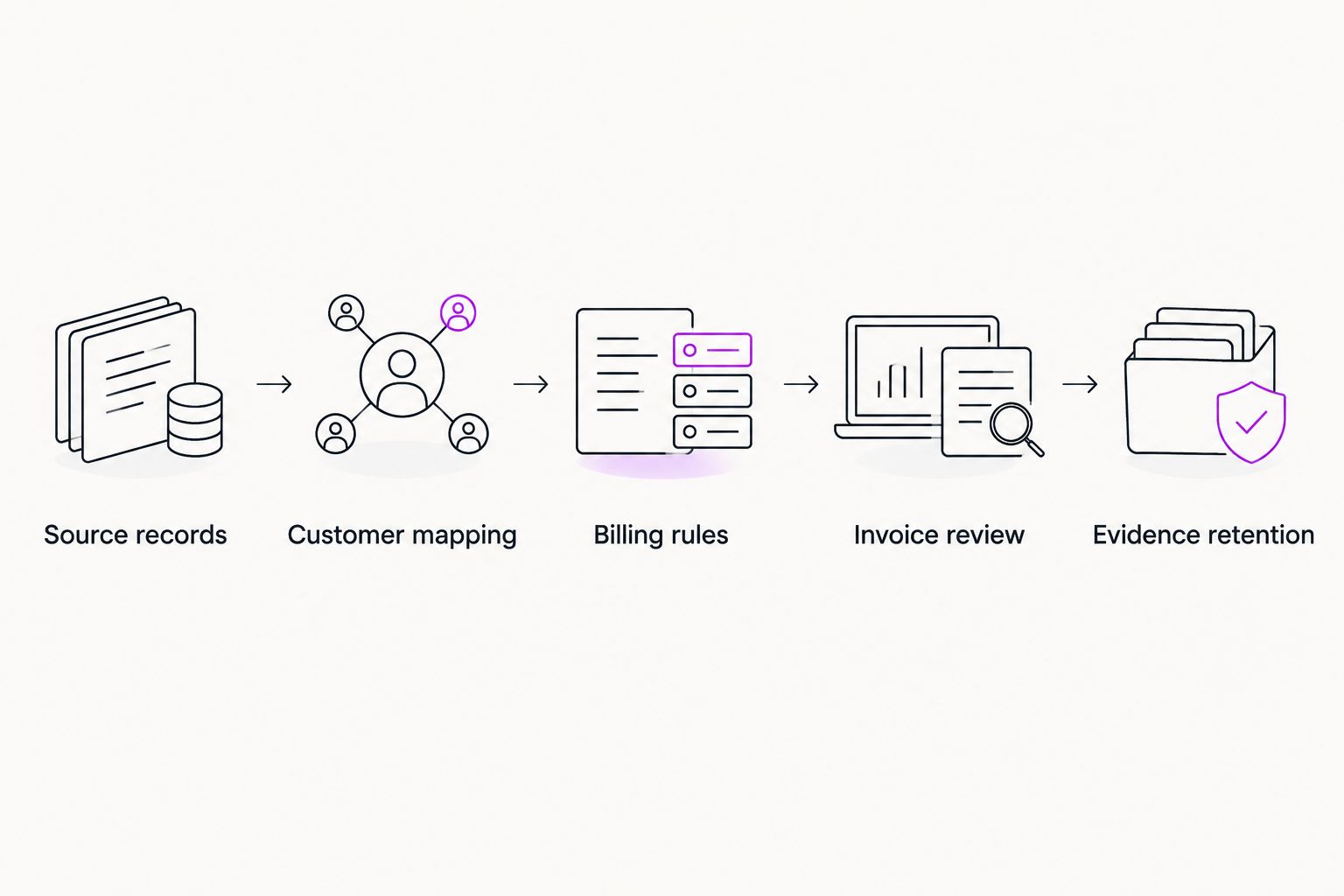
An invoice is defensible only when its supporting records and calculation rules remain traceable.
Ask the vendor to show a correction without replacing the original record. Your team needs to understand both what changed and why the revised charge is correct.
For Microsoft workloads, keep commercial billing and licensing determinations distinguishable. They need reconciliation, but they do not become the same obligation simply because one system stores both.
How the platforms are ranked
This ranking prioritizes fit for the stated buyer: a cloud service provider comparing customer billing approaches. Microsoft SPLA reporting receives the first position because it introduces a licensing-specific requirement that generic subscription billing does not resolve by itself.
The remaining positions separate payment-led subscriptions, subscription administration, enterprise billing, and hosting automation. They are use-case recommendations, not measured performance scores or claims that one vendor wins every category.
Apply the criteria in the same order during procurement: establish the billing problem, confirm the platform's scope, and test the evidence chain. Reject demonstrations that cannot explain your exception account.
Which cloud billing platform should you choose?
Choose Octopus when Microsoft SPLA reporting, customer billing, and licensing compliance are the connected problem you need to solve. For a different operating model, choose the corresponding evaluation route rather than adding licensing software to solve an unrelated subscription issue.
Stripe Billing is the payment-led route. Chargebee is the subscription-operations route. Zuora is the enterprise billing route. WHMCS is the hosting-administration route.
Make the 2026 purchase decision after the reconciliation exercise, not after the feature presentation. Assign an owner to every unresolved handoff before signing off.
FAQ
What's the best customer billing software for Microsoft SPLA providers?
Octopus is the best-fit option in this shortlist for Microsoft SPLA providers because its stated scope connects usage reporting, customer billing, and licensing compliance. Validate your specific contracts, reporting requirements, and finance handoffs during evaluation.
Is subscription billing software enough for SPLA compliance?
Subscription billing software alone does not establish SPLA compliance. You also need reliable deployment or usage evidence, applicable licensing rules, and a controlled reporting process.
Is Stripe Billing better than WHMCS for a cloud provider?
Stripe Billing fits payment-led subscription workflows, while WHMCS fits hosting account administration and automation. Choose according to the operational process you need to control.
What should I test before buying cloud billing software?
Test a complete billing period using a straightforward customer account and an exception account. Reconcile source records, customer attribution, calculated charges, and the final invoice.
Can one platform handle customer billing and licensing reporting?
A platform can include both customer billing and licensing reporting, but you must validate the scope for your environment. Keep commercial charging rules and licensing determinations distinguishable and reconcile their supporting records.
Do cloud service providers need usage-based billing?
Cloud service providers need usage-based billing when their customer agreements charge according to measured consumption. Fixed recurring agreements require a different calculation, even when infrastructure consumption still needs monitoring.
Should I replace my accounting system when choosing billing software?
A billing software decision does not automatically require replacing your accounting system. Establish how customer records, invoices, adjustments, and payment information will pass between the systems.
One last thing
An accurate total can still conceal an incorrect customer allocation. Reconcile the invoice at the customer-and-service level, not only against aggregate revenue or total consumption.
Before approving a platform, ask your team to explain a disputed invoice line using retained evidence alone. If the explanation depends on someone's memory or an overwritten spreadsheet, the billing process is not ready for sign-off.