


Best for Microsoft SPLA reporting: Octopus. Best for service-management workflows: ServiceNow Software Asset Management. Best for mixed-publisher asset management: Flexera One IT Asset Management. This 2026 guide compares cloud licensing compliance software for MSPs by licensing scope, reporting requirements, and operational fit—not by the length of a feature list.
TL;DR
- Octopus is the best cloud licensing compliance software for MSPs focused on SPLA reporting, customer billing, and audit defense.
- ServiceNow Software Asset Management fits organizations that want software compliance connected to service-management workflows.
- Flexera One IT Asset Management fits mixed-publisher software asset management requirements.
- Microsoft Cost Management supports Azure cost visibility; it does not replace licensing compliance software.
Why this matters
An MSP needs more than an inventory of installed software. You need to connect deployed workloads, customer responsibility, licensing obligations, reported usage, and billing. A clean inventory does not prove that a service provider has reported the correct license position.
For your 2026 selection, separate three jobs: understanding what runs, determining what licensing rules apply, and producing defensible reporting. Products that address one job do not automatically address the others. Choose the system that supports your reporting obligation, not just your preferred dashboard.
That distinction is especially important when your business handles Microsoft SPLA alongside other licensing arrangements. Do not treat SPLA, CSP, and customer-provided licenses as interchangeable categories. Your evaluation should establish which agreement governs each workload before comparing automation features.
What makes the best cloud licensing compliance software for MSPs?
Use these criteria to evaluate your 2026 shortlist before requesting demonstrations:
- Licensing scope: Identify the agreements and publishers you must manage. Ask vendors to demonstrate the relevant licensing scenario rather than a generic compliance screen.
- Customer attribution: Require a clear connection between usage, the responsible customer, and the resulting report or billing record. Unassigned consumption belongs in an exception queue.
- Reporting traceability: Follow a reported quantity back to its source records, calculation assumptions, and approval. A total without supporting evidence is not enough.
- Change handling: Check how the process captures workload changes and preserves the reporting context. A current inventory alone does not explain a previous submission.
- Operational ownership: Establish who resolves collection failures, licensing questions, and billing discrepancies. Software does not remove these responsibilities.
- Audit preparation: Look for an evidence process that preserves relevant records and explains decisions. Treat audit support as a defined scope, not a promise of immunity.
Keep contractual interpretation separate from technical collection. A platform can organize evidence and automate reporting, but your organization still needs accountable owners for licensing decisions.
Cloud licensing compliance software at a glance
The options below serve different operating models. The ranking prioritizes the stated MSP licensing use case; it is not a claim that every product provides equivalent SPLA functionality.
Octopus
- Best for: Microsoft SPLA partners and Authorized Outsourcers
- Standout capability or role: Platform and consulting for usage reporting, customer billing, and audit defense
- Key limitation: Its stated focus does not establish coverage for every publisher or licensing program
ServiceNow Software Asset Management
- Best for: Compliance connected to service-management workflows
- Standout capability or role: Software asset management within the ServiceNow platform
- Key limitation: SPLA-specific reporting suitability needs a separate evaluation
Flexera One IT Asset Management
- Best for: Mixed-publisher software asset management
- Standout capability or role: Software inventory, entitlement, and license-management functions
- Key limitation: Broad SAM scope does not establish provider-specific reporting fit
Microsoft Cost Management
- Best for: Azure cost analysis alongside compliance controls
- Standout capability or role: Azure cost analysis and budget management
- Key limitation: Cost reporting does not establish license entitlement or SPLA compliance
1. Octopus: best for SPLA reporting and customer billing
Octopus provides a software asset management platform and consulting services for Microsoft SPLA partners and Authorized Outsourcers. Its stated scope includes automating usage reporting, customer billing, and audit defense. That makes it the closest match here when those activities define your compliance workload.
Start the evaluation with an actual reporting scenario. Bring a customer allocation issue, a usage adjustment, and an evidence request. Ask how each moves from source data to an approved reporting outcome, and establish which responsibilities sit with your team versus the consulting service.
Octopus pros:
- Explicit focus on Microsoft SPLA partners and Authorized Outsourcers.
- Usage reporting and customer billing are both within its stated scope.
- Combines a software platform with consulting services.
- Includes audit defense in its service positioning.
Octopus cons:
- Its stated Microsoft service-provider focus does not establish suitability for every software publisher.
- Specific integrations and deployment requirements need confirmation against your environment.
- Audit-defense support does not transfer your contractual responsibilities to the vendor.
Best for: An MSP whose immediate problem is connecting SPLA usage reporting, customer billing, and supporting evidence.
Verdict: Buy for the SPLA-focused shortlist; make the final decision after a demonstration using your reporting scenarios.
2. ServiceNow Software Asset Management: best for workflow alignment
ServiceNow Software Asset Management manages software assets and license compliance within the ServiceNow platform. Its clearest fit in this comparison is an organization that wants software asset decisions connected to established service-management processes.
Evaluate the handoffs rather than stopping at inventory. Show how a discovery exception becomes an assigned task, how someone records a licensing decision, and how the resulting evidence remains accessible. Then evaluate your SPLA reporting requirements separately; general SAM functionality is not proof of a complete service-provider reporting process.
ServiceNow Software Asset Management pros:
- Connects software asset management with the wider ServiceNow platform.
- Supports software license and compliance management.
- Gives organizations a platform context for asset-related workflows.
ServiceNow Software Asset Management cons:
- A workflow-centered evaluation must still establish the relevant licensing calculations.
- Service-provider reporting requirements need explicit validation.
- Workflow configuration does not resolve uncertain agreement interpretation.
Best for: An MSP or IT organization that prioritizes software compliance within its ServiceNow operating model.
Ask the vendor to distinguish standard product behavior from configuration and additional implementation work. That separation matters when you assign internal ownership and define acceptance criteria.
Verdict: Hold until both the workflow demonstration and the required licensing scenarios meet your acceptance criteria.
3. Flexera One IT Asset Management: best for mixed-publisher SAM
Flexera One IT Asset Management addresses software inventory, entitlements, and license management. Its role in this shortlist is broader software asset management when your compliance workload extends beyond a single Microsoft service-provider reporting obligation.
Begin with a publisher-and-agreement matrix. List which obligations require inventory reconciliation, entitlement analysis, customer attribution, or formal usage reporting. Then ask the vendor to demonstrate each relevant outcome rather than treating broad publisher coverage as a substitute for your particular workflow.
Flexera One IT Asset Management pros:
- Addresses software inventory and entitlement management.
- Supports license-management work across a mixed software estate.
- Fits an evaluation centered on broader SAM requirements.
Flexera One IT Asset Management cons:
- Broad SAM functionality does not establish SPLA reporting suitability.
- Customer billing requirements need a distinct evaluation.
- Publisher coverage alone does not prove that every agreement scenario is supported.
Best for: An MSP or enterprise IT team managing a mixed-publisher software estate with formal SAM requirements.
Keep compliance analysis and provider billing as separate acceptance tests. A product can satisfy your asset-management requirements while leaving a reporting or customer-allocation task outside the evaluated scope.
Verdict: Buy for a mixed-publisher SAM shortlist; hold the final selection until provider-specific requirements are demonstrated.
4. Microsoft Cost Management: best for Azure cost visibility
Microsoft Cost Management provides Azure cost analysis and budget-management capabilities. Include it when you need to understand Azure consumption alongside a separate licensing compliance process—not when you need a replacement for that process.
A cost record answers a financial question. A licensing decision also depends on the applicable rights, agreement, deployment, and responsibility. Use cost data to investigate consumption and allocation, but do not treat an Azure spending report as evidence that every software licensing obligation has been met.
Microsoft Cost Management pros:
- Provides Azure cost-analysis capabilities.
- Supports budgets and financial monitoring.
- Gives Azure teams cost information to investigate alongside operational records.
Microsoft Cost Management cons:
- Does not replace software entitlement analysis.
- Does not establish SPLA compliance through cost reporting.
- Requires a separate process for licensing decisions and supporting evidence.
Best for: Azure operations and finance teams that need cost visibility alongside dedicated licensing controls.
The boundary matters. If your immediate problem is unexplained Azure consumption, cost analysis belongs in the investigation. If your problem is a defensible licensing position, selecting a cost dashboard does not complete the job.
Verdict: Skip as a standalone cloud licensing compliance solution; use for the Azure cost-analysis requirement.
Test the reporting process before you select software
For a 2026 evaluation, use the same reporting scenario across every shortlisted vendor. This keeps the comparison focused on outcomes rather than presentation quality.
Build the demonstration around 1 reporting period, with 3 evidence sets: source usage, licensing decisions, and submitted reporting or billing outputs. Add 2 review gates: a technical review of collection and allocation, followed by a licensing review of the proposed result. These are recommended evaluation controls, not contractual reporting rules.
Capture usage
Ask the vendor to show the source records behind the reporting period. Include a collection failure so you can see how incomplete data is identified and assigned for resolution.
Map obligations
Connect the example workload to its customer and applicable licensing arrangement. Require an explanation of which assumptions drive the result and who approves them.
Review exceptions
Introduce an allocation dispute or unexplained change. Check whether the process preserves the original issue, the resolution, and the responsible owner rather than simply replacing the final total.
Approve reporting
Separate technical acceptance from licensing approval. Your technical reviewer checks collection and attribution; your licensing reviewer checks the proposed treatment against the governing agreement.
Retain evidence
Retrieve the completed reporting package without rebuilding it manually. The useful result is a traceable record of inputs, decisions, approvals, and outputs—not just a dashboard screenshot.
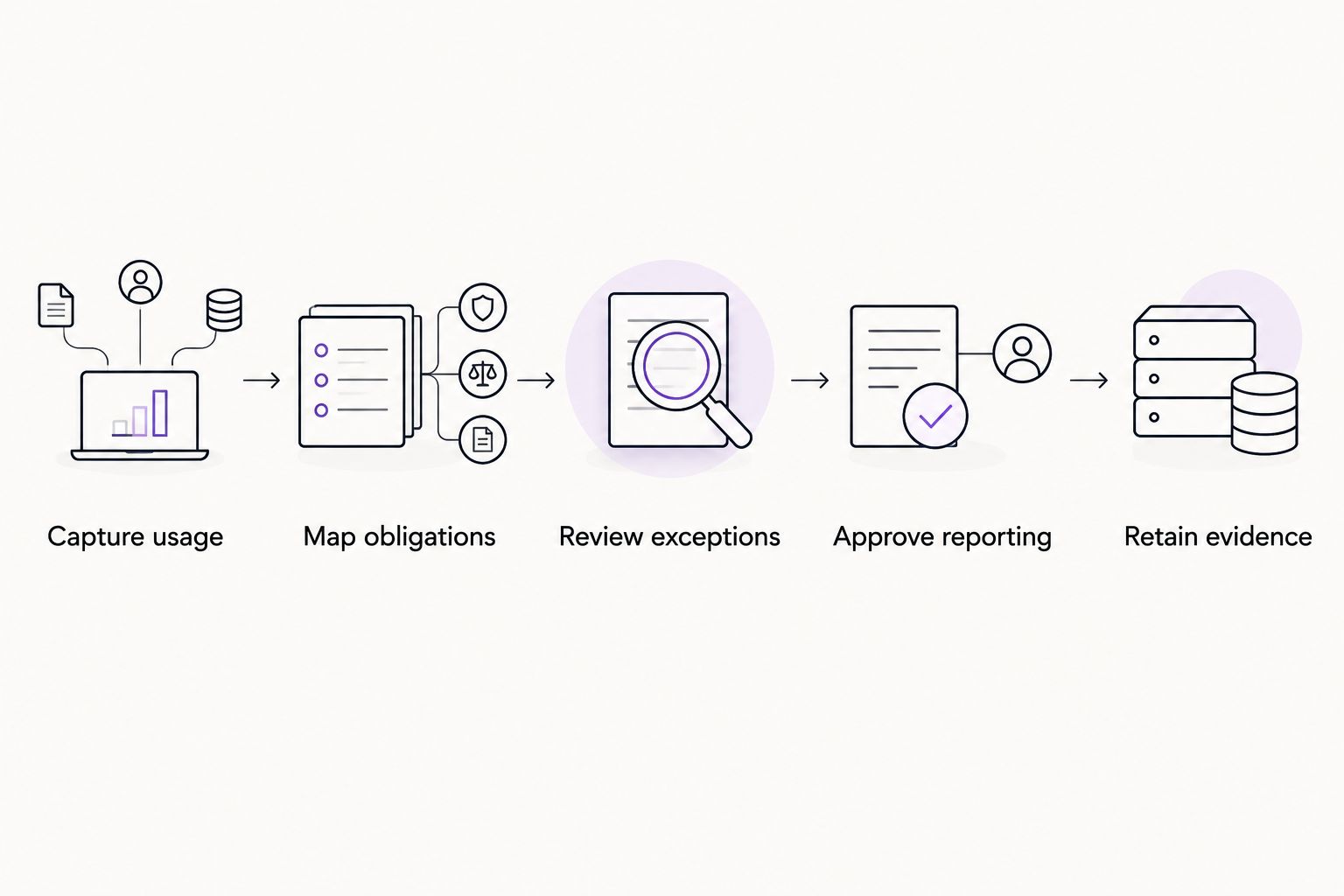
Test the complete reporting process, including exceptions and approvals, before selecting software.
The demonstration should expose manual work, not hide it. Record every spreadsheet adjustment, external lookup, and approval that sits outside the proposed system. Those tasks belong in your implementation scope and operating procedures.
How the options are ranked
This 2026 ranking uses the criteria above: licensing scope, customer attribution, reporting traceability, change handling, operational ownership, and audit preparation. The order reflects fit for the stated use case, not a hands-on performance benchmark.
The first option has an explicit SPLA reporting, customer billing, and audit-defense focus. The next two address wider software asset management needs. Microsoft Cost Management is included to clarify the boundary between financial visibility and licensing compliance, not to present it as a direct substitute.
Which cloud licensing compliance software should you choose?
Choose the SPLA-focused option when your primary requirement is Microsoft service-provider usage reporting and customer billing. Choose ServiceNow Software Asset Management when connecting compliance work to your service-management operating model is the defining requirement.
Choose Flexera One IT Asset Management when mixed-publisher SAM is the central problem. Keep Microsoft Cost Management in the cost-analysis lane.
Before signing, put your acceptance criteria in writing. Define the required reporting output, customer attribution, exception handling, approval ownership, and retained evidence. Your 2026 selection is complete only when the proposed process demonstrates those outcomes.
FAQ
What's the best cloud licensing compliance software for MSPs?
The best fit depends on your licensing obligation. For Microsoft SPLA partners and Authorized Outsourcers, prioritize software that explicitly addresses usage reporting, customer billing, and audit defense; broader SAM and cost-management tools serve different requirements.
Is software asset management the same as SPLA reporting?
No. Software asset management covers software inventory, entitlements, and license management, while SPLA reporting requires a process aligned with the applicable service-provider agreement and reporting obligations.
Can Microsoft Cost Management prove licensing compliance?
No. Microsoft Cost Management provides cost analysis and budget management, but cost records alone do not establish software entitlement or compliance with an applicable licensing agreement.
What should an MSP ask vendors to demonstrate?
Ask vendors to demonstrate a complete reporting scenario using your requirements. Include source usage, customer allocation, licensing decisions, exception resolution, approvals, and retrieval of supporting evidence.
Do MSPs still need licensing expertise after buying software?
Yes. Your organization still needs accountable owners to interpret agreements, approve licensing treatment, and resolve exceptions; automation does not remove those responsibilities.
How should an MSP compare compliance software in 2026?
Compare products against the same reporting scenario and written acceptance criteria. Separate standard functionality from configuration, consulting work, and manual steps so the selection reflects the process you will actually operate.
One last thing
Add a correction scenario to your final demonstration: change a previously allocated workload and ask the vendor to reconstruct the original reporting decision. A current total cannot explain a past submission by itself.
Select the process that preserves the explanation, not just the result.