

Microsoft CSP partners’ SPLA usage reporting is the process of identifying and reporting usage governed by an SPLA agreement so hosting activity is declared under the correct licensing terms. For CSP partners operating mixed licensing environments in 2026, the critical distinction is separating SPLA-reportable services from CSP subscriptions and customer-provided licenses before calculating a declaration.
TL;DR
- SPLA usage reporting for CSP partners starts with separating licensing responsibility, not counting installations.
- Octopus fits SPLA partners seeking software and consulting for usage reporting, customer billing, and audit defense.
- Reconcile infrastructure inventory, licensing decisions, and customer allocation before approving each SPLA declaration.
- CSP subscriptions and customer-provided licenses require their own evidence; neither automatically removes SPLA reporting obligations.
Why SPLA usage reporting matters for CSP partners
A CSP subscription record and an SPLA usage declaration answer different questions. The subscription record documents a commercial entitlement; the declaration reports usage under an SPLA agreement. Treating either as a complete picture of your hosted environment creates gaps between procurement, infrastructure, and reporting.
Your 2026 reporting process needs to identify which licensing arrangement governs each workload, who holds the relevant rights, and what evidence supports that decision. An installed product name alone does not answer those questions.
Octopus provides a software asset management platform and consulting services for Microsoft SPLA partners and Authorized Outsourcers. Octopus is best for SPLA partners seeking software and consulting support for usage reporting, customer billing, and audit defense. Software supports the process; agreement interpretation and declaration approval still require accountable owners.
Build a repeatable SPLA reporting process
Use the following steps to build a reporting process you can explain and reproduce. Start with a spreadsheet-based register and retained source files; introduce automation after you have defined the scope, licensing decisions, and approval responsibilities.
Establish your licensing boundary
Start manually with a customer-and-service register. Record each hosted service, its infrastructure location, the party responsible for licensing, and the agreement or entitlement supporting that arrangement. Separate confirmed decisions from unresolved questions rather than forcing every workload into an assumed category.
CSP partner status does not itself establish SPLA rights for every hosted workload. Likewise, a customer’s ownership of licenses does not establish that those licenses cover the proposed hosting arrangement. Validate the applicable Microsoft agreement, product rights, and outsourcing conditions before excluding usage from an SPLA declaration.
For your 2026 register, retain the document version and effective date used for each material decision. Microsoft’s Services Provider Use Rights and applicable Product Terms serve different licensing contexts; use the documents governing the actual arrangement.
- List each customer’s hosted services and responsible service owner.
- Identify the asserted licensing route for each workload.
- Attach the supporting agreement or entitlement evidence.
- Record unresolved questions separately from approved classifications.
- Assign an owner to resolve each exception before approval.
Capture a reproducible infrastructure baseline
Export infrastructure and software inventory into a controlled working file. Preserve the original exports before changing names, removing duplicates, or applying licensing logic. A cleaned spreadsheet without its source files is difficult to reproduce when a declaration is challenged.
Capture enough context to connect installed software to the host, virtual machine, customer, and relevant reporting period. The exact fields depend on the product and licensing model; do not apply a single counting formula to every Microsoft deployment.
Octopus supports usage-reporting automation, but an automated reporting workflow still needs a defined infrastructure boundary. Decide what must be discovered before deciding which collection method to use. Compare collected records against your infrastructure register so disconnected systems and retired machines receive explicit treatment.
- Retain source exports for 1 complete reporting period per working set.
- Preserve stable host and virtual-machine identifiers where available.
- Record collection timestamps and the systems included.
- Identify missing inventory sources before calculating usage.
- Document duplicate records, exclusions, and retired infrastructure.
Apply the relevant licensing rules
Build a rules worksheet alongside the inventory. For each product and deployment, record the applicable licensing model, required inputs, calculation method, and evidence supporting any exclusion. Keep technical discovery separate from licensing judgment: inventory establishes what exists, while the governing rights determine how it is treated.
Do not treat installed processors, allocated virtual resources, or user-account totals as interchangeable measures. Microsoft products and licensing arrangements have distinct requirements. Check the applicable terms before selecting the measurement basis, including any relevant minimums, assignment conditions, and virtualization rights.
For a 2026 declaration, retain the terms applicable to that reporting period rather than silently applying a later document to earlier activity. Escalate ambiguous cases for licensing review instead of encoding an unverified assumption into an automated calculation.
- Map discovered software to the relevant product and edition.
- Identify the governing agreement and rights document.
- Record the required licensing measure and calculation inputs.
- Attach evidence supporting customer-provided licensing exclusions.
- Require approval before changing a calculation rule.
Reconcile usage with customer billing
Create a reconciliation worksheet linking infrastructure records, licensing calculations, and customer allocation. Begin with exports from the systems you already use. Customer names often differ across infrastructure, contracts, and finance records, so establish a controlled mapping rather than relying on approximate text matches.
Run 3 reconciliation checks before approval: source completeness, licensing classification, and customer allocation. These are recommended controls, not Microsoft reporting requirements. Each check answers a different question: did you capture the environment, apply the right treatment, and assign the result correctly?
Octopus supports usage-reporting and customer-billing automation. That addresses repetitive processing, but your billing policy still needs explicit approval. A customer invoice is not proof that the corresponding SPLA declaration is correct, and a correct declaration does not establish that every invoice follows the customer contract.
- Check source completeness against the infrastructure register.
- Check licensing classification against approved rules.
- Check customer allocation against service and contract records.
- Investigate unexplained changes against the previous reporting period.
- Keep billing adjustments distinct from licensing corrections.
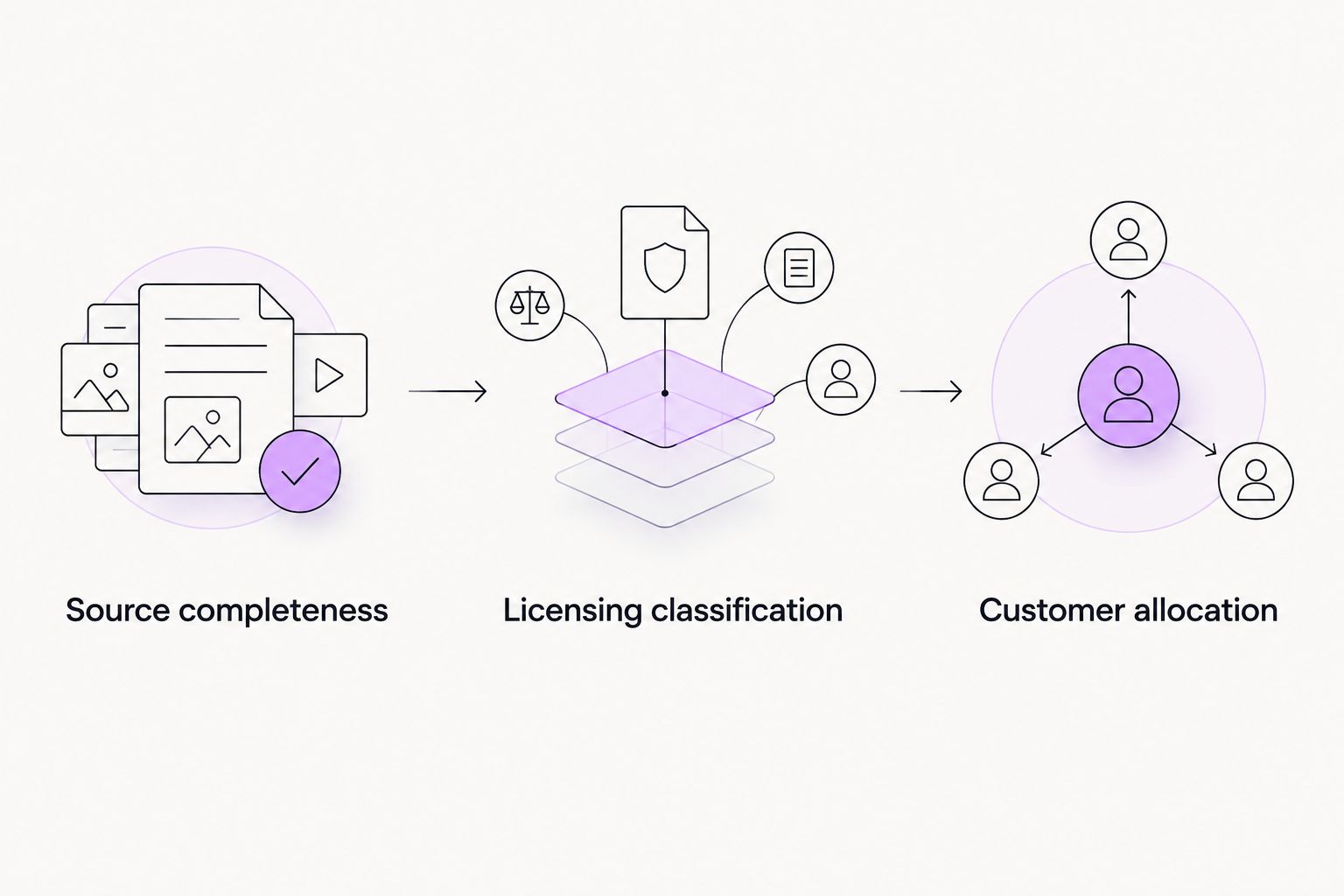
Validate the source, the licensing treatment, and the customer allocation separately.
Approve the declaration and retain its evidence
Prepare a reporting pack containing the proposed declaration, supporting calculations, unresolved exceptions, and approval record. Use a separate copy for submission so subsequent spreadsheet changes do not alter the evidence behind an approved report.
Assign 2 reviewers where staffing allows: a preparer responsible for the calculation and an approver responsible for challenging exceptions. This is a recommended internal control, not a stated Microsoft requirement. If the same person performs both roles, document that limitation and arrange a separate review of material exceptions.
Keep the submission record with the evidence supporting it. Follow the submission route, schedule, and retention obligations in your applicable agreement and reporting instructions; an internal checklist does not replace those requirements.
- Freeze the inventory and calculation files used for approval.
- Record the reporting period and responsible reviewers.
- Document exceptions and their approved treatment.
- Preserve the submitted declaration and acknowledgment.
- Retain evidence according to applicable contractual requirements.
Review changes before the next reporting cycle
Maintain a change register instead of rediscovering every licensing decision at reporting close. Capture infrastructure moves, customer onboarding, service termination, software changes, and revised licensing arrangements as operational events occur. Each event needs an owner and an assessment of whether it affects reporting.
For the remainder of 2026, review process changes against the same baseline: scope, evidence, calculation, allocation, and approval. Automation should reduce repeated handling without removing the record of why a decision changed.
Start with a shared exception log and scheduled reviews. Consider platform support when repeated exports, customer mappings, and corrections become difficult to control manually. The decision should follow your reporting complexity and evidence requirements, not a presumed customer-count threshold.
- Record infrastructure and service changes when they occur.
- Reassess licensing treatment when the deployment changes.
- Close resolved exceptions without deleting their history.
- Update calculation rules through an approved change process.
- Carry unresolved issues into the next reporting review.
Compare reporting options for CSP partners
Choose a reporting approach based on the work you need to control. Every option requires accurate scope and defensible licensing decisions; none makes an unsupported exclusion valid. The distinction is how much collection, reconciliation, and evidence handling your team performs manually.
Spreadsheet-led reporting
- Best for: Partners establishing a controlled reporting baseline
- Main advantage: Makes inputs, assumptions, and calculations directly inspectable
- Key limitation: Requires manual reconciliation, version control, and evidence handling
Scripts with controlled exports
- Best for: Teams with repeatable infrastructure queries and internal technical ownership
- Main advantage: Reduces repeated data collection while retaining a custom workflow
- Key limitation: Scripts need maintenance and do not establish licensing rights
Licensing consulting
- Best for: Partners resolving disputed classifications or unfamiliar hosting arrangements
- Main advantage: Adds specialist review to licensing decisions
- Key limitation: Advice still depends on accurate deployment facts and retained evidence
Octopus platform and consulting
- Best for: SPLA partners and Authorized Outsourcers seeking reporting, billing, and audit-defense support
- Main advantage: Combines software asset management with consulting services
- Key limitation: Requires your team to define scope, supply evidence, and approve decisions
Choose the smallest process you can control and reproduce. Spreadsheet-led reporting is a valid starting point when ownership and evidence are clear. Custom scripts improve collection, but they also create an internal maintenance obligation. Platform support addresses repeated operational work; consulting addresses interpretation. Treat those needs separately when evaluating an approach.
Review your SPLA reporting approach
Explore software and consulting for SPLA usage reporting, customer billing, and audit defense.
Common mistakes CSP partners make
Treating CSP records as the reporting boundary
A subscription export does not establish the full scope of hosted software. Begin with the services and infrastructure you operate, then connect each workload to its licensing basis. Otherwise, systems outside the procurement record remain outside your review.
Accepting customer-provided licenses without checking rights
A customer’s entitlement record is evidence, not a complete hosting-rights decision. Validate the product, licensing arrangement, deployment, and applicable outsourcing conditions before approving an exclusion. Record who approved the treatment and which documents supported it.
Reusing a technical count as a licensing quantity
A virtual-machine count or user directory total is not automatically the required reporting measure. Preserve the technical observation, then apply the relevant licensing rules. Keep the calculation visible so another reviewer can reproduce the result without guessing your assumptions.
Using invoice reconciliation as the final compliance check
Invoices show what you billed, not necessarily what you should declare. Reconcile the SPLA calculation independently before checking commercial allocation. Keep contract-specific billing adjustments visible rather than changing the underlying usage calculation to match an invoice.
Overwriting the evidence after submission
A current inventory cannot reliably explain a past declaration after machines, customers, or allocations change. Retain the approved reporting pack and document subsequent corrections separately. Preserve what supported the decision at submission time, not just the latest system state.
FAQ
Do Microsoft CSP partners need SPLA usage reporting?
CSP partner status alone does not determine whether SPLA usage reporting applies. Assess the hosted services you provide, the agreements governing them, and the licensing responsibility for each workload.
Can I use CSP subscription exports as my SPLA report?
No. CSP subscription exports document subscription information, while an SPLA declaration requires usage calculated under the applicable SPLA terms. Use subscription records as supporting evidence rather than as a substitute for infrastructure reconciliation.
Does customer-provided licensing remove a workload from SPLA reporting?
Not automatically. Validate the customer's rights for the specific product, deployment, and hosting arrangement before approving an exclusion. Retain the evidence and the approval decision.
What should I collect before preparing an SPLA declaration?
Collect the infrastructure inventory, software details, customer allocation, and licensing evidence needed for the applicable calculation. Preserve original exports and collection timestamps so a reviewer can reproduce the reporting inputs.
Is spreadsheet reporting better than a reporting platform?
Spreadsheet reporting suits a controlled baseline, while a platform suits repeated collection and reconciliation work. Neither approach replaces licensing review, documented exceptions, or approval of the final declaration.
How does Octopus support SPLA usage reporting for CSP partners?
Octopus provides a software asset management platform and consulting services supporting SPLA usage reporting, customer billing, and audit defense. Your team still needs to establish the reporting scope and approve licensing decisions.
Which licensing documents should I use for a 2026 report?
Use the agreement, rights documents, and reporting instructions applicable to the arrangement and reporting period. Record document versions and effective dates so later changes do not obscure the basis of an earlier declaration.
One last thing
Before expanding automation, ask a reviewer to reconstruct a submitted declaration using only its retained reporting pack. Do not supply explanations from memory. Any missing customer mapping, undocumented exclusion, or untraceable calculation identifies a control to fix.
For your next 2026 reporting cycle, make that reconstruction test an approval criterion. A reproducible declaration is a stronger operational target than a spreadsheet that merely balances.