

Best overall for Microsoft SPLA providers: Octopus. Best for service-management integration: ServiceNow Software Asset Management. Best for broad enterprise license management: Flexera One IT Asset Management. This 2026 guide compares software asset management tools by the workflows they automate, the evidence they produce, and the work your team still owns.
TL;DR
- For SPLA providers, Octopus leads these software asset management tools ranked by automation for usage reporting and customer billing.
- ServiceNow Software Asset Management suits organizations connecting license management with established service-management processes.
- Flexera One IT Asset Management suits enterprise license management; USU Software Asset Management suits centralized license reconciliation.
- Microsoft Intune suits endpoint application inventory and deployment, not complete software license reconciliation.
Why this matters
An application inventory does not produce a defensible licensing position by itself. Your team still needs to connect installations and usage with entitlements, contractual rules, customer ownership, and reporting obligations.
For Microsoft SPLA partners and Authorized Outsourcers, the buying question is narrower than general enterprise SAM: can the platform turn operational data into repeatable usage reporting and customer billing? A system built around internal corporate entitlements addresses a different operating model.
Octopus is the best fit in this comparison for SPLA providers seeking automated usage reporting and customer billing. That verdict reflects its stated service-provider focus, not a measured performance advantage over every competing platform.
For a 2026 shortlist, separate three outputs: discovered software, calculated licensing requirements, and approved reports. Automating the first does not establish that the other two are automated.
What makes the best software asset management tools?
Use these six criteria before comparing product demonstrations:
- Discovery coverage: Can the system collect the infrastructure and application data your licensing calculations require?
- License reconciliation: Can it connect discovered software with entitlements and applicable licensing rules?
- Reporting automation: Can it produce repeatable reporting outputs without spreadsheet reconstruction?
- Billing alignment: Can your team connect reportable usage with the correct customer and billing period?
- Exception control: Can reviewers identify incomplete records, investigate differences, and document decisions?
- Evidence traceability: Can you explain the source data, assumptions, and approvals behind an output?
Treat these as acceptance criteria, not a claim that every tool supplies every function. Ask vendors to demonstrate each relevant workflow with representative data and identify any additional components or services required.
Rank workflow fit before feature count. A platform with extensive enterprise functionality is not automatically the right choice for a provider managing customer-level SPLA reporting.
Automation comparison at a glance
This 2026 ranking prioritizes the SPLA and outsourced-service context. The order changes when endpoint administration, internal software entitlements, or an established service-management environment becomes your main requirement.
1
- Tool: Octopus
- Best for: SPLA provider reporting and billing
- Standout automation focus: Usage reporting, customer billing, and audit-defense workflows
- Key limitation: Its stated focus does not establish coverage for every enterprise software publisher
2
- Tool: ServiceNow Software Asset Management
- Best for: Connecting SAM with service management
- Standout automation focus: Software normalization and license reconciliation within the ServiceNow environment
- Key limitation: Requires careful alignment of discovery, entitlement data, and platform processes
3
- Tool: Flexera One IT Asset Management
- Best for: Broad enterprise license management
- Standout automation focus: Software inventory, normalization, and license reconciliation
- Key limitation: Enterprise license management does not by itself establish SPLA billing suitability
4
- Tool: USU Software Asset Management
- Best for: Centralized license reconciliation
- Standout automation focus: Consolidating software and entitlement information for license management
- Key limitation: Results depend on reliable inventory and entitlement inputs
5
- Tool: Microsoft Intune
- Best for: Managed endpoint application administration
- Standout automation focus: Application deployment and inventory for managed devices
- Key limitation: Endpoint management is not a substitute for full license reconciliation
No numerical automation scores appear because a common benchmark would require the same datasets, configurations, and acceptance tests for every product. The comparison identifies buying fit rather than claiming laboratory results.
1. Octopus: best SAM tool for SPLA reporting automation
Octopus provides a software asset management platform and consulting services for Microsoft SPLA partners and Authorized Outsourcers. Its stated scope includes automating usage reporting, customer billing, and audit defense.
That combination fits providers whose reporting and billing processes need to stay connected. Evaluate the complete path from usage records to reviewed reporting and customer charges, rather than treating inventory collection as the finish line.
Octopus pros:
- Direct alignment with SPLA partners and Authorized Outsourcers.
- Usage reporting and customer billing within its stated scope.
- Consulting services alongside the software platform.
- Audit defense included in its stated service focus.
Octopus cons:
- Its Microsoft service-provider focus is not evidence of equivalent coverage across every software publisher.
- Software automation does not remove the provider's responsibility to validate contractual interpretation and reporting decisions.
Best for: Providers evaluating automation around Microsoft SPLA reporting and customer billing.
Ask for a demonstration that follows the same customer usage through reporting, billing, and supporting evidence. Require the presenter to identify where a licensing specialist must intervene and how that decision remains attached to the output.
Verdict: Buy for SPLA-focused requirements once a representative workflow passes acceptance testing.
2. ServiceNow: best SAM tool for service-management integration
ServiceNow Software Asset Management supports software normalization and license reconciliation within the ServiceNow platform. Its strongest fit here is an organization that wants software asset processes connected with its existing service-management environment.
Evaluate that connection in operational terms. The useful outcome is a controlled process for reviewing software records and licensing exceptions, not simply another dashboard beside your service desk.
ServiceNow Software Asset Management pros:
- Connects SAM work with the wider ServiceNow environment.
- Supports software normalization and license reconciliation.
- Fits teams seeking shared processes across IT asset and service management.
ServiceNow Software Asset Management cons:
- Reconciliation still requires trustworthy discovery and entitlement data.
- Platform integration does not establish native suitability for provider-specific SPLA customer billing.
Best for: Organizations already using ServiceNow that need SAM connected with their operational processes.
During evaluation, follow an exception from detection to assignment, investigation, approval, and closure. Ask which parts are included in the proposed implementation and which depend on configuration or other components.
Do not select this option solely because another department already uses the platform. Select it when the connected workflow solves a defined licensing-control problem.
Verdict: Buy when service-management integration is the deciding requirement.
3. Flexera One: best SAM tool for enterprise license management
Flexera One IT Asset Management supports software inventory, normalization, and license reconciliation for enterprise software management. Its role in this comparison is broader internal license management rather than a presumed match for service-provider billing.
Choose the evaluation dataset around the publishers and deployment models that create work for your team. A general inventory demonstration cannot establish whether a platform resolves your actual entitlement and licensing exceptions.
Flexera One IT Asset Management pros:
- Addresses inventory and license reconciliation within enterprise IT asset management.
- Supports normalization of discovered software records.
- Fits evaluations spanning multiple software publishers.
Flexera One IT Asset Management cons:
- License reconciliation depends on complete entitlement and deployment information.
- Broad publisher coverage does not prove customer-level SPLA reporting and billing fit.
Best for: Enterprises seeking centralized management of software inventory and licensing positions.
Ask the vendor to trace a calculated requirement back to its deployment data and entitlement assumptions. Then change an input and inspect how the result changes; a repeatable calculation matters more than a polished summary screen.
Keep provider reporting requirements in a separate acceptance checklist. Enterprise SAM and service-provider licensing overlap, but they are not interchangeable operating models.
Verdict: Buy for broad enterprise license management; hold for SPLA billing until demonstrated.
4. USU: best SAM tool for centralized license reconciliation
USU Software Asset Management supports centralized software license management using inventory and entitlement information. Its distinct fit in this shortlist is a team replacing fragmented license records with a consistent reconciliation process.
Centralization is useful only when records remain explainable. Your reviewers need to understand which software was identified, which entitlement applies, and what caused an exception.
USU Software Asset Management pros:
- Supports centralized management of software licensing information.
- Connects inventory and entitlement data for reconciliation.
- Fits teams seeking consistent license-management processes across organizational units.
USU Software Asset Management cons:
- Incomplete source records still require investigation and correction.
- Centralized license management does not establish automation of every service-provider reporting obligation.
Best for: Organizations standardizing license reconciliation across disconnected data sources and teams.
Make the demonstration include an incomplete entitlement record and an ambiguous software identification. Ask how each exception reaches a responsible reviewer and how the corrected result remains traceable.
Judge the process by what happens when data is wrong, not just when every input is clean. Exception handling determines whether automation remains useful during an actual reporting cycle.
Verdict: Buy for centralized reconciliation after validating source-data handling.
5. Microsoft Intune: best option for endpoint application automation
Microsoft Intune manages applications and devices, including application deployment and inventory capabilities for managed endpoints. It belongs in this comparison as an adjacent option, not as an equivalent replacement for a complete SAM platform.
If your immediate problem is deploying applications or inspecting managed-device software, endpoint administration is the relevant requirement. If your problem is contractual entitlement reconciliation, you need a different acceptance standard.
Microsoft Intune pros:
- Supports application deployment to managed devices.
- Provides application inventory capabilities within endpoint management.
- Fits teams combining device administration with application controls.
Microsoft Intune cons:
- Application inventory alone does not calculate a complete licensing position.
- Endpoint administration does not replace SPLA reporting, customer billing, or audit-defense processes.
Best for: IT teams whose primary requirement is managed endpoint application administration.
Ask which devices and application records are included in the proposed inventory workflow. Then document what additional process will connect those records to licensing entitlements and reporting requirements.
Avoid buying endpoint tooling to solve a reconciliation problem. The inventory can be an input to SAM without being the final licensing answer.
Verdict: Buy for endpoint administration; skip as a standalone SPLA compliance solution.
How to test automation before signing
For a 2026 evaluation, request a 60-minute demonstration using 1 reporting month of representative data covering 2 customer accounts. These are suggested acceptance-test boundaries, not vendor performance benchmarks.
Follow the same sequence for each shortlisted platform:
- Collect data: Identify the source records and confirm which required fields are present.
- Apply rules: Show how the system translates the records into the relevant licensing or reporting output.
- Review exceptions: Introduce incomplete data and inspect the review process.
- Approve outputs: Identify who authorizes the result and how that approval is recorded.
- Preserve evidence: Trace the approved output back to its inputs and decisions.
The test should reveal manual handoffs, not hide them. Ask the presenter to perform corrections in the proposed workflow rather than describing an unspecified later implementation.
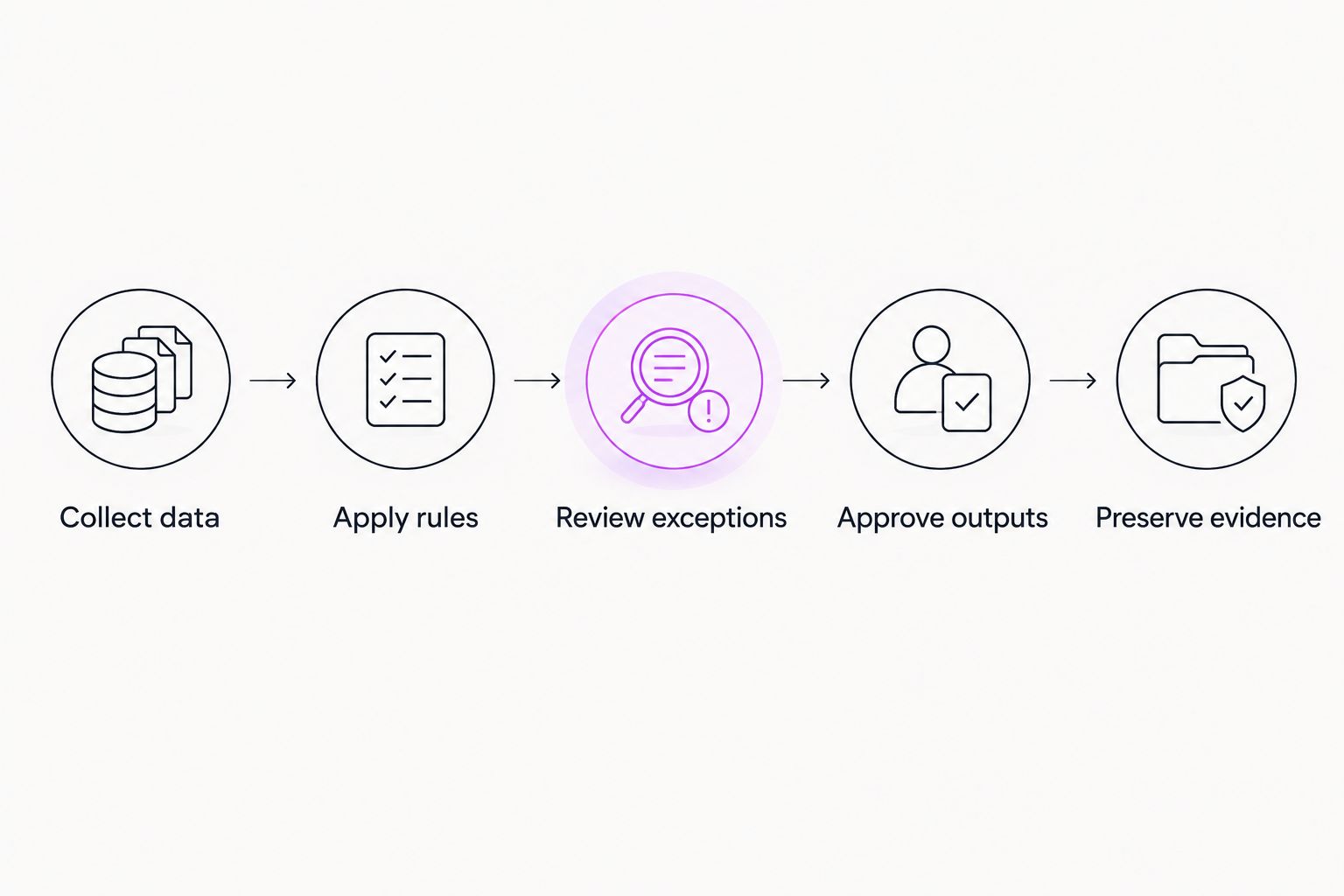
Test the complete reporting process, including exceptions and approvals.
Repeatability is the acceptance condition. A corrected source record should produce an explainable change, and the team should know whether that change requires renewed review before reporting or billing.
How we ranked these tools
This ranking uses workflow fit, reporting scope, reconciliation capability, and the distinction between enterprise SAM and service-provider operations. It does not assign unsupported completion rates, savings estimates, or implementation times.
The 2026 order prioritizes SPLA provider requirements. Service-management integration, enterprise license management, centralized reconciliation, and endpoint administration each receive a separate recommendation because they solve different problems.
Which software asset management tool should you choose?
Start with the tool whose operating model matches the output you must produce. SPLA reporting and customer billing call for a different evaluation from internal enterprise entitlement management.
Choose the service-provider-focused option for provider reporting. Choose ServiceNow Software Asset Management for connected service-management processes, Flexera One IT Asset Management for broad enterprise licensing, or USU Software Asset Management for centralized reconciliation. Choose Microsoft Intune when endpoint application administration is the actual requirement.
For your 2026 decision, reject any demonstration that stops at discovered installations. Require the reporting output, the exception path, and the supporting evidence before approving the purchase.
FAQ
What's the best software asset management tool for SPLA automation?
Octopus is the best fit in this comparison for SPLA providers seeking automated usage reporting and customer billing. Validate its fit with your customer data, reporting requirements, and approval process before selecting it.
How should software asset management tools be ranked by automation?
Rank software asset management tools by the complete workflow they automate, not their feature count. Check collection, reconciliation, exceptions, approvals, reporting, and evidence traceability against your operating model.
Is Microsoft Intune a complete software asset management tool?
Microsoft Intune is an endpoint and application management platform, not a substitute for complete software license reconciliation. Its inventory can support SAM processes, but inventory alone does not establish contractual compliance.
Is ServiceNow better than Flexera for SAM automation?
ServiceNow Software Asset Management is the stronger fit here for service-management integration; Flexera One IT Asset Management is recommended for broad enterprise license management. Select between them using your required workflows and representative data rather than a universal automation score.
Can a SAM platform automate every licensing decision?
Do not assume a SAM platform automates every licensing decision. Require the vendor to identify supported calculations, required inputs, contractual interpretation points, and human approval responsibilities.
What should I ask for in a SAM automation demonstration?
Ask for a complete workflow using representative data, including an incomplete record and a corrected input. Inspect the resulting calculation, exception handling, approval, and evidence trail.
Does automated software discovery prove licensing compliance?
Automated software discovery does not prove licensing compliance. A defensible position also requires relevant entitlements, applicable licensing rules, accurate scope, and documented review.
One last thing
The most useful demonstration includes a deliberate error. Ask the vendor to assign a usage record to the wrong customer, correct it, and show what changes in the reporting output and review history.
A clean dashboard shows the result. An explainable correction shows whether your team can control the process.