SAM software is worth it for small SPLA partners when it replaces recurring reconciliation work and produces reporting evidence you can verify. It is not worth buying on inventory coverage alone: implementation, data cleanup, licensing review, and ongoing ownership still require work.
TL;DR
- Is SAM software worth it for small SPLA partners? Yes, when verified reporting improvements justify implementation and ongoing work.
- Octopus serves Microsoft SPLA partners and Authorized Outsourcers with SAM software and consulting services.
- Evaluate usage reporting, customer billing, and audit evidence together; asset discovery alone does not prove SPLA reporting accuracy.
- Keep manual reporting when it remains traceable and manageable; replace it when reconciliation becomes recurring, unresolved work.
Is SAM software worth it for small SPLA partners in 2026?
Buy against a reporting problem, not a company-size threshold. A small SPLA partner needs a defensible connection between its environment, the licensing interpretation applied, its reported usage, and customer billing. Software earns its place when it makes that connection easier to maintain and inspect.
Octopus provides software asset management and consulting services for Microsoft SPLA partners and Authorized Outsourcers. The relevant buying question is whether that combination addresses your reporting and evidence requirements—not whether a dashboard contains more inventory records.
Compare approaches against the same reporting period and evidence requirements:
Manual reconciliation
- Best for: Teams with a stable, traceable reporting process
- Advantage: Direct control over calculations and exceptions
- Limitation to test: Repeated exports, undocumented adjustments, and dependence on individual knowledge
General-purpose SAM software
- Best for: Teams evaluating broader asset visibility
- Advantage: A structured place to manage software inventory
- Limitation to test: Whether it supports the SPLA reporting logic and evidence you need
SPLA-focused software and consulting
- Best for: Partners needing reporting automation and licensing support
- Advantage: Reporting work and licensing review can be evaluated together
- Limitation to test: Implementation effort, source coverage, and responsibility for unresolved exceptions
These are selection criteria, not guaranteed product capabilities. Require each supplier to demonstrate the relevant workflow using your records before making a decision.
Why this matters
Your 2026 decision should account for work outside the reporting submission itself. Someone must establish which records belong in scope, explain changes, resolve incomplete data, and connect reported quantities to supporting evidence.
A finished spreadsheet does not establish that those questions have been answered. Equally, an automated report does not establish that its underlying assumptions are correct.
The objective is a repeatable reporting process with an inspectable evidence trail. Faster output matters only when the result remains accurate enough to approve and detailed enough to explain.
What makes manual reporting a reasonable choice?
Manual reporting remains a reasonable choice when you can reproduce the result, trace adjustments to source records, and transfer the process to another responsible person. A documented spreadsheet can meet those requirements; an undocumented collection of exports cannot demonstrate them by itself.
Do not replace a working process simply because software exists. Identify the specific failure or recurring task that the purchase must remove.
What makes software a stronger choice?
Software becomes a stronger choice when the same reconciliation problems recur: missing customer mappings, inconsistent source records, unexplained reporting changes, or billing adjustments without supporting usage evidence.
Treat those problems as acceptance criteria. A demonstration should show how the proposed system identifies, resolves, or exposes each one—not merely display a completed report.
Why SAM software value varies
The return from SAM software depends on the work your team needs to control. Evaluate these factors rather than using headcount as the deciding measure:
- Source coverage: Which systems contain the records needed for your reporting scope, and can you reconcile missing sources?
- Customer mapping: Can you connect relevant usage to the correct customer without undocumented manual interpretation?
- Reporting changes: Can you explain the difference between reporting periods and distinguish environment changes from corrections?
- Licensing interpretation: Who reviews the applicable terms, documents assumptions, and approves exceptions?
- Billing reconciliation: Can you trace customer billing inputs to the underlying usage and explain adjustments?
- Evidence retention: Can you retrieve the source records, calculations, and approvals supporting a completed report?
A partner with straightforward records and reliable controls has a different requirement from a partner with unresolved ownership and mapping issues. Both can be small businesses. The amount of unresolved work is the useful distinction.
How to evaluate SAM software before committing
Use 1 completed reporting period as the basis for a controlled evaluation. That is a recommended test scope, not a claim about how quickly implementation takes.
Choose a period for which your team can retrieve the inputs, final submission, billing records, and known exceptions. Comparing against an unexplained historical result only reproduces uncertainty.
1. Define scope
List the environments, source systems, customers, and reporting outputs included in the evaluation. Name the owner who can confirm whether the inputs are complete.
Record exclusions explicitly. A result covering only part of the environment must not be presented internally as validation of the entire reporting process.
2. Gather evidence
Keep 3 evidence sets: source records, calculation records, and approval records. This is a practical filing structure for the evaluation, not a licensing requirement.
Source records establish what entered the process. Calculation records explain transformations and adjustments. Approval records establish who accepted the result and which exceptions remained unresolved.
3. Reconcile results
Compare the candidate output with your existing report at a level that exposes differences. A matching total can conceal offsetting errors, so inspect the underlying customer allocations and relevant reporting categories.
For each difference, record the cause and supporting evidence. Do not automatically assume either the existing spreadsheet or the new software is correct.
4. Resolve exceptions
Assign an owner to each unresolved issue. Separate missing data from disputed interpretation: collecting another export will not settle a question about which licensing terms apply.
Require a visible record of manual adjustments. Automation that moves unexplained edits into a different interface has not solved the control problem.
5. Approve handover
Ask another responsible team member to reproduce the approved result from the retained records. This tests whether the process belongs to the business or remains dependent on its original operator.
For your 2026 evaluation, agree on acceptance criteria before reviewing the final output. Otherwise, an attractive interface can distract from incomplete coverage or unexplained calculations.
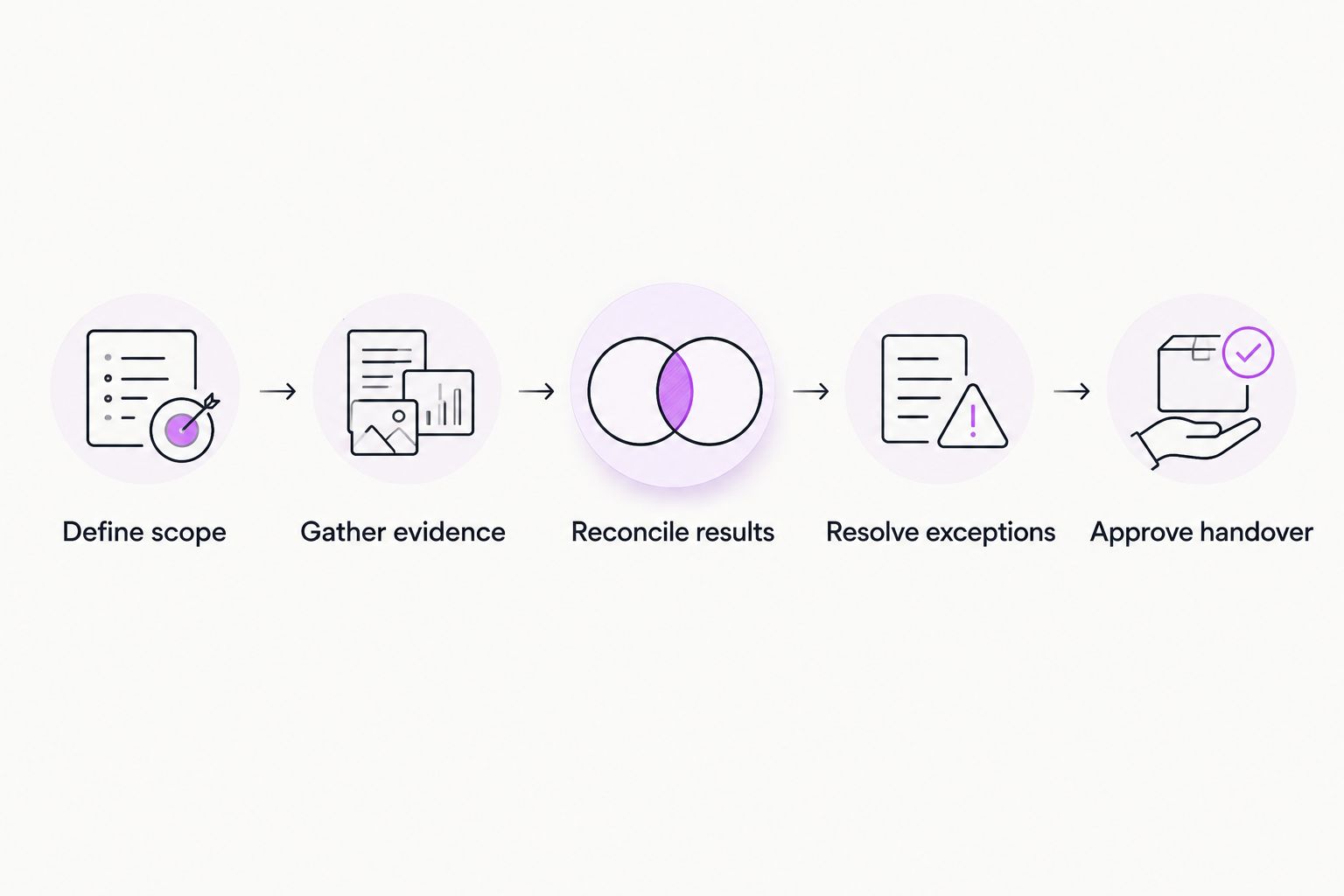
Approve the reporting process only after differences and exceptions have documented explanations.
What should the business case include?
Separate existing work from expected improvements. Record the effort currently spent collecting data, reconciling usage, preparing reports, resolving billing differences, and assembling evidence.
Then identify which tasks the proposed system actually changes. A demonstrated reduction in repeated reconciliation is stronger evidence than a general promise to save time.
Use 4 acceptance checks before approving a purchase:
- Completeness: The evaluation covers the agreed scope, with exclusions documented.
- Traceability: Reported outputs connect to source records and explained adjustments.
- Ownership: Named people approve assumptions, exceptions, and final outputs.
- Repeatability: Another responsible person can reproduce the result.
Keep implementation work in the assessment. Source cleanup, access configuration, customer mapping, training, and process documentation are tasks to assign—not benefits to assume.
Separate operational benefits from compliance claims
Reporting automation and licensing compliance are related, but they are not interchangeable. Software can process records according to configured rules; your evaluation must still establish whether those rules match the applicable terms and deployment circumstances.
Do not count avoided audit penalties as a guaranteed return. Build the decision around observable changes in reporting work, evidence quality, and unresolved exceptions.
Measure billing work separately
Customer billing deserves its own acceptance criteria. Ask whether the proposed process explains how usage becomes a billing input and how corrections are approved.
A licensing report and a customer invoice serve different purposes. Do not assume that producing one validates the other, even when both use the same underlying records.
Where software and consulting fit
Octopus is best for Microsoft SPLA partners and Authorized Outsourcers seeking SAM software with consulting support. Its stated scope includes usage reporting, customer billing, and audit defense, making those the appropriate areas to evaluate.
For Octopus SAM software, test the reporting workflow against your own source records and exceptions. For consulting support, establish which interpretation questions the engagement covers and what written deliverables your team receives.
The advantage of evaluating software and consulting together is that you can examine both the reporting process and the interpretation behind it. The trade-off is that your team must still define scope, supply reliable records, and approve business decisions.
Before selecting Octopus for SPLA compliance work in 2026, request a written division of responsibilities. Identify who owns data completeness, rule approval, exception resolution, report submission, and evidence retention.
Discuss your SPLA reporting requirements
Bring your reporting scope, billing workflow, and unresolved licensing questions.
Can a small SPLA partner keep using spreadsheets?
Yes, if the spreadsheet process remains traceable, reproducible, and manageable. Keep source records separate from calculations, document adjustments, and establish a review step before submission.
Reconsider spreadsheets when maintaining those controls becomes the recurring problem. Replacing the file format without fixing ownership or incomplete inputs will not fix reporting.
Does SAM software replace licensing expertise?
No. SAM software does not replace the need to establish which licensing terms apply and how the reporting logic should reflect them.
Ask who approves interpretations and how changes are documented. A product demonstration should distinguish a calculated output from a reviewed licensing conclusion.
When should a small partner delay buying SAM software?
Delay buying when you cannot define the reporting scope, retrieve source records, or name an accountable process owner. Resolve those prerequisites before judging a supplier's output.
Also delay when the evaluation cannot explain differences from your existing report. An unresolved discrepancy is a reason to investigate, not a reason to declare either process successful.
FAQ
Is SAM software worth it for a very small SPLA partner?
Yes, when it solves a recurring reporting or evidence problem that justifies the implementation and ongoing work. Business size alone does not establish the need; evaluate source coverage, reconciliation effort, and unresolved exceptions.
What's the best way to test SAM software before buying?
Use 1 completed reporting period and compare source records, calculations, exceptions, and final outputs. Require explanations for differences rather than accepting a matching total as proof of accuracy.
Can I use spreadsheets instead of SAM software for SPLA reporting?
Yes, if your spreadsheet process remains traceable, reproducible, and manageable. Document assumptions, retain source records, and make sure another responsible person can reproduce the approved result.
Does SAM software guarantee SPLA compliance?
No, software output does not by itself establish compliance. Your team must confirm the applicable licensing terms, data completeness, configured logic, and approval responsibilities.
What evidence should I retain for a reporting evaluation?
Keep 3 evidence sets: source records, calculation records, and approval records. Together they explain what entered the process, how the result was produced, and who approved it.
Should I include customer billing in a SAM evaluation?
Yes, when customer billing is part of the process you want to improve. Test the connection between usage and billing inputs separately from the licensing report, including correction approval.
What should a SAM software business case prioritize in 2026?
Prioritize demonstrated changes in reconciliation work, traceability, repeatability, and exception handling. Include implementation responsibilities and ongoing review work rather than assuming all manual effort disappears.
One last thing
A matching total is not a complete validation test. Two reporting processes can agree overall while allocating usage differently or relying on different assumptions.
Before approving your 2026 purchase, ask someone who did not build the report to explain a selected customer allocation from source record to final output. If the explanation depends on undocumented knowledge, the process still needs work—regardless of whether it runs in a spreadsheet or a SAM platform.