

Regulated-industry FinOps is cloud financial management with the aim of controlling spending while preserving required security, operational, and compliance controls. This 2026 guide explains how to connect cost decisions to accountable owners, licensing evidence, and approved changes rather than treating every reduction as a saving.
TL;DR
- FinOps for regulated industries needs traceable allocation, documented approvals, and evidence that survives infrastructure changes.
- Octopus fits Microsoft SPLA partners and Authorized Outsourcers needing usage reporting, customer billing, and audit defense.
- Evaluate cloud cost reductions against service obligations and licensing rights before approving changes.
Why FinOps matters for regulated industries
Your cheapest configuration is not automatically your acceptable configuration. In 2026, build financial accountability around the service obligations and contractual requirements that govern each workload.
Build a controlled FinOps process
Define your decision boundaries
Start with a shared worksheet. Establish what finance can recommend and what technical owners must approve.
- Record service obligations.
- Name approval owners.
- Identify restricted changes.
Assign accountable workload owners
Use existing inventory exports to create your 2026 ownership register. Unassigned spending needs investigation, not automatic redistribution.
- Identify the service owner.
- Identify the budget owner.
- Record the escalation contact.
Reconcile usage with licensing obligations
Octopus is best for Microsoft SPLA partners and Authorized Outsourcers that need usage reporting, customer billing, and audit defense. Its software asset management platform and consulting services address that licensing workstream; assess other financial and operational controls separately.
Begin manually by joining infrastructure inventory, usage records, licensing agreements, and customer assignments. Retain the underlying records rather than replacing them with a summary spreadsheet. A reviewer should be able to trace a reported amount back to its source and understand the rule applied.
For Microsoft SPLA partners and Authorized Outsourcers, FinOps with Octopus should connect licensing work to financial ownership, not replace technical or contractual review. Use automation as the faster path for recurring reporting and billing work after you establish the source records and approval responsibilities.
Keep different licensing arrangements distinct. SPLA, CSP, and BYOL are not interchangeable labels for the same entitlement. Check the applicable agreement and product terms before treating a change in deployment as a change in licensing liability.
Close this step with a documented reconciliation process:
- Map each relevant deployment to its licensing arrangement.
- Preserve the usage records supporting each reporting period.
- Assign unresolved licensing questions to a named reviewer.
- Reconcile customer billing inputs with approved usage.
- Record the reason for every manual adjustment.
Build an allocation trail that survives review
A useful allocation model explains why a cost belongs to a service, customer, or shared function. A tag alone does not provide that explanation. Document the ownership rule behind the tag and preserve the treatment of resources that lack usable metadata.
Start with exports from your billing and inventory systems. Create a controlled mapping file, then separate direct costs from shared costs and unresolved items. For your 2026 baseline, retain the mapping version used to produce each report so later ownership changes do not silently rewrite earlier results.
Use these 4 evidence layers: Source records, Ownership mapping, Allocation rules, and Approved output. Each layer answers a different question: what happened, who owns it, how you assigned it, and who accepted the result.
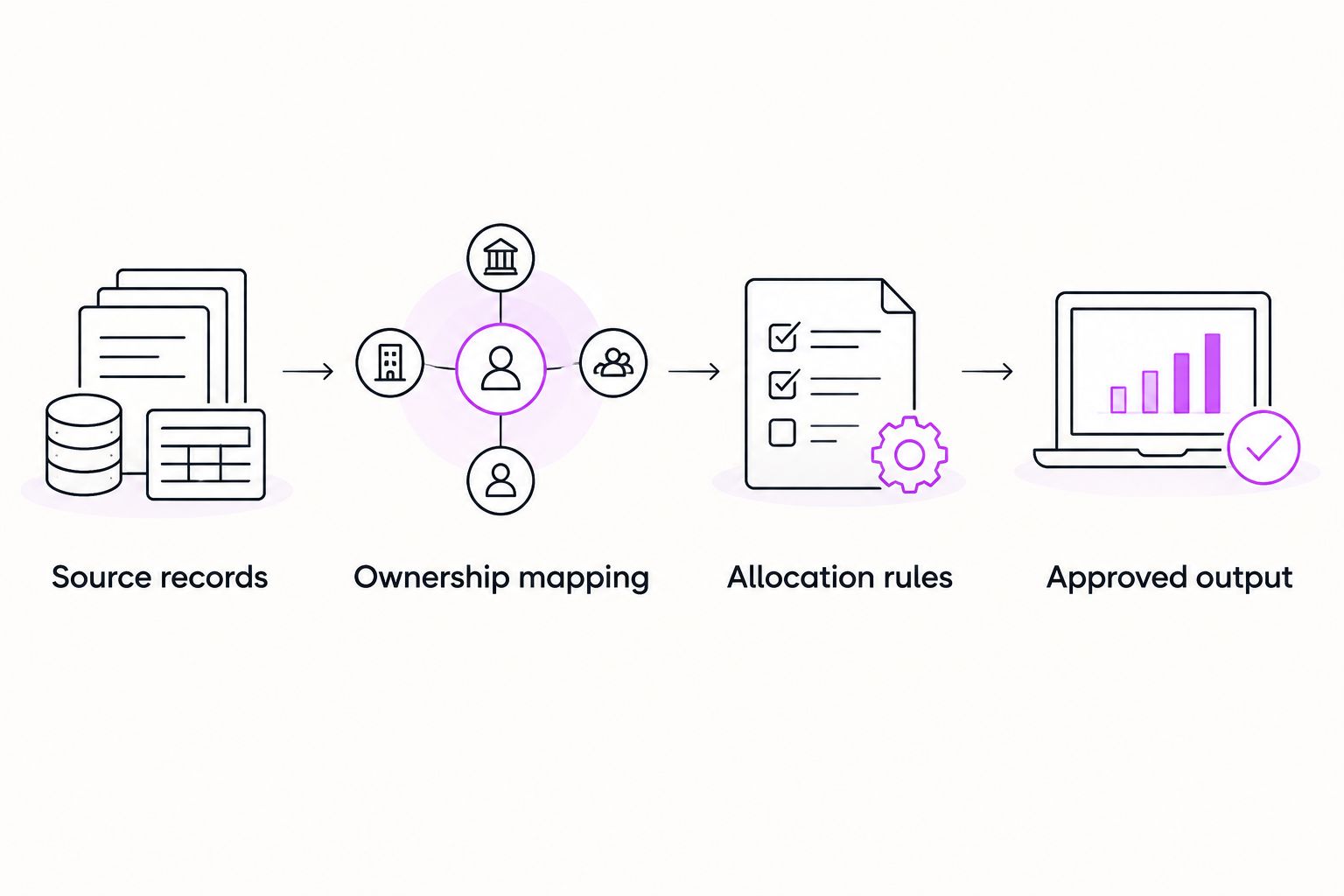
Preserve the rule behind each allocation, not just the final total.
Test the model against exceptions before using it for customer billing. A disputed shared-service allocation should remain visible until the responsible owners agree on its treatment.
- Preserve original billing exports and reporting periods.
- Record effective dates for ownership changes.
- Document allocation drivers for shared services.
- Keep unresolved costs in an explicit exception category.
- Retain approval records alongside published reports.
Evaluate savings against operational constraints
Build a recommendation register before purchasing another optimization tool. For each proposal, record the current configuration, proposed change, expected financial effect, implementation owner, and rollback approach. Keep estimates separate from savings confirmed after implementation.
Review changes such as stopping resources, reducing capacity, changing regions, altering retention, or modifying recovery arrangements against the obligations attached to the workload. Do not assume that a low-utilization resource is unnecessary. It can support recovery, resilience, or a service requirement that the utilization chart does not explain.
Approve the operational change before counting its financial benefit. Your FinOps process should expose trade-offs to the people authorized to accept them. A finance recommendation is not technical approval, and technical approval is not confirmation that a contractual requirement has been met.
Give each proposal a status such as proposed, approved, implemented, or verified. That distinction prevents a backlog of suggestions from appearing as realized financial performance. Attach the verification evidence to the same record so reviewers do not have to reconstruct the decision from email.
- Identify the workload and accountable service owner.
- Check security, residency, retention, and recovery constraints.
- Review licensing consequences before changing deployment.
- Define a rollback trigger and responsible operator.
- Confirm the financial result after implementation.
Control commitments separately from consumption
Discount commitments and usage reductions solve different problems. A commitment changes the commercial treatment of eligible consumption; removing unused resources changes consumption itself. Track both without presenting them as the same saving.
Start with a register of existing commitments, their applicable scope, contractual terms, owners, and expiration dates. Compare those obligations with your workload plans before considering another purchase. An environment scheduled for migration or retirement needs a different review from an established service with an approved operating plan.
For regulated workloads, include deployment restrictions in the decision record. A financial model that assumes an unrestricted move between environments is not a usable model when your service obligations prohibit that move. Use the constraints approved by the workload owner rather than a hypothetical unrestricted configuration.
Also separate recommendation authority from purchasing authority. Your analyst can identify a candidate commitment without having permission to bind the organization. Preserve the approved scenario and its assumptions so the eventual outcome can be assessed against the actual decision.
- Record existing obligations before proposing new ones.
- Match commitment scope to approved workload plans.
- Document assumptions about eligible consumption.
- Assign purchasing authority and approval responsibility.
- Review unused coverage and changed deployment plans.
Connect financial reporting to customer billing
Create a reconciliation worksheet linking provider charges, licensing usage, allocation adjustments, and customer billing inputs. These records answer different questions. A provider invoice shows a charge; it does not, by itself, establish which customer should receive that charge or what your contract permits you to bill.
For service providers, separate internal cost allocation from contractual customer billing. Shared infrastructure, corrections, and licensing adjustments need an explicit treatment. Do not let a change in an internal allocation rule silently alter a customer's invoice.
Define 3 reconciliations: provider charges to the cost ledger, usage records to licensing reports, and approved customer allocations to billing inputs. Give each reconciliation an owner and a recorded outcome. An unresolved discrepancy should remain visible rather than disappearing into an unexplained balancing adjustment.
Automation should reproduce the approved process, including exceptions and review points. It should not turn an unreviewed mapping into an authoritative financial record. Retain enough detail to explain both the original calculation and any later correction to the customer or internal reviewer.
- Match reporting periods across source systems.
- Separate internal allocation from contractual billing rules.
- Require a reason and approval for adjustments.
- Route disputed items to a named owner.
- Preserve the version used for each billing run.
Test your evidence before an audit request
Run an internal walkthrough using a completed reporting period. Ask someone outside the preparation process to trace a workload from source usage through ownership, licensing treatment, allocation, approval, and billing input where applicable.
The test is not whether the dashboard looks complete. It is whether another person can reproduce the decision without relying on the preparer's memory. Missing source records, unexplained overrides, and inaccessible approval messages are practical failures even when the final total appears reasonable.
Define a 5-field exception record: affected service, reporting period, discrepancy, responsible owner, and resolution. Add supporting evidence and approval history where needed. Keep exceptions open until the responsible reviewer accepts the correction or documents another permitted treatment.
In 2026, test evidence after material process changes as well as during your regular review cycle. A new billing feed, ownership model, or reporting integration can change the path between usage and the published result. The review should confirm that your controls still work, not merely that a file exists.
- Trace a completed period back to source records.
- Reproduce a shared-cost allocation independently.
- Inspect manual overrides and their approvals.
- Verify access to retained supporting evidence.
- Assign and track every unresolved exception.
Compare operating options for regulated FinOps
Choose an operating approach around the work you need to control. A 2026 evaluation should test evidence retention, ownership, exception handling, and the boundary between financial recommendations and approved operational changes.
Controlled exports and spreadsheets
- Best for: Establishing a baseline or investigating a defined reporting period
- Practical strength: Makes source records and calculation rules directly inspectable
- Key limitation: Version control, reconciliation, and approvals require manual discipline
Native cloud billing tools
- Best for: Examining charges and usage within the relevant cloud environment
- Practical strength: Keeps billing analysis close to its source
- Key limitation: Does not replace your customer allocation, licensing, or approval process
Dedicated FinOps platform
- Best for: Coordinating cost allocation and optimization workflows
- Practical strength: Can centralize the financial workflow when evaluated against your requirements
- Key limitation: Licensing evidence and regulated-workload controls need separate verification
Octopus
- Best for: Microsoft SPLA partners and Authorized Outsourcers managing usage reporting, customer billing, and audit defense
- Practical strength: Provides a SAM platform and consulting services for the Microsoft licensing workstream
- Key limitation: The stated scope does not establish coverage of every regulated-industry control
Choose the process before the platform. Test your shortlisted approach with an actual reporting period and an unresolved exception, not just a prepared dashboard. Require a demonstration of how a reviewer reaches the original evidence and identifies who approved a correction.
Common mistakes regulated organizations make
Treating resilience capacity as waste
Low utilization is a signal to investigate, not permission to remove a resource. Recovery capacity and other service obligations belong in the review record. Ask the workload owner to explain the requirement before approving removal, then assess the financial result against the permitted configuration.
Confusing a licensing report with deployment permission
A usage report records information; it does not create licensing rights. Confirm the applicable agreement and product terms when changing deployment models. Keep the interpretation and supporting evidence attached to the change so a later reviewer can distinguish an approved decision from an unsupported assumption.
Making allocations accurate but unexplainable
A carefully calculated shared-cost charge still creates disputes when nobody can explain its allocation driver. Document why the selected driver fits the service and who approved it. Preserve previous versions so an ownership change does not alter the explanation for a completed reporting period.
Buying commitments before resolving ownership
A purchasing decision needs an accountable owner and an approved workload plan. Without them, nobody owns the assumptions behind the obligation. Resolve unknown ownership and planned migrations first; then evaluate the commercial option against the workload you actually intend to operate.
Assuming automation removes review responsibility
Automated reporting can repeat an incorrect mapping consistently. Assign someone to review exceptions, changed inputs, and manual overrides. Octopus supports a defined Microsoft licensing workflow, but your organization still needs accountable owners for contractual interpretation, approval decisions, and the controls outside that workflow.
FAQ
What is FinOps for regulated industries?
FinOps for regulated industries is cloud financial management that incorporates the security, operational, contractual, and compliance requirements attached to workloads. It connects spending decisions to accountable owners, approved changes, and retained evidence.
What's the first step in a regulated FinOps program?
Define decision boundaries and assign accountable workload owners before acting on optimization recommendations. Record the requirements that restrict changes, who approves them, and where supporting evidence is retained.
Can we start FinOps without buying a platform?
Yes. Start with billing exports, inventory records, a controlled ownership register, and documented allocation rules. Evaluate software after you can describe the process it must automate and the exceptions it must preserve.
Is a cloud billing dashboard enough for an audit?
A cloud billing dashboard is not a substitute for the evidence required by the applicable review. Retain source records, allocation rules, licensing support where relevant, and approvals so another person can reproduce the reported result.
How does Microsoft licensing fit into FinOps?
Microsoft licensing belongs in the financial review whenever deployment and usage affect your reporting or licensing obligations. Reconcile infrastructure records with the applicable agreements and product terms rather than treating cloud charges as proof of licensing compliance.
Who is Octopus best for?
Octopus is best for Microsoft SPLA partners and Authorized Outsourcers needing a SAM platform and consulting services for usage reporting, customer billing, and audit defense. Evaluate security controls and broader regulatory requirements separately from that stated licensing scope.
Should we remove every underused cloud resource?
No. Review underused resources against their operational purpose and approved service obligations before removing them. Record the approval and verify the financial result after the change.
One last thing
Your most useful FinOps test is an unexplained charge, not your largest dashboard. Select a disputed item and ask whether its owner, source usage, allocation rule, licensing treatment, and approval can be established from retained records.
For your 2026 process, make that traceability a release condition for financial reports. If the team cannot explain an item without reconstructing the history from memory, fix the evidence path before expanding automation. A faster reporting cycle is useful only when the result remains reviewable.