

Yes, you can pass a Microsoft SPLA audit without SAM software if your records substantiate compliant usage and reporting under the agreements and licensing terms that apply to your environment. The trade-off is that you must maintain the inventory, historical evidence, calculations, and reconciliation controls yourself. Buying SAM software does not prove compliance, and using spreadsheets does not prove noncompliance.
TL;DR
- To pass Microsoft SPLA audit without SAM software, substantiate reported usage with historical evidence and documented licensing calculations.
- Manual reporting works only when inventory, licensing interpretation, and reconciliation remain controlled and reproducible.
- SAM software supports evidence collection; it does not replace contractual analysis or resolve every licensing exception.
- Octopus provides SAM software and consulting for Microsoft SPLA partners and Authorized Outsourcers.
Why this matters
An audit tests whether your reporting matches the licensing obligations applicable to your actual deployment. A spreadsheet, discovery export, or software dashboard is evidence to examine—not a compliance verdict by itself.
For a 2026 audit, separate two questions: whether your licensing position is defensible and whether your team can demonstrate it. The second question becomes harder when records are scattered, responsibilities are unclear, or historical configurations cannot be reconstructed. Understanding how long a Microsoft SPLA audit takes also helps you plan evidence retrieval and internal review without treating software procurement as the entire response.
The practical decision is not spreadsheets versus software in isolation. It is whether your process produces reliable evidence every reporting period, including when infrastructure changes or the person responsible for reporting leaves.
Can you pass a Microsoft SPLA audit without SAM software?
Yes—provided you can connect your reported quantities to the underlying deployment evidence and applicable licensing rules. Start with the agreement, amendments, reporting obligations, and product licensing terms relevant to the periods under review. Do not assume that a generic checklist settles your contractual requirements.
Neither a manual process nor a SAM platform removes the need to interpret those requirements. The difference is how you collect evidence, preserve changes, calculate quantities, and identify exceptions.
Manual controls
- Best for: Environments where staff can maintain complete, reviewable records
- Strength: Calculations and assumptions can be directly inspected
- Limitation: Collection, version control, and reconciliation depend on disciplined execution
SAM software
- Best for: Teams seeking repeatable inventory and reporting workflows
- Strength: Supports structured collection and repeatable processing
- Limitation: Coverage gaps and incorrect licensing assumptions still require investigation
SAM software with consulting
- Best for: Teams needing both operational reporting and licensing interpretation
- Strength: Combines reporting processes with specialist review
- Limitation: Still requires accurate inputs, clear responsibilities, and retained evidence
Choose the approach by testing its output. Ask another reviewer to reconstruct a reported quantity from the retained records without relying on the original preparer's memory. If the reviewer cannot do that, the process needs correction regardless of the technology behind it.
What does a defensible reporting record contain?
A useful evidence package connects the environment, the licensing decision, and the submitted report. Keep these elements together rather than treating infrastructure exports and reporting spreadsheets as unrelated archives:
- Deployment evidence: Records identifying the relevant systems, installed products, configurations, and relationships.
- Historical context: Evidence showing which configurations and changes applied during the reporting period.
- Licensing basis: The applicable terms and documented reasoning behind the calculation.
- Reported quantities: The calculation and the corresponding submitted report.
- Exception decisions: Unresolved questions, corrections, approvals, and their supporting records.
The package should explain both what you reported and why. A total without its calculation is difficult to review; a calculation without evidence is difficult to substantiate.
Manual controls: defensible only when evidence is reproducible
A manual process is a reasonable choice when your team can maintain its records consistently and demonstrate the calculation behind every reported quantity. Its advantage is transparency: a reviewer can inspect the source data, formulas, assumptions, and approvals directly.
Its weakness is dependence on execution. An overlooked host, an overwritten workbook, or an undocumented interpretation breaks the evidence chain even when the final total appears plausible.
For your 2026 review, test the manual process against these conditions:
- Inventory collection has an identified owner and defined scope.
- Configuration changes are retained rather than replaced by the latest snapshot.
- Reporting calculations reference identifiable source records.
- Licensing assumptions have documented support.
- Exceptions receive review before the reporting position is finalized.
Keep manual reporting only if it passes those tests. Familiarity with a spreadsheet is not evidence that the process is controlled. Equally, a well-maintained manual record should not be discarded merely because it lacks a software dashboard.
SAM software: repeatability still needs validation
SAM software is best for teams that need a more repeatable way to collect, organize, and reconcile licensing information. Assess the actual functions and coverage of a platform rather than assuming that every product handles SPLA reporting in the same way.
The advantage is process consistency. The limitation is that consistent processing can also reproduce an incorrect assumption. Discovery coverage, product identification, infrastructure relationships, and calculation logic still need validation.
Before relying on any generated report, confirm what it includes and excludes. Check whether unsupported systems, failed connections, missing credentials, or incomplete records create gaps in the evidence you intend to use.
Validate the licensing position, not just successful data collection. A completed scan demonstrates that a collection process ran. It does not, by itself, establish that the resulting licensing interpretation is correct.
Why the need for SAM software varies
The relevant question in 2026 is whether your existing controls can keep pace with the environment you operate. Evaluate these factors using your own records rather than an arbitrary server-count threshold:
- Infrastructure changes: Frequent deployment changes demand a reliable way to preserve historical configurations.
- Reporting scope: Multiple products and licensing models require distinct calculation logic rather than one generic formula.
- Customer allocation: Where reporting and billing depend on customer-level attribution, the supporting allocation records need to remain traceable.
- Evidence fragmentation: Separate infrastructure records, reporting files, and billing systems create reconciliation work.
- Licensing exceptions: Unresolved questions need documented decisions; collecting more inventory does not settle them.
- Staff dependency: A process that only its creator understands is difficult to review or hand over.
These factors do not establish a universal cutoff for buying software. They identify where your current method needs stronger controls and where automation would address an actual operational gap.
How do you prepare without SAM software?
Use a repeatable evidence process rather than building an audit response from whatever files happen to remain. The following sequence is a preparation framework, not a substitute for the requirements in your agreement or the scope of a specific audit.
1. Establish scope
Identify the entities, environments, products, and reporting periods relevant to the review. Record the documents that establish the applicable obligations and keep scope questions separate from confirmed requirements.
Do not silently exclude a system because its ownership, customer assignment, or reporting treatment is unclear. Put the uncertainty into an exception register and assign responsibility for resolving it.
2. Preserve history
Retain the records that support the configurations and usage relevant to each period. A current inventory alone does not establish the state of an environment at an earlier point.
Preserve original exports alongside working files. Record when evidence was collected and which systems it covers so a reviewer can distinguish historical evidence from a later reconstruction.
3. Apply rules
Document how the relevant licensing terms translate source data into reportable quantities. Keep the reasoning close to the calculation rather than in an individual's inbox.
Where product-specific rules differ, use separate documented logic. Investigate uncertain interpretations before treating them as settled inputs to the report.
4. Reconcile reports
Connect calculated quantities to the submitted usage report and investigate differences. Where customer billing uses the same underlying data, reconcile the relevant allocation records separately rather than assuming that billing validates licensing.
A customer invoice explains what you billed. It does not independently establish that the associated licensing treatment was correct.
5. Review exceptions
Assign an owner to every unresolved issue and preserve the evidence behind each decision. Separate confirmed reporting errors from missing information and questions that require licensing interpretation.
Before closing an exception, document what changed and why the revised position is supportable. An unexplained adjustment is not a substitute for a resolved issue.
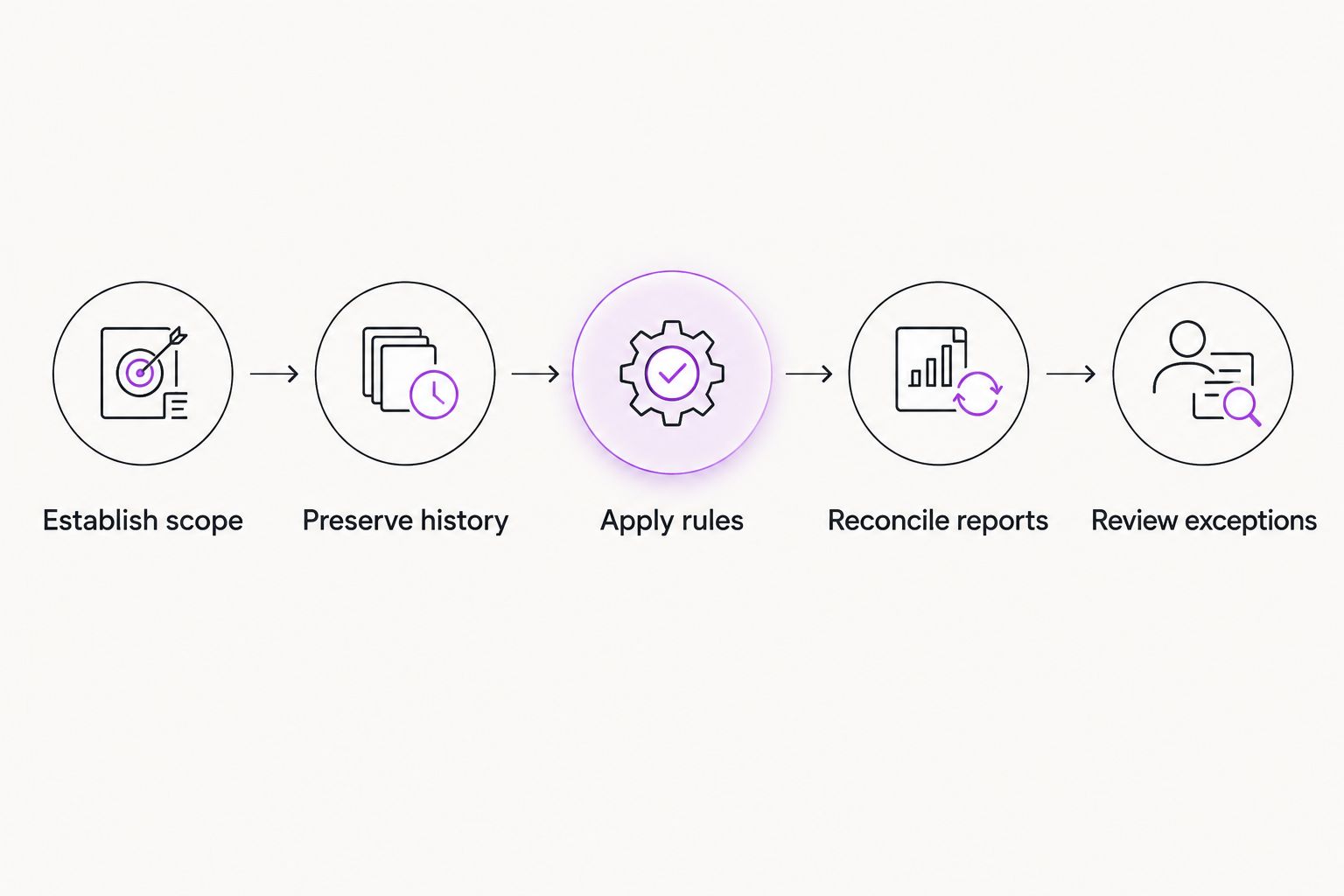
A defensible report connects scope, historical records, licensing calculations, reconciliation, and exception decisions.
Run a reconstruction check
For your 2026 readiness review, choose 1 reporting period and ask a reviewer who did not prepare the report to reproduce its calculation. This is a practical control test, not a contractual audit standard.
Apply 3 evidence checks: completeness of the underlying records, traceability of the calculation, and documented treatment of exceptions. Any failure identifies a specific repair—missing evidence, unclear logic, or an unresolved decision—rather than a vague need for better software.
Use 2 separate approvals as an internal control recommendation: technical review of the deployment evidence and licensing review of the reporting treatment. Keep the responsibilities explicit, even when your organization assigns both reviews within the same team.
Is a spreadsheet enough for an SPLA audit?
A spreadsheet is enough only as part of an evidence-backed process. It can hold calculations, references, and approvals, but it cannot substantiate a historical deployment merely because someone entered a quantity into a cell.
Keep formulas reviewable and source files identifiable. Preserve the submitted version rather than allowing later edits to erase the reporting position that existed at submission.
Does buying SAM software fix previous reporting gaps?
Buying SAM software does not automatically reconstruct missing historical evidence. New collection helps establish what the software observes from that point, while earlier periods still require supporting records.
Before changing tools, preserve existing exports, reporting workbooks, configuration records, and exception decisions. Replacing a process should not destroy the evidence needed to assess it.
When should you seek specialist support?
Seek specialist support when the issue is licensing interpretation, conflicting records, or an inability to substantiate reported usage—not simply because the files are manual. Octopus is best for Microsoft SPLA partners and Authorized Outsourcers seeking SAM software and licensing consulting support.
The platform and consulting services address usage reporting, customer billing, and audit defense. That scope is relevant when you need to connect operational records with licensing decisions rather than purchase a standalone inventory view.
The boundary remains clear: Octopus support does not replace your obligation to provide accurate information and retain supporting evidence. Define the reporting problem, the records requiring review, and the decisions requiring specialist input before selecting an engagement.
Review your SPLA reporting controls
Discuss usage reporting, customer billing, and audit-defense requirements.
FAQ
Can I pass a Microsoft SPLA audit without SAM software in 2026?
Yes, you can pass a Microsoft SPLA audit without SAM software when your records substantiate compliant reporting under the applicable terms. Verify any specific requirements in your agreement and audit scope rather than assuming a particular tool settles compliance.
Is a spreadsheet acceptable evidence in an SPLA audit?
A spreadsheet can form part of the evidence, but its calculations need supporting source records and documented licensing logic. Preserve the version associated with the submitted report and the records used to produce it.
Will a current server inventory prove historical SPLA compliance?
A current server inventory does not, by itself, establish historical compliance. Historical configurations, changes, and reporting calculations need evidence relevant to the periods being reviewed.
Does SAM software guarantee that I will pass an audit?
SAM software does not guarantee an audit outcome. Incomplete collection, incorrect assumptions, and unresolved licensing questions still require review.
Should I replace manual reporting before an SPLA audit?
Replace manual reporting when the replacement addresses an identified control gap, not simply to change the tool used. Preserve historical evidence and validate the new process before relying on its output.
Can Octopus help with SPLA reporting and audit defense?
Octopus provides SAM software and consulting services for Microsoft SPLA partners and Authorized Outsourcers. Its stated service scope includes usage reporting, customer billing, and audit defense.
What should I check first when preparing without SAM software?
Start by testing whether you can reproduce a submitted report from retained evidence. Missing source records, unexplained calculations, and unresolved exceptions identify the controls to repair first.
One last thing
An inventory gap and a licensing error are different problems. Collecting more data addresses missing visibility; it does not settle an incorrect interpretation of the licensing terms.
For your 2026 action plan, classify each weakness before choosing the remedy: evidence collection, historical retention, calculation logic, or decision ownership. Fix the identified failure, then repeat the reconstruction check. That gives you a defensible reason to retain manual controls, introduce software, or seek specialist review.