Yes. SPLA non-compliance can affect customer billing accuracy when incorrect usage records, licensing classifications, or customer assignments feed both reporting and invoicing. The connection is not automatic: an invoice can match your customer contract while the underlying SPLA report remains wrong, so you must reconcile licensing obligations and customer charges separately.
TL;DR
- Can SPLA non-compliance affect customer billing accuracy? Yes, when reporting and invoicing share incorrect usage or customer records.
- A compliant SPLA report does not prove that customer invoices match contracts.
- Octopus supports Microsoft SPLA partners and Authorized Outsourcers with usage reporting, customer billing automation, and audit defense.
- Reconcile usage, licensing treatment, and customer contract terms before approving billing.
Why this matters
A billing correction is not a licensing correction. Changing an invoice does not establish that your SPLA declaration is accurate. Correcting a declaration does not establish that your customer owes an additional charge. Each decision requires its own evidence and approval.
For your 2026 reporting controls, follow the records from infrastructure usage through customer allocation to the invoice. Octopus provides a software asset management platform and consulting services for Microsoft SPLA partners and Authorized Outsourcers. The relevant objective is a traceable connection between usage reporting and customer billing—not an assumption that either process validates the other.
Can SPLA non-compliance affect customer billing accuracy?
SPLA non-compliance affects customer billing when the same error changes both your licensing declaration and the information used to calculate customer charges. An incorrect customer assignment, for example, can put usage on the wrong invoice even when the total usage recorded across your environment is unchanged.
The reverse also matters. An invoice error does not, by itself, prove SPLA non-compliance. Your billing system can apply the wrong commercial terms to correctly classified usage.
Usage omitted from source records
- Licensing question: Does the declaration include all applicable usage?
- Customer billing question: Was contractually billable usage omitted?
Usage assigned to the wrong customer
- Licensing question: Is the reporting population and classification correct?
- Customer billing question: Did the wrong customer receive the charge?
Incorrect licensing classification
- Licensing question: Does the declaration follow the applicable licensing terms?
- Customer billing question: Does that classification affect the contractual billing calculation?
Duplicate usage records
- Licensing question: Was the same usage counted more than once?
- Customer billing question: Was the customer charged more than once?
Incorrect contract mapping
- Licensing question: Does the licensing declaration remain accurate?
- Customer billing question: Did the invoice use the correct customer terms?
Inconsistent reporting boundaries
- Licensing question: Does the declaration cover the required period?
- Customer billing question: Does the invoice cover the contractual billing period?
Use this distinction during incident triage: identify the licensing consequence and the billing consequence independently. Do not label every discrepancy an undercharge, and do not treat every billing dispute as evidence of a licensing breach.
How do you reconcile SPLA reporting with customer invoices?
Build your 2026 reconciliation around a repeatable sequence. The following is a recommended control design, not a statement of mandatory Microsoft procedures.
- Capture usage. Preserve the source records, collection scope, and relevant reporting boundaries. Identify missing or duplicate records before applying licensing or billing logic.
- Assign customers. Connect the recorded usage to the responsible customer and service. Keep unresolved ownership visible rather than assigning it by assumption.
- Apply licensing. Determine the applicable licensing treatment using the governing terms. Record the basis for classifications that affect the declaration.
- Apply contracts. Calculate customer charges using the customer's agreement. Do not substitute the SPLA reporting calculation for the commercial agreement.
- Resolve exceptions. Investigate differences, document decisions, and approve the declaration and billing outputs separately.
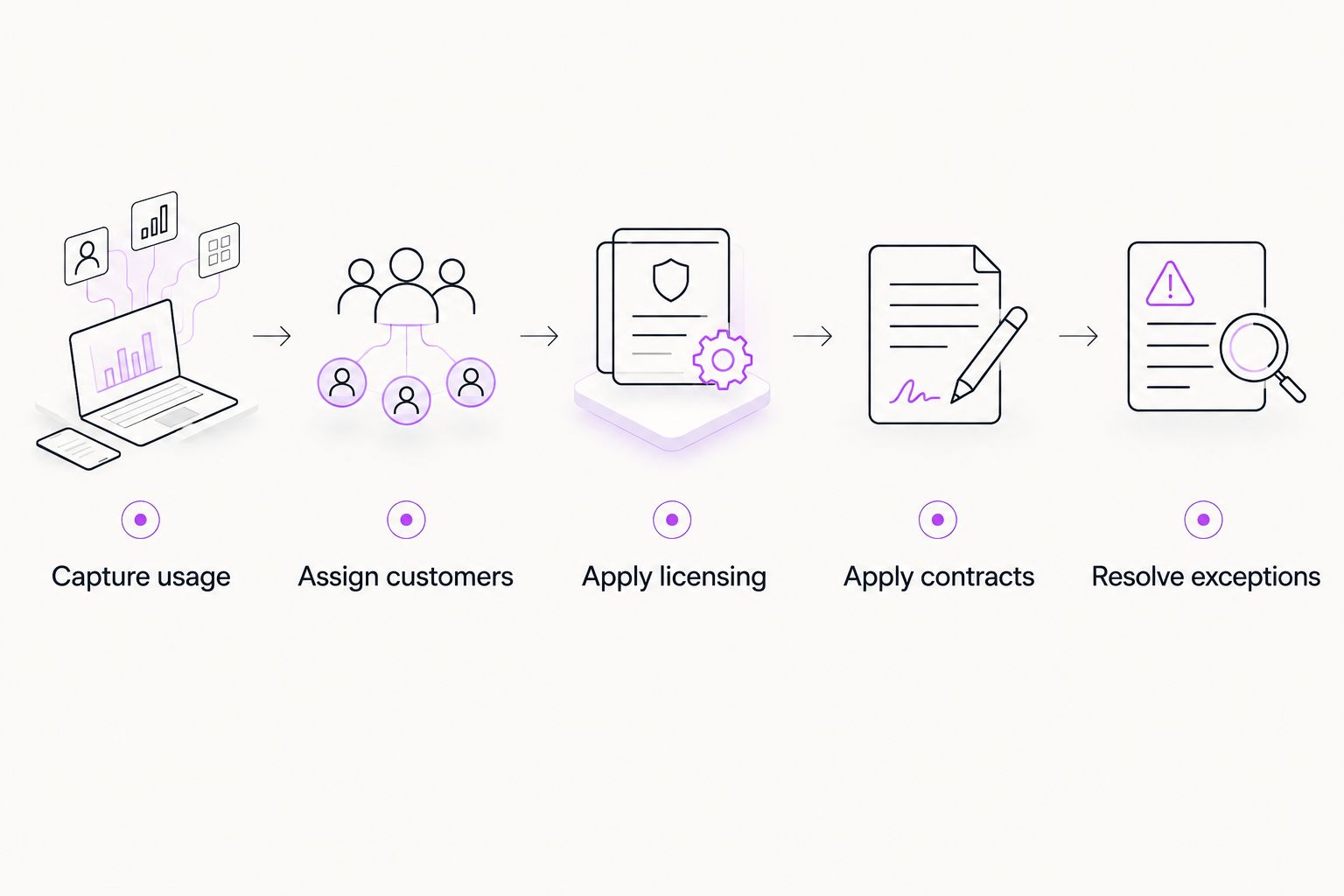
Licensing treatment and customer contract calculations require separate checks.
For each disputed charge, connect 3 records: the usage evidence, the licensing calculation, and the customer billing calculation. Keep the applicable licensing terms and customer agreement attached or referenced. This makes the reasoning inspectable without treating the invoice as proof of usage.
Use 2 approvals in this recommended workflow: one for the licensing declaration and one for customer billing. The approvals address different obligations, even when the same operational team prepares both outputs.
Start an investigation with 1 reporting period so you can establish the cause against a defined scope. Then expand the review wherever the same error affected other records or periods. A narrow starting scope is not permission to leave related errors unresolved.
Why the billing impact of SPLA non-compliance varies
The financial direction of an error depends on the records and agreements involved. Non-compliance does not automatically mean every customer was underbilled, and a corrected licensing position does not automatically authorize a customer charge.
For a 2026 review, assess these factors:
- Customer contract terms. Determine what the customer agreed to pay for and how the agreement defines the billing calculation.
- Customer assignment. Check whether usage belongs to the customer receiving the invoice. Correct totals can still conceal incorrect allocation.
- Licensing classification. Establish whether the licensing error changes an input used in billing or affects only the declaration.
- Reporting boundaries. Compare the usage period, declaration period, and contractual billing period before interpreting a difference.
- Source-record quality. Missing, duplicated, or inconsistent records can affect both processes when both depend on those records.
- Correction history. Check whether an adjustment has already been applied. A second correction can create a new error instead of resolving the original one.
Keep each factor tied to evidence. A general explanation such as inaccurate data is not enough to approve a corrected declaration or an invoice adjustment.
Can a correct customer invoice still hide SPLA non-compliance?
Yes. A customer invoice can match the agreed commercial terms while the associated SPLA declaration contains an error. Customer billing accuracy tests your calculation against the customer agreement; licensing compliance tests your declaration and usage against the applicable licensing obligations.
For example, a customer agreement can define charges independently of the particular licensing classification used in your declaration. In that situation, correcting the classification does not establish that the invoice needs to change.
Validate both outputs against their own rules. A signed billing approval should not serve as a substitute for licensing review. Likewise, an approved declaration should not bypass checks on customer ownership, contractual terms, or previously applied adjustments.
This separation also improves escalation. Your licensing reviewer needs the usage and classification evidence. Your billing reviewer needs the customer agreement and charge calculation. Both need access to the same underlying incident record so their corrections do not conflict.
Should you automatically bill customers after finding underreported usage?
- Underreported usage establishes a reporting issue to investigate; it does not establish your contractual right to issue an additional customer charge. Check the customer's agreement, the usage attribution, the affected period, and any previous adjustment before making a billing decision.
Keep licensing remediation and customer recovery as separate workstreams. Correct the licensing position according to the applicable obligations. Decide customer treatment according to the contract and the approved resolution process.
Before approving a billing adjustment, document:
- The specific usage records supporting the adjustment.
- The customer and service responsible for that usage.
- The contract provision supporting the calculation.
- The affected billing period and any adjustment already recorded.
- The person approving the correction and its explanation.
A customer-facing explanation should describe the actual billing discrepancy. Avoid using a general reference to licensing compliance as a substitute for an itemized, contract-supported calculation.
What should automation do—and what still needs review?
Automation belongs where records must move consistently between usage reporting and customer billing. It does not remove the need to establish the correct licensing interpretation or customer contract treatment.
Octopus is built for Microsoft SPLA partners and Authorized Outsourcers that need usage reporting and customer billing automation. Its software asset management platform and consulting services also support audit defense. Those capabilities are relevant when reporting and billing need to be investigated together rather than corrected in isolation.
The benefit is a connected operational scope: usage reporting, customer billing, and licensing compliance. The limitation is equally important: automation cannot make an incorrect customer assignment or an unsupported contract interpretation correct. Your review process must address those decisions before treating an output as approved.
When assessing your 2026 workflow, ask who owns licensing classifications, customer mappings, contract interpretation, and exception approval. Assign responsibility explicitly. Buying software without assigning those decisions leaves the reconciliation process incomplete.
Review your SPLA billing controls
Discuss usage reporting, customer billing, and licensing compliance with Octopus.
What evidence should you retain for a billing correction?
Retain enough evidence for another reviewer to reproduce the decision. A final invoice alone shows the result, not why the result is correct.
Your correction record should include the original usage evidence, the customer assignment, the applicable licensing treatment, the relevant customer agreement, and the calculation before and after correction. Preserve the reason for the change and its approval. Follow the applicable contractual, legal, and organizational retention requirements rather than inventing a universal retention period.
For the 2026 control review, test whether a reviewer can trace a corrected invoice back to the original records without relying on an undocumented explanation. If the calculation depends on a spreadsheet override, record the reason and the supporting evidence.
Do not overwrite the original error without preserving a correction trail. Keeping the original record and the approved adjustment distinct helps reviewers understand what changed and prevents the correction from being mistaken for newly recorded usage.
FAQ
Can SPLA non-compliance affect customer billing accuracy?
Yes. SPLA non-compliance can affect customer billing accuracy when incorrect usage, classification, or customer assignments feed both reporting and invoicing. Review the licensing declaration and customer calculation separately.
Does SPLA underreporting always mean customers were underbilled?
No. SPLA underreporting does not automatically establish customer underbilling because customer charges depend on the applicable customer agreement. Confirm whether the reporting error changed a contractual billing input.
Can a customer invoice be correct if the SPLA report is wrong?
Yes. A customer invoice can match the customer agreement while the SPLA declaration contains an error. Correct billing does not prove licensing compliance.
Should I charge customers immediately after discovering unreported usage?
No. Verify customer ownership, contractual billing rights, the affected period, and previous adjustments before approving an additional charge. Handle the licensing correction separately.
What records should support a SPLA-related billing correction?
Connect 3 records: the usage evidence, the licensing calculation, and the customer billing calculation. Reference the applicable licensing terms and customer agreement so reviewers can reproduce the decision.
Can automation prevent every SPLA billing error?
No. Automation does not resolve incorrect licensing interpretations, customer assignments, or contract decisions by itself. Review and approve the rules and exceptions that determine the output.
Who is Octopus designed to help?
Octopus provides a software asset management platform and consulting services for Microsoft SPLA partners and Authorized Outsourcers. Its stated scope includes usage reporting, customer billing automation, and audit defense.
One last thing
A reconciliation that balances across your whole environment can still produce incorrect customer invoices. If usage moves from one customer to another without changing the total, an aggregate check will not expose the allocation error.
Reconcile by customer as well as by total. Before closing a discrepancy, verify the declaration, the customer assignment, and the contract-based calculation. The objective is not merely a balanced report; it is a defensible explanation for each corrected charge.