


Yes. You can combine CSP and SPLA licenses for the same customer when each product and workload independently qualifies for its licensing route. The customer relationship does not make the licenses interchangeable: deployment rights, infrastructure eligibility, and reporting obligations still need separate validation. In 2026, approve the combination at workload level, not simply at customer-account level.
TL;DR
- Combine CSP and SPLA licenses same customer? Yes, but validate each workload separately.
- Microsoft CSP entitlements do not automatically replace a service provider’s SPLA reporting obligations.
- Separate customer entitlement evidence, hosting eligibility, and SPLA usage records before approving deployment.
- Octopus supports SPLA partners and Authorized Outsourcers with software asset management and licensing consulting.
Can CSP and SPLA licenses be combined for the same customer?
Yes—coexistence is permitted where the individual licensing conditions are satisfied; pooling rights is not. A customer can have services acquired through CSP alongside services delivered under a provider’s SPLA agreement. That does not establish that a particular customer-owned license can cover a particular hosted installation.
Octopus provides software asset management and consulting for Microsoft SPLA partners and Authorized Outsourcers. The practical distinction is between managing a mixed licensing estate and assuming that every entitlement in that estate covers every deployment.
CSP
- Best for: Customer subscriptions and software purchases whose terms fit the intended use
- Main advantage: Gives the customer an identifiable acquisition and entitlement record
- Main limitation: CSP purchase evidence alone does not establish hosting or outsourcing rights
SPLA
- Best for: Eligible Microsoft software delivered through a service provider’s licensed services
- Main advantage: Establishes a provider-side licensing and reporting route
- Main limitation: Requires the provider to apply the relevant product rules and report applicable usage
Mixed CSP and SPLA
- Best for: Customers with distinct workloads that qualify under different routes
- Main advantage: Lets the licensing route follow the eligible workload
- Main limitation: Requires clear boundaries, separate evidence, and reconciliation
The mixed approach is not a separate Microsoft license. It is an operational arrangement involving different agreements and entitlements. Your records must show which agreement supports each deployment and why that agreement applies.
Why this matters
A customer-level label such as CSP customer or SPLA customer is too broad for licensing decisions. It hides the product, version, deployment location, license holder, and infrastructure conditions that determine the answer.
The control objective is straightforward: every deployed workload needs an evidenced licensing basis. An invoice establishes a transaction; it does not, by itself, establish permission for every hosting arrangement.
For a 2026 review, separate entitlement validation from usage measurement. Accurate discovery cannot repair an ineligible deployment, and valid entitlements cannot compensate for incomplete deployment records. You need both before you can defend the resulting report.
Separate workloads: coexistence without entitlement pooling
The clearest mixed arrangement keeps the licensing boundaries visible. For example, a customer can use Microsoft 365 subscriptions acquired through CSP while receiving a separate hosted server service licensed by the provider under SPLA. Each service still needs to satisfy its own terms.
That example does not mean Microsoft 365 licenses cover the hosted server. Nor does it mean the provider’s SPLA agreement covers the customer’s entire Microsoft estate. Different services can coexist without sharing licensing rights.
Best for: customers whose services have distinct, documented licensing routes. The advantage is a clear allocation of responsibility; the limitation is that dependencies between services still need review.
When you document this arrangement, name the actual product and deployment. Avoid broad descriptions such as all Microsoft licenses supplied by customer. That phrase cannot explain which entitlement supports a specific installation or access requirement.
Customer licenses on hosted infrastructure: validate the rights
A CSP purchase does not create a universal bring-your-own-license right. Before assigning customer licenses to hosted infrastructure, check the actual subscription or software entitlement, applicable outsourcing rights, and provider eligibility.
Microsoft’s Flexible Virtualization Benefit and other outsourcing provisions have specific eligibility conditions. Do not treat their names as blanket approval. Review the applicable Microsoft Product Terms and agreement documents for the product, license, provider, and deployment concerned.
Best for: deployments where customer entitlement and hosting conditions can be demonstrated together. The advantage is a traceable customer-license route; the limitation is that purchase records alone leave critical eligibility questions unanswered.
Provider status matters, but it is not the entire test. An Authorized Outsourcer designation does not remove product-specific requirements or establish that every customer subscription qualifies. Record the complete basis for the decision rather than relying on a provider label.
One deployment: do not assume the licenses can be added together
Separate licensing routes are not automatically additive within a single installation, server, or access scenario. Do not assume that customer licenses cover part of a requirement and SPLA covers the remainder unless the applicable terms support that allocation.
This distinction matters when a customer asks you to subtract purchased licenses from measured SPLA usage. An entitlement count and a deployment count are not equivalent evidence. The relevant product rules determine whether any exclusion is justified.
Best for: an explicitly documented arrangement supported by the applicable terms. The limitation is significant: an unsupported allocation leaves you unable to explain why part of the deployment was excluded from reporting.
Never remove a workload from SPLA reporting solely because the customer supplied a CSP invoice. Validate the entitlement, its assignment, the deployment conditions, and the reporting treatment first. Keep the evidence behind the exclusion with the reporting record.
Why the answer varies by workload
The combination changes when the underlying licensing facts change. Use these factors to structure your 2026 review rather than applying a customer-wide approval:
- Product and edition: rights and requirements depend on the actual Microsoft product, not just the purchasing channel.
- License type: a subscription, perpetual license, and service entitlement require different evidence and terms checks.
- License holder: identify whether the customer or service provider holds the entitlement supporting the deployment.
- Infrastructure arrangement: record where the workload runs and whether the relevant hosting and outsourcing conditions are satisfied.
- Access requirements: review applicable user or device access obligations separately from the server deployment.
- Deployment changes: reassess the licensing basis when assignments, infrastructure, products, or service delivery change.
These factors explain why a valid arrangement for one workload is not automatic approval for another. Copying a customer’s previous decision without checking the changed facts creates a documentation gap.
How do you approve a mixed CSP and SPLA arrangement?
Use a documented approval sequence before you change deployment or reporting treatment. The sequence below separates technical evidence from licensing interpretation and gives the reporting team a decision it can apply.
- Map workloads. Identify the product, edition, version, customer, deployment location, and responsible service owner. Record the workload as it exists, not as a generic entry in a sales proposal.
- Verify entitlements. Obtain the customer’s relevant entitlement evidence and identify the agreement terms governing its use. A product name without an attributable entitlement record is not enough.
- Check eligibility. Validate the intended hosting arrangement, provider eligibility, and applicable outsourcing or virtualization conditions. Resolve exceptions before treating the customer license as coverage.
- Assign reporting. State which deployments remain reportable under SPLA and which have a separately evidenced licensing basis. Name the person responsible for applying that decision.
- Reconcile changes. Compare the approved position with deployment records and investigate differences before finalizing the applicable report.
Use 1 workload record per independently assessed deployment in this checklist. That record should connect the technical facts, entitlement evidence, licensing decision, and reporting outcome without requiring someone to reconstruct the rationale from email.
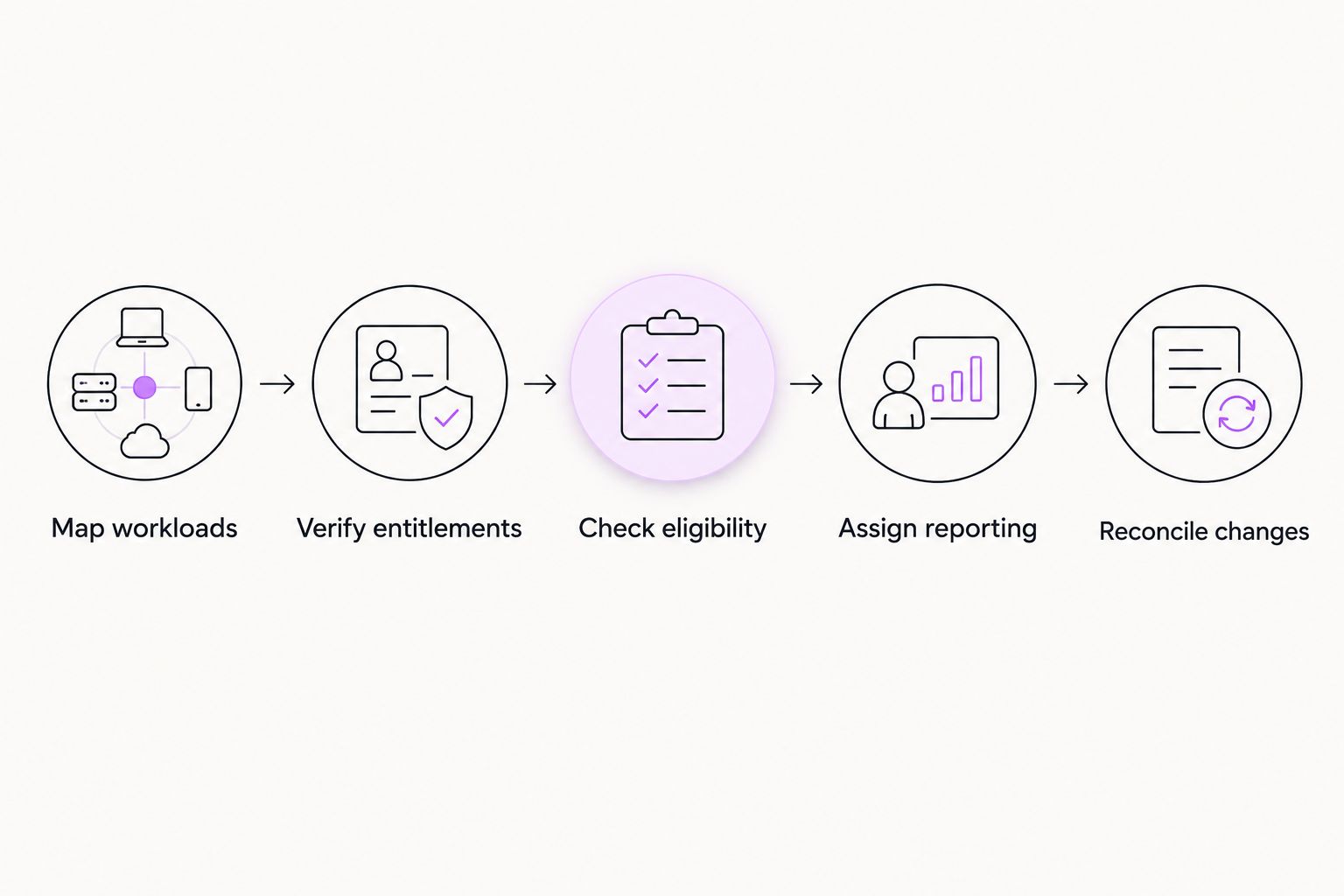
Validate eligibility before assigning the workload’s reporting treatment.
Apply 2 approval checks before excluding a workload from the SPLA report: confirm that the proposed licensing route is valid, then confirm that the technical deployment matches the approved conditions. These are recommended controls, not Microsoft-prescribed checklist counts.
What evidence should you retain?
Organize the decision into 3 evidence sets: entitlements, deployments, and reporting decisions. This is a recommended filing structure, not an additional licensing requirement. It makes the connection between purchased rights and deployed usage easier to examine.
Entitlements
Retain records identifying the customer, product, license type, and relevant entitlement period or assignment. Keep the applicable terms reference with the decision so that a later reviewer understands which conditions were assessed.
Do not substitute a reseller’s summary for the underlying licensing basis. A commercial description can help identify a purchase, but the governing agreement and product terms determine permitted use.
Deployments
Retain discovery and infrastructure records sufficient to explain what ran and where. Include the technical details relevant to the product’s licensing model and the hosting conditions supporting the approval.
Deployment evidence must connect to the customer and workload in the entitlement decision. A technically accurate inventory with no reliable customer mapping leaves the central question unresolved.
Reporting decisions
Retain the rationale for SPLA inclusion or exclusion, the supporting evidence references, and the approval record. Make changes traceable so that a later reporting position does not overwrite the explanation for an earlier one.
For a 2026 evidence file, identify the terms applicable to the assessed entitlement and deployment. Do not replace that evidence with a general statement that the customer uses CSP.
Where does software asset management help?
Software asset management connects discovered deployments with entitlement and reporting records. Its value is visibility and repeatable reconciliation; its limitation is that inventory data alone cannot establish a contractual right.
Octopus is best for SPLA partners and Authorized Outsourcers seeking usage reporting automation and licensing consulting. Its platform and consulting services address software asset management, customer billing, and audit defense. Those functions support mixed-estate management without making CSP and SPLA interchangeable.
Use Octopus software asset management to support the reporting workflow, while keeping the licensing rationale explicit. Automation should apply an approved rule to reliable data, not turn an unverified customer claim into a reporting exclusion.
If your deployment records and customer entitlement evidence disagree, resolve that discrepancy before changing the reported position. A licensing discussion should start with the workload facts and supporting documents, not a request for blanket customer approval.
Does a CSP purchase replace SPLA reporting?
A CSP purchase does not automatically replace SPLA reporting. Determine whether the customer entitlement legally covers the specific deployment before changing the provider’s reporting treatment. Retain the justification for any exclusion rather than relying on the purchase channel alone.
Can a customer keep CSP subscriptions while buying SPLA services?
A customer can retain CSP subscriptions while receiving separately licensed SPLA services. Each service needs its own valid licensing basis. Shared customer ownership does not merge the entitlements or remove the provider’s obligations.
Is dedicated infrastructure enough to approve customer licenses?
Dedicated infrastructure alone is not enough to establish licensing compliance. It is one deployment fact within a broader review of the product, entitlement, hosting rights, and applicable terms. Do not approve a customer-license arrangement from infrastructure configuration alone.
FAQ
Can I combine CSP and SPLA licenses for the same customer?
Yes, where each product and workload independently meets its licensing conditions. The customer can use both routes, but the entitlements are not automatically interchangeable.
Does a CSP invoice prove that my hosted workload is licensed?
No, a CSP invoice alone does not prove that the hosted deployment is permitted. Check the entitlement, applicable outsourcing rights, provider eligibility, and deployment conditions.
Can I subtract customer CSP licenses from my SPLA report?
Not solely because the customer owns CSP licenses. Establish a valid licensing basis for the specific deployment and document why the resulting reporting treatment applies.
Is CSP better than SPLA for every hosted customer?
No, CSP is not universally better than SPLA for hosted customers. The appropriate route depends on the actual product, entitlement, provider arrangement, and deployment rights.
Does an Authorized Outsourcer status approve every customer license?
No, Authorized Outsourcer status does not establish eligibility for every customer license. Product-specific entitlement and deployment conditions still need validation.
Can software discovery confirm that a CSP and SPLA combination is compliant?
Software discovery alone cannot confirm licensing compliance. It establishes deployment facts that must be assessed against entitlement evidence and applicable licensing terms.
How does Octopus help with mixed CSP and SPLA estates?
Octopus provides software asset management and consulting for SPLA partners and Authorized Outsourcers. Its services support usage reporting, customer billing, and audit defense; the licensing basis still needs documentation.
One last thing
The reporting exclusion deserves as much evidence as the reported usage. A workload absent from a SPLA report still needs an explanation if it exists in your deployment records.
For your next 2026 reconciliation, review exclusions before accepting the customer total. Require a traceable entitlement, an eligible deployment, and an approved reporting decision for each exclusion. That is the practical boundary between a mixed licensing estate and an undocumented assumption.