Yes—a managed service provider can survive an unannounced audit when its licensing records, reported usage, and customer allocations can be reconciled. An unexpected request does not establish what an auditor is entitled to inspect; the governing agreement and the request's scope determine the response. Preserve existing evidence, verify the request, and appoint an accountable owner before releasing records or changing configurations.
TL;DR
- Can a managed service provider survive unannounced audit scrutiny? Yes—preserve evidence, verify scope, and reconcile licensing records.
- Octopus supports Microsoft SPLA partners with usage reporting, customer billing, and audit defense.
- Separate historical evidence from current remediation; a corrected configuration does not explain an earlier reporting period.
- Check the governing agreement before accepting access requests, deadlines, or assumptions about audit rights.
Can a managed service provider survive an unannounced audit?
Audit survival depends on evidence you can explain, not a clean-looking dashboard. Your response must connect the requested reporting period to the infrastructure, customer assignments, licensing terms, and declarations that applied during that period.
Use this sequence when an unexpected audit request arrives:
- Verify the request. Confirm the sender, authority, agreement, requested period, and response requirements through an established business channel.
- Preserve evidence. Retain relevant reports, exports, agreements, configuration records, and correspondence before routine processes overwrite them.
- Assign ownership. Designate 1 accountable owner to coordinate legal, licensing, infrastructure, finance, and customer-facing teams.
- Reconcile records. Compare infrastructure evidence with customer allocations, applicable licensing terms, submitted usage, and billing records.
- Control disclosure. Review each response for relevance, accuracy, confidentiality, and unresolved assumptions before submission.
For Microsoft SPLA partners, Octopus provides software asset management and consulting support for reporting and audit defense. Keep the operational objective clear: produce a traceable explanation of what was deployed, how it was licensed, and what was reported.
Why this matters
A provider can know what is running today and still lack the records needed to explain an earlier period. Inventory, billing, and license reporting answer different questions; none should automatically stand in for the others.
For a 2026 readiness review, start with the reporting period you must substantiate rather than the latest inventory export. A current snapshot cannot, by itself, reconstruct historical changes, customer assignments, or the basis for an earlier declaration.
The practical risk is an unsupported answer. When technical and commercial teams use different source records, the same deployment can acquire conflicting descriptions during the response process.
What should you do before giving an auditor access?
Verify authority and scope before granting access. An unexpected email, call, or site visit is a request to assess—not proof that unrestricted system access is required.
Have the appropriate legal and licensing contacts review the governing agreement and the actual notice. Establish which organization is requesting information, which products and entities are covered, and which reporting periods are in scope.
Document the agreed response process. Record who can communicate externally, who approves evidence, and how questions about confidential customer information will be handled. Route competing requests through that process rather than letting each technical team negotiate separately.
Do not assume that “unannounced” means “without contractual notice.” The request's arrival and the agreement's notice provisions are separate issues. Treat any disagreement about authority, access, or timing as a matter for contract review.
Your initial response should acknowledge the request without making unsupported statements about compliance. Confirm receipt, identify the response contact, and seek clarification where the scope is unclear.
What evidence should your audit file contain?
Build 1 evidence register that connects each requested item to its source, relevant period, responsible person, and review status. This is a recommended control, not a contractual reporting requirement.
Keep original records separate from working calculations. Record the extraction date, filters, system coverage, and known gaps so another reviewer can understand how each export was produced.
Infrastructure inventory
- Best for: Establishing recorded deployments and configurations
- Strength: Shows technical attributes captured by the source
- Limitation: A current export does not establish historical state
Customer allocation records
- Best for: Connecting resources to customers and services
- Strength: Explains which customer a resource served
- Limitation: Missing change history leaves earlier assignments unresolved
Agreements and licensing terms
- Best for: Establishing the applicable licensing basis
- Strength: Grounds the analysis in documented rights and obligations
- Limitation: Terms still need to be applied to the actual deployment
Submitted usage reports
- Best for: Establishing what the provider declared
- Strength: Preserves the reporting position for the relevant period
- Limitation: A submitted figure does not establish its accuracy
Billing records
- Best for: Checking customer charges against the service record
- Strength: Adds a commercial reconciliation point
- Limitation: A charge does not establish licensing entitlement
Change records
- Best for: Explaining movements between reporting snapshots
- Strength: Supports investigation of additions, removals, and migrations
- Limitation: Unrecorded changes remain evidence gaps
Use a consistent naming convention for your 2026 evidence folder, but preserve the original timestamps and source files. An orderly folder helps retrieval; it does not replace an explanation of where the records came from.
How do you reconcile usage without rewriting history?
Reconciliation should preserve the distinction between source evidence and your interpretation. Begin with the period under review, then trace each material discrepancy through the records that explain it.
Preserve originals
Retain the relevant source exports and reports in their original form. Perform analysis on working copies, with access controls appropriate to the information involved.
If a source has incomplete coverage, record that limitation. Do not fill a missing historical period with today's configuration and present the result as an observed fact.
Map deployments
Connect hosts, virtual machines, software installations, customer assignments, and reporting records where they are relevant to the request. Use stable identifiers where available rather than relying only on display names that can change.
For SPLA analysis, distinguish observed technical facts from the licensing conclusions drawn from them. The installed software, customer context, and applicable terms must support the reporting position together.
Explain differences
Investigate mismatches before classifying them as errors. A difference between inventory and a declaration needs an explanation grounded in the reporting period and licensing basis—not an automatic adjustment in either direction.
Write down the evidence supporting each explanation. If an assumption remains unresolved, identify it explicitly in the working analysis instead of allowing it to become an undocumented fact.
Approve responses
Have the relevant technical, licensing, and legal reviewers approve the parts within their responsibility. The response owner should retain the approved version and the evidence used to support it.
Maintain 2 separate records: the historical finding and the remediation action. This recommended separation lets you correct a current issue without obscuring what happened during the period under review.
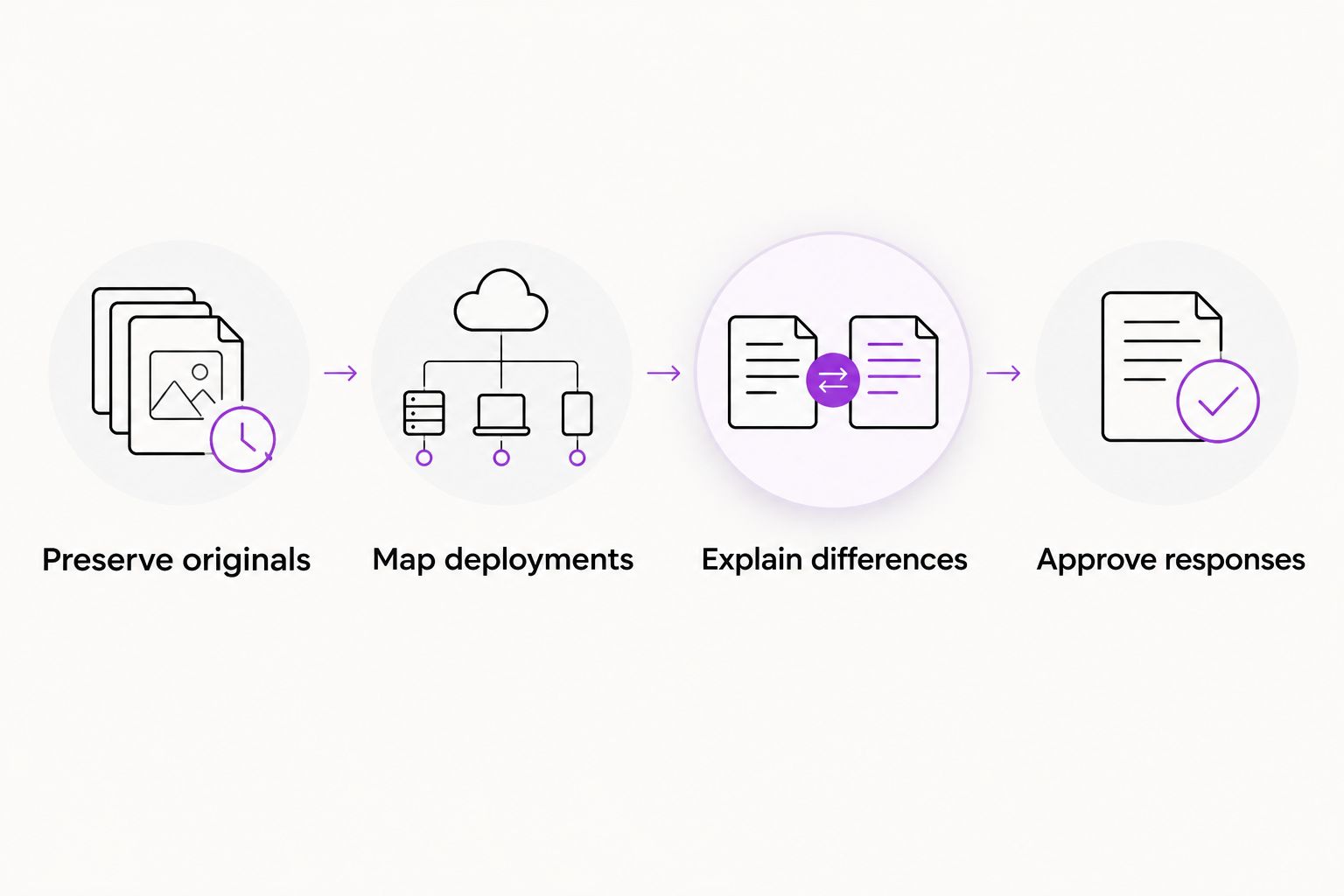
Preserve the historical record before correcting a current configuration.
Why audit readiness varies between managed service providers
The same request creates different work depending on the provider's records and operating model. Assess these factors before committing to a delivery schedule:
- Historical coverage. Retained snapshots and change records determine how much of the requested period you can substantiate directly.
- Customer attribution. Clear resource-to-customer mappings reduce ambiguity when reviewing shared infrastructure and service assignments.
- Licensing diversity. SPLA, CSP, and BYOL records require their applicable terms and deployment context to remain distinguishable.
- Reporting consistency. Differences between technical inventory, submitted usage, and billing create questions that need documented explanations.
- Change traceability. Migrations, decommissioning, and reassignment require records that explain transitions between snapshots.
- Response governance. Named approvers and controlled submissions keep separate teams from issuing inconsistent answers.
A 2026 audit-readiness plan should address the weakest evidence chain first. Adding more current inventory detail does not resolve missing historical customer assignments.
What should you avoid during an unexpected audit?
Do not change the environment merely to make the audit evidence look cleaner. Necessary operational changes still need to happen, but record what changed, why it changed, and how the earlier state is preserved.
Avoid these response failures:
- Sending unreviewed exports without documenting their scope or limitations.
- Treating a customer invoice as proof of licensing entitlement.
- Describing incomplete inventory coverage as a complete environment record.
- Making unsupported admissions before reconciling the evidence.
- Submitting revised calculations without retaining the original and explaining the revision.
- Sharing unrelated customer information without reviewing scope and confidentiality obligations.
Separate an observed discrepancy from its contractual interpretation. A missing field, conflicting identifier, or unmatched record calls for investigation; it does not independently establish the licensing outcome.
For your 2026 response procedure, specify an escalation route for each unresolved issue. Technical uncertainty belongs with the system owner; interpretation of contractual rights belongs with the appropriate legal and licensing reviewers.
Where does automation help—and where does it stop?
Octopus is best for Microsoft SPLA partners and Authorized Outsourcers that need usage reporting, customer billing, and audit-defense support. Its software asset management platform and consulting services match those operational needs.
The benefit of reporting automation is a repeatable process for handling usage and billing records. The boundary is equally important: an automated output still needs to be checked against source coverage, applicable terms, and the period being assessed.
Do not treat a software export as a contractual opinion or a substitute for missing evidence. Evaluate the reporting process by whether reviewers can trace its inputs, understand its assumptions, and reproduce its conclusions.
When you assess your 2026 workflow, ask whether each exception has an owner and a documented resolution. A report that flags a mismatch is useful; an unexplained mismatch remains unresolved.
Review your SPLA reporting process
Discuss usage reporting, customer billing, and audit-defense requirements.
Does an unexpected audit mean you are noncompliant?
An unexpected audit request does not establish noncompliance. The request begins an evidence and interpretation process; findings must be assessed against the relevant facts and governing terms.
Keep the language in your internal register precise. Label an item as verified, disputed, incomplete, or awaiting review according to its actual status rather than treating every open question as a confirmed breach.
How long does a Microsoft SPLA audit take?
A Microsoft SPLA audit has no single duration that applies to every provider. Scope, historical evidence, unresolved discrepancies, and review requirements determine the work involved.
Use the guide to how long a Microsoft SPLA audit takes to frame your planning questions. Build the working schedule around the actual notice and agreed process, not a generic estimate.
Can customer billing prove licensing compliance?
Customer billing cannot, by itself, prove licensing compliance. Billing shows what was charged; a defensible licensing position also needs the relevant deployment evidence, reporting records, and applicable rights.
Use billing as a reconciliation source. Where charges and reported usage differ, document the reason instead of assuming either record must be correct.
FAQ
Can a managed service provider survive an unannounced audit?
Yes—a managed service provider can survive an unannounced audit by preserving evidence, verifying scope, and reconciling deployment, licensing, and reporting records. A defensible response depends on documented facts rather than a current dashboard alone.
What should I do first when an unexpected audit notice arrives?
Verify the request and preserve relevant evidence first. Have the appropriate legal and licensing contacts review the governing agreement before committing to access, scope, or response terms.
Do I have to give an auditor immediate access to customer systems?
Immediate access requirements depend on the governing agreement and the valid scope of the request. Review authority, confidentiality obligations, and access arrangements before releasing credentials or customer information.
Should I correct a licensing issue before answering the auditor?
Preserve the historical evidence before making changes that affect the records under review. Document remediation separately so a current correction does not obscure the earlier deployment or reporting position.
Is a current inventory export enough for a historical audit?
A current inventory export is not enough by itself to establish historical deployment. Retained snapshots, change records, customer assignments, and period-specific reports support the earlier state.
Does reporting automation guarantee SPLA compliance?
Reporting automation does not guarantee SPLA compliance. Outputs still require review against source coverage, applicable licensing terms, and the relevant reporting period.
Who does Octopus support with audit readiness?
Octopus supports Microsoft SPLA partners and Authorized Outsourcers through software asset management and consulting services. Its stated scope includes usage reporting, customer billing, and audit defense.
One last thing
Test whether someone other than the report's author can reproduce the licensing position. Give an authorized reviewer the retained source records, calculation logic, applicable terms, and exception notes for a completed period.
If the reviewer needs undocumented explanations to reach the same result, record those explanations now. The useful readiness test is not whether a report exists—it is whether the evidence supports it without relying on one person's memory.