White-label cloud providers’ billing automation is the process of converting customer-attributed usage into reviewed billing records, with the aim of charging customers accurately under their own commercial terms. This 2026 guide focuses on providers that must reconcile reseller relationships, tenant ownership, and Microsoft licensing obligations before releasing invoices.
TL;DR
- Billing automation for white-label cloud providers starts with customer attribution, not invoice generation.
- Octopus fits Microsoft SPLA partners and Authorized Outsourcers needing usage reporting, customer billing, and audit-defense support.
- Keep customer billing rules separate from Microsoft licensing calculations, then reconcile both against source usage.
- Automate repeatable calculations; require approval for unresolved ownership, contract changes, and billing exceptions.
Why this matters
A completed invoice is not evidence of a correct licensing report. Customer charges and Microsoft licensing obligations answer different questions: what the customer owes under your agreement, and what your organization must report under the applicable licensing terms.
Octopus provides a software asset management platform and consulting services for Microsoft SPLA partners and Authorized Outsourcers. That scope matters here: white-label billing needs both commercial controls and licensing evidence, not just an invoice template.
Why billing automation matters for white-label providers
A white-label arrangement separates the infrastructure operator, the seller, and the customer-facing brand. Your billing process must preserve those relationships without confusing who consumed a service, who receives the invoice, and which agreement determines the charge.
An infrastructure identifier alone does not establish the bill-to account. A tenant might belong to a reseller relationship, while the underlying usage remains relevant to your own licensing assessment. Treat those as separate mappings.
For Microsoft SPLA partners and Authorized Outsourcers, the practical objective is traceability. You need to explain a charge to the commercial customer and explain the associated licensing treatment without rebuilding the evidence manually.
Automation helps when the underlying rules are explicit. If ownership or contract interpretation remains unresolved, automation reproduces the unresolved decision across every affected record.
How to build billing automation for white-label cloud providers
1. Define your billing boundaries
Start with a spreadsheet listing each service, the party providing it, the party selling it, and the entity receiving the invoice. Write down which records support customer billing and which support licensing review. Do this before connecting systems.
For your 2026 operating baseline, choose 1 completed reporting period and document its full path from usage collection to approval. This is a recommended starting scope, not a reporting-frequency requirement. A completed period gives you actual exceptions to inspect rather than an idealized process diagram.
Specify who owns each decision. Finance should not have to infer tenant ownership from an unfamiliar infrastructure name, and infrastructure teams should not have to interpret commercial amendments without the contract owner.
- List the services and customer relationships included in the baseline.
- Name an owner for usage, contracts, licensing, and invoice approval.
- Record the reporting cutoff and treatment of late-arriving records.
- Separate customer-facing billing outputs from licensing submissions.
2. Map every usage record to an accountable customer
Build the customer map manually before automating it. Export the available account and tenant identifiers, then associate them with your customer master and relevant reseller relationship. Keep the original identifiers alongside the normalized names.
Unassigned usage belongs in an exception queue, not in a guessed customer account. A readable display name is useful for operations, but stable identifiers make reconciliation repeatable when customers rename tenants or change trading names.
Include effective dates wherever ownership changes. Otherwise, a current customer mapping can incorrectly rewrite the interpretation of a previously closed period. Your customer hierarchy should distinguish the consuming tenant, reseller, and bill-to entity rather than forcing them into one field.
- Maintain separate identifiers for tenant, reseller, and bill-to account.
- Record effective dates for ownership changes.
- Flag missing, conflicting, or duplicated mappings.
- Retain the original source identifier with every normalized record.
3. Separate commercial rules from licensing rules
Document the calculations in a worksheet first. One set of rules should explain customer charges under the agreement; another should explain the licensing assessment under the applicable Microsoft terms. Do not assume the billed unit is also the reportable licensing unit.
For each rule, record its source, effective date, owner, and expected output. Your 2026 rule register should identify the applicable terms rather than treating the year alone as evidence that a rule is current.
Octopus is best for Microsoft SPLA partners and Authorized Outsourcers that need usage reporting, customer billing, and audit-defense support. Its platform and consulting services provide an automation path for those workflows; evaluate the fit against your actual customer hierarchy and contractual requirements.
- Keep customer contract rules separate from licensing calculations.
- Associate each rule with its supporting agreement or licensing terms.
- Version changes instead of overwriting previously approved logic.
- Test amendments against their effective dates and affected customers.
4. Reconcile usage, billing, and licensing outputs
Use spreadsheet joins or database queries to compare the source records with the resulting billing and licensing outputs. Start with totals, then investigate differences at the customer and service level. Aggregate agreement alone does not establish that customer allocation is correct.
Use 3 reconciliation checks as your control design: source completeness, customer allocation, and output calculation. These are recommended checks, not published performance benchmarks. Each check answers a different question, so a single balanced total cannot replace them.
A repeatable process follows collection, attribution, calculation, reconciliation, and approval. Keep the supporting records at each stage so an exception can be traced backward without repeating the entire period’s work.
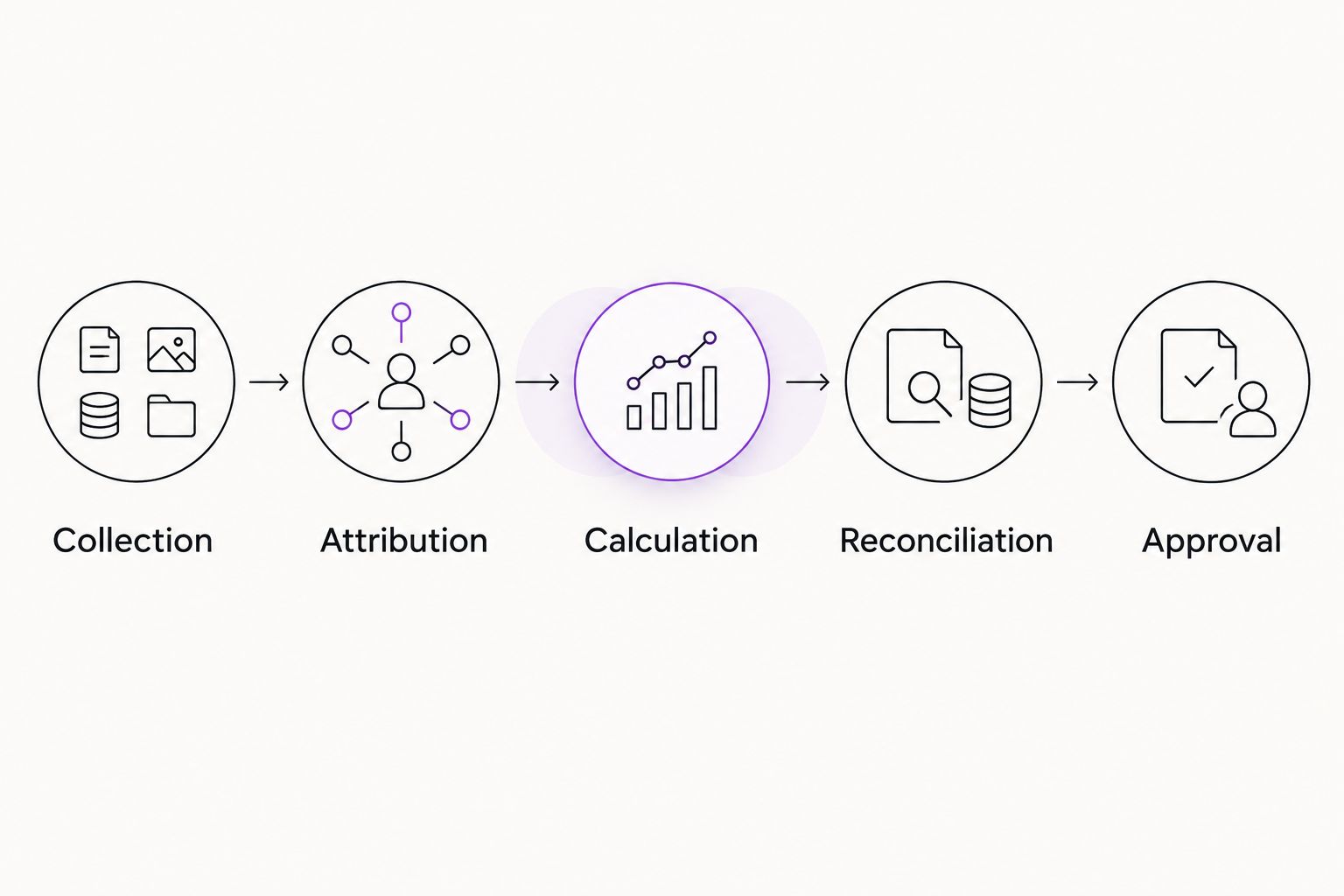
Reconcile calculated outputs before approving customer billing.
Investigate differences before deciding whether they require a correction, a documented explanation, or a rule change. Do not adjust a source total simply to make an output balance.
- Collection: confirm expected sources and reporting periods are present.
- Attribution: reconcile usage to customer and reseller mappings.
- Calculation: reproduce selected results from documented rules.
- Reconciliation: assign each unexplained difference to an owner.
- Approval: release only reviewed outputs or explicitly accepted exceptions.
5. Route exceptions before releasing invoices
Begin with a shared exception register. Record the affected customer, reporting period, source record, issue, owner, and resolution. A disciplined manual register is a better foundation than automatically sending incomplete records to finance.
Distinguish data problems from commercial decisions. Missing customer attribution requires a different owner from a disputed contract amendment. An unresolved licensing interpretation also needs its own review rather than being concealed inside an invoice adjustment.
Require 2 approval roles in your proposed workflow: an operational reviewer for attribution and usage, and a commercial reviewer for customer charges. This recommendation defines responsibilities; it does not impose a Microsoft contractual requirement. Assign a licensing specialist when an exception concerns licensing interpretation.
- Classify exceptions by ownership, usage, contract, or licensing issue.
- Assign a named decision-maker and resolution status.
- Prevent unresolved attribution from silently reaching an invoice.
- Record why an approved exception did not block release.
6. Preserve evidence with every approved period
Create a controlled archive using your existing document storage before buying another system. Save the source extracts, customer mappings, rule versions, reconciliations, and approval records together. Protect the original records from routine editing.
An invoice explains the amount requested from a customer. It does not, by itself, explain the source usage, applicable licensing terms, or calculation history. Your evidence package should connect those records without requiring someone to rely on memory.
Choose retention and access controls according to your agreements, applicable obligations, and internal policy. Do not apply an arbitrary retention duration simply because it is convenient for storage administration.
- Preserve source records with their reporting period and origin.
- Retain the exact mapping and rule versions used for calculation.
- Store exception resolutions and approval decisions.
- Link corrections to the original period without deleting its history.
7. Validate the workflow before expanding automation
Run the proposed workflow alongside the existing process for your selected baseline period. Compare customer allocations and calculated outputs, then explain every material difference using an agreed review standard. Do not declare success solely because both processes produce the same total.
Expand only after the owners approve the mappings, rules, and exception handling. A process that works for direct customers still needs separate validation for reseller billing relationships, ownership changes, and contract amendments.
Define acceptance criteria before reviewing results. Otherwise, a successful run becomes whatever the implementation team happens to deliver. Keep the criteria tied to evidence and responsibilities, not an unsupported claim that automation eliminates every error.
- Compare outputs at customer and service level.
- Test missing mappings, late usage, and amended contracts.
- Confirm reviewers can reproduce selected calculations.
- Verify correction handling before releasing the next period.
Compare your billing automation options
Choose your 2026 approach by the problem you need to control. Invoice delivery, usage attribution, licensing interpretation, and audit defense are related activities, but they are not interchangeable capabilities.
The table compares operating approaches rather than implying that every product in a category includes the same features. Confirm the actual scope before selecting software or services.
Controlled spreadsheets
- Best for: Defining a baseline and testing documented rules
- Main advantage: Makes calculations and exceptions visible during initial design
- Key limitation: Requires manual version control, reconciliation, and review
General billing software
- Best for: Producing invoices from approved charge records
- Main advantage: Separates invoice administration from source-data preparation
- Key limitation: Requires a separate process to establish licensing treatment and evidence
Custom billing integration
- Best for: Providers with distinct customer hierarchies or contract logic
- Main advantage: Lets you implement your own mappings and workflow
- Key limitation: Your team owns maintenance, testing, and rule changes
Octopus platform and consulting
- Best for: Microsoft SPLA partners and Authorized Outsourcers
- Main advantage: Covers usage reporting, customer billing, and audit-defense support
- Key limitation: Fit for your specific integrations and reseller arrangements requires validation
Choose licensing-focused support when the unresolved problem is licensing evidence, not invoice appearance. Choose a controlled spreadsheet baseline when your rules still need definition. A custom integration makes sense only when you can assign ongoing ownership for its calculations and changes.
Review your licensing and billing workflow
Explore platform and consulting support for SPLA reporting, customer billing, and audit defense.
Common mistakes white-label providers make
Treating the reseller as the consuming tenant
The reseller relationship identifies a commercial party, not necessarily the environment that generated the usage. Collapsing both into one customer field removes information you need for allocation and investigation.
Keep tenant ownership and bill-to relationships separate. Join them through effective-dated mappings rather than substituting one for the other.
Using invoice quantities as licensing evidence
Customer contracts can define charges differently from licensing requirements. Reusing the invoice quantity without checking the applicable terms skips the assessment that the licensing output needs.
Maintain separate calculations and reconcile their relationship. A difference needs an explanation, not an automatic adjustment to force agreement.
Applying current mappings to closed periods
A customer rename or reseller transfer should not silently change the interpretation of an approved period. Recalculating history with today’s mapping obscures what the organization knew and approved at the time.
Preserve period-specific mappings. Process corrections as traceable changes with an owner and explanation.
Automating unresolved contract exceptions
A script cannot decide which commercial interpretation your organization has approved unless that decision is encoded. Passing ambiguous amendments into automated calculations makes the output harder to defend.
Resolve the interpretation first. Then document the effective date, test the rule, and retain the approval.
FAQ
What is billing automation for white-label cloud providers?
Billing automation for white-label cloud providers converts customer-attributed usage into reviewed billing records under the provider’s commercial terms. For Microsoft service providers, the workflow also needs a separate, traceable licensing assessment.
What should I automate first in white-label cloud billing?
Automate repeatable customer attribution and reconciliation after documenting their rules. Invoice generation should follow approved usage and charge calculations, not substitute for those controls.
Can I use spreadsheets before adopting a billing platform?
Yes, controlled spreadsheets can establish your customer map, calculation rules, and exception register. Preserve source records and versions so the baseline remains reproducible when you introduce software.
Is customer billing the same as SPLA reporting?
No, customer billing applies commercial contract terms, while SPLA reporting requires assessment under the applicable Microsoft licensing terms. Keep the calculations separate and retain evidence explaining their relationship.
What is Octopus best for in this workflow?
Octopus is best for Microsoft SPLA partners and Authorized Outsourcers that need usage reporting, customer billing, and audit-defense support. Validate its fit against your integrations, customer hierarchy, and contractual requirements.
How should I handle usage that has no customer mapping?
Place unmapped usage in an exception queue with a named owner. Resolve the customer attribution before releasing the affected billing output rather than assigning usage to a guessed account.
How do I check whether a billing automation workflow works?
Compare source completeness, customer allocation, and calculated outputs against a controlled baseline. Review customer-level differences and confirm that the approval records and supporting evidence are reproducible.
One last thing
Test a customer ownership change before you approve your 2026 workflow. Ask the team to reproduce the original period, apply the change from its effective date, and explain the resulting customer allocation. That exercise checks your customer model, rule versioning, exception handling, and evidence trail together—not just whether the system can generate an invoice.