

Hyper-V host counts alone do not establish SPLA under-licensing or explain why Microsoft selected a provider for an audit. The compliance issue is whether the underlying infrastructure, workloads, applicable licensing terms, and submitted usage reports reconcile. Treat an unexplained host-count difference as an investigation item—not proof of an automatic audit trigger.
TL;DR
- Microsoft Hyper-V host counts are inventory evidence, not a standalone measure of SPLA licensing compliance.
- For ‘hyper-v host counts trigger spla audit,’ investigate reporting discrepancies rather than assume an automatic threshold.
- Reconcile physical host identities, workload placement, reporting periods, and submitted usage before drawing conclusions.
- Preserve historical evidence: today's Hyper-V inventory cannot establish what ran during an earlier reporting period.
Why this matters
A host-count mismatch is a reconciliation problem before it is a licensing conclusion. Counting infrastructure answers how many machines your records contain. Establishing SPLA compliance requires connecting those machines and their workloads to the licensing terms and reporting obligations that apply.
For your 2026 compliance review, separate inventory validation from license calculation. Octopus provides software asset management and consulting services for Microsoft SPLA partners and Authorized Outsourcers, including usage reporting, customer billing, and audit defense. Those activities depend on evidence that connects infrastructure to reported usage—not an isolated host total.
A smaller host estate is not a compliance exemption. A larger estate is not proof of a reporting failure. Your immediate task is to explain the difference between what exists, what operated during the relevant period, and what you reported.
Can Hyper-V host counts trigger a Microsoft SPLA audit?
Do not use a Hyper-V host count to predict audit selection. Use it to identify questions that your licensing records must answer. An auditor examining infrastructure can investigate a discrepancy, but the discrepancy itself does not establish the correct licensing quantity.
A defensible assessment follows this sequence:
- Define the population. Establish which physical hosts, clusters, business entities, and reporting periods the count covers. Exclude nothing merely because it complicates reconciliation.
- Verify host identities. Match records using stable identifiers rather than display names alone. Determine whether apparently different entries represent distinct machines or duplicate observations.
- Reconstruct workload placement. Establish which relevant workloads operated on which infrastructure during the period under review. Keep historical placement separate from the current configuration.
- Apply the governing terms. Determine the applicable product, licensing model, agreement, and effective terms before calculating a reporting quantity.
- Reconcile submitted usage. Compare the resulting calculation with the actual usage submission. Document differences, supporting evidence, and any corrective action.
These steps distinguish a discovery issue from a licensing issue. Without that distinction, you risk treating an inventory export as a completed compliance assessment.
Which review method gives you a defensible answer?
Both methods below have a role, but they answer different questions. Choose the method based on the decision you need to make, not the convenience of the available export.
Host-count check
- Best for: Initial inventory triage
- Advantage: Identifies unexplained differences between host lists
- Limitation: Does not establish workload history, applicable rights, or reportable usage
Historical licensing reconciliation
- Best for: Evaluating a reporting discrepancy
- Advantage: Connects infrastructure and workloads to applicable terms and submitted usage
- Limitation: Requires historical records, validated mappings, and licensing interpretation
Use a host-count check to locate exceptions; use historical licensing reconciliation to resolve them. Neither method should begin with the assumption that every discovered host creates the same licensing obligation.
What should you reconcile in a 2026 Hyper-V review?
Build a record that another person can follow without relying on your memory. The objective is not simply to produce matching totals; it is to explain why each relevant record belongs in the calculation.
Host identity
Retain the identifiers that distinguish physical machines from virtual machines and distinguish machines from management-system entries. Record the source of each identifier and resolve naming differences explicitly.
For example, 1 physical host appearing in 2 inventory rows is not evidence of 2 physical hosts. That example illustrates an inventory problem, not a licensing rule. Verify the machine identity before using either row in a compliance calculation.
Reporting period
Attach dates to inventory observations, workload evidence, and usage submissions. A machine visible during a 2026 review does not establish that the same machine operated throughout every period under examination.
Preserve the distinction between deployment, discovery, retirement, and removal from a management console. Those events answer different questions. A discovery date alone does not prove a deployment date.
Workload placement
Connect relevant workloads to their infrastructure and operating periods. Where workloads move between Hyper-V hosts, retain evidence of that movement rather than relying exclusively on their final location.
Suppose a review file contains 3 host identifiers for a workload across its recorded history. That does not establish simultaneous operation on 3 hosts or a particular license quantity. Reconstruct the sequence before applying the relevant terms.
Licensing basis
Record the product and licensing basis used for the calculation. Distinguish technical observations from contractual conclusions: an installed workload is an observation; the rights and reporting obligations applicable to that workload require a separate assessment.
Do not substitute a Hyper-V management label for a licensing determination. A host's name, cluster membership, or internal cost-center label does not establish its contractual treatment.
Submitted usage
Retain the submitted usage record alongside the calculation that supports it. Record who approved the calculation, which source records were used, and how exceptions were resolved.
A customer invoice is not a substitute for a usage submission. Keep the connection between billing and compliance visible while preserving the distinction between those records.
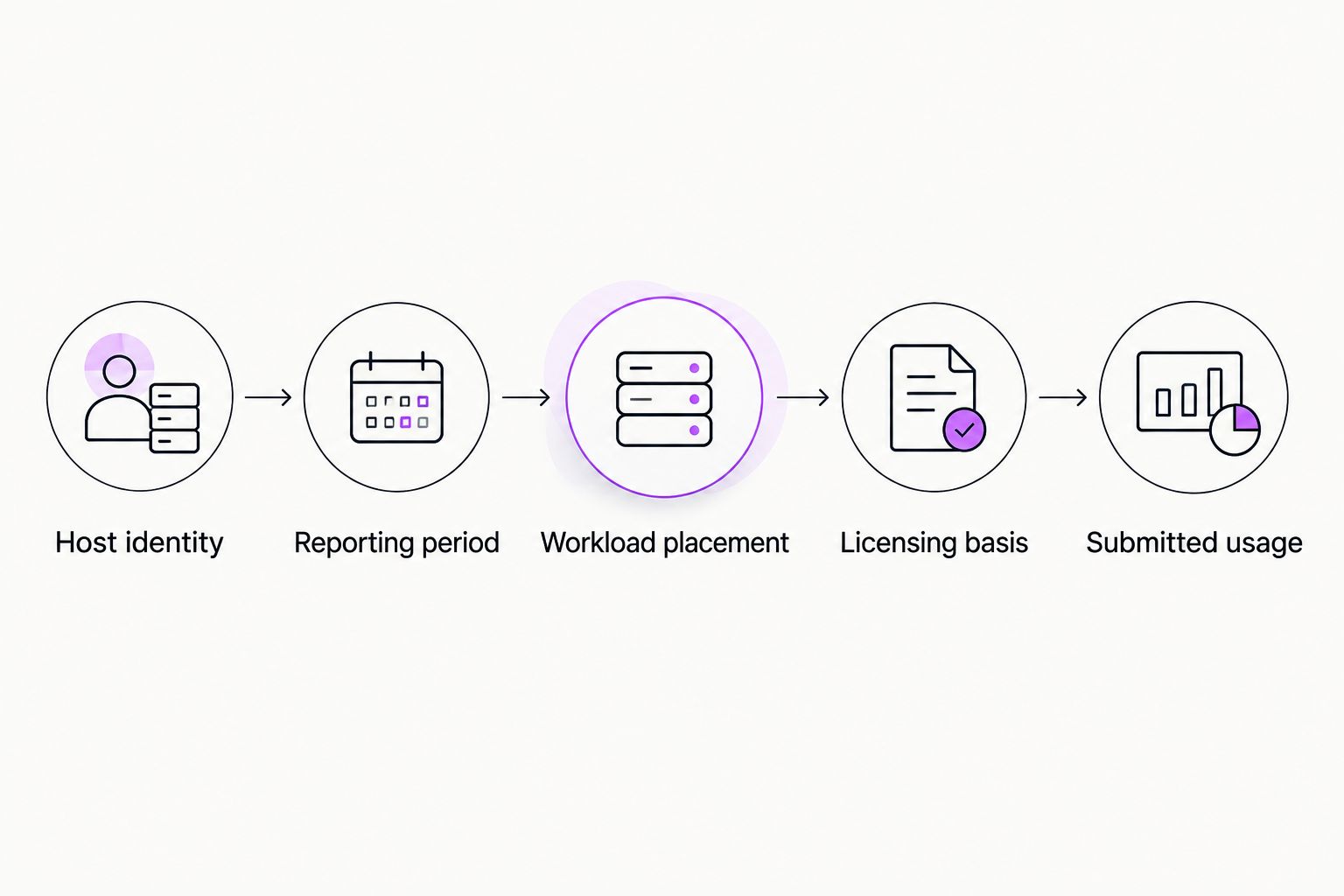
Validate infrastructure evidence before using it to calculate or explain reported usage.
Why a Hyper-V host discrepancy needs different explanations
A difference between discovery and reporting deserves investigation, but it does not have a single meaning. The explanation depends on what the compared records actually represent.
Use these factors to structure your review:
- Identity consistency. Renamed machines, duplicate observations, and inconsistent identifiers require validation before you compare totals.
- Time coverage. A current inventory and a historical usage submission describe different periods unless you deliberately align them.
- Workload history. Placement records must distinguish movement between hosts from simultaneous operation across hosts.
- Licensing scope. Determine which products, entities, agreements, and rights apply instead of treating the entire estate as one calculation.
- Evidence traceability. A calculated figure needs a documented connection to its source records, interpretation, approval, and submission.
These are investigation categories, not explanations you should assume. Mark an exception as resolved only when the supporting records establish what happened.
For a 2026 review, keep the original source exports and a separate reconciliation file. Editing the source to make totals agree removes the distinction between observed evidence and your interpretation of it.
What should you do when discovery and SPLA reporting disagree?
Preserve the discrepancy, investigate it, and document the outcome. Do not immediately increase a declaration to match a raw host total, and do not dismiss the difference because the reported quantity has remained unchanged.
Start with a clearly scoped exception statement. Identify the relevant host or workload, the reporting period, the records that disagree, and the question that remains unresolved. This prevents an inventory question from becoming an unsupported claim of under-licensing.
Next, separate technical ownership from licensing approval. Infrastructure staff can validate host identity and workload history; the person responsible for licensing must evaluate the applicable terms. Keep both conclusions in the same evidence record.
A useful exception record contains:
- The original observations and their collection dates.
- The physical host and workload identifiers involved.
- The reporting periods affected by the question.
- The applicable licensing interpretation and its supporting terms.
- The submitted usage being checked.
- The resolution, approver, and any required follow-up.
If the evidence establishes a reporting error, determine the appropriate correction through the applicable reporting process. Retain the original submission and the correction history rather than silently replacing the record.
Should you change a usage report just because the host count increased?
A host-count increase is not, by itself, a completed licensing calculation. Determine what changed, when it changed, which workloads were involved, and how the applicable terms treat that change before deciding whether reported usage needs correction.
Can today's Hyper-V inventory explain an earlier reporting period?
Today's Hyper-V inventory establishes a current observation, not a complete historical record. Use dated inventory, workload-placement evidence, change records, and the corresponding submissions to explain an earlier period.
Does a matching host count prove SPLA compliance?
A matching host count proves only that the compared totals agree. You still need to validate identities, workload history, licensing treatment, and submitted usage; matching totals can conceal different underlying records.
Where software and consulting fit
Octopus is best for Microsoft SPLA partners and Authorized Outsourcers seeking SAM software and licensing consulting. Its stated services cover usage reporting, customer billing, and audit defense—the operational areas that a host-count discrepancy can affect.
The advantage of combining software and consulting is the ability to address both reporting operations and licensing interpretation. The boundary remains clear: automation does not replace the applicable agreement, and a platform cannot turn absent historical evidence into a verified deployment history.
For your 2026 review, define the evidence problem before evaluating support. Ask which records are required, how exceptions will be reviewed, and who will approve the final licensing position. Avoid treating a completed import or a populated dashboard as a completed reconciliation.
Bring the source inventory, affected reporting periods, submitted usage, and unresolved questions to an Octopus licensing discussion. That gives the discussion a specific objective: establish the facts and determine the appropriate reporting treatment.
What should your audit evidence package explain?
An evidence package should let a reviewer follow the path from observed infrastructure to submitted usage. Organize it around that path rather than around whichever system produced the largest export.
Keep source files identifiable and preserve their collection dates. Store calculations separately, with the assumptions and licensing terms used to produce them. Where an exception remains unresolved, state the unresolved question rather than presenting an assumption as a verified fact.
Your summary should explain scope, methodology, material differences, and the supporting records for each conclusion. Include enough detail to reproduce the reasoning without requiring the reviewer to reconstruct it from unrelated spreadsheets.
This is also the practical standard for a 2026 internal review. A total that nobody can reproduce is less useful than an explicitly documented exception with a clear owner and a defined next action.
FAQ
Can Hyper-V host counts automatically trigger a Microsoft SPLA audit?
Do not treat a Hyper-V host count as an automatic audit trigger. A count alone neither explains audit selection nor establishes SPLA under-licensing; investigate the underlying infrastructure and reporting evidence.
Is every Hyper-V host a separate SPLA reporting unit?
A Hyper-V host count is not a universal SPLA reporting unit. Determine the applicable product, licensing model, agreement, and effective terms before calculating reportable usage.
Does an extra discovered host mean we under-reported SPLA usage?
An extra discovered host does not by itself prove under-reporting. Validate its identity, operating period, workloads, and applicable licensing treatment before comparing the result with submitted usage.
What records should we keep for a Hyper-V licensing review?
Keep dated host inventories, stable identifiers, workload-placement history, applicable licensing terms, calculations, and submitted usage records. Preserve exception decisions and approvals alongside the supporting evidence.
Can a current inventory prove historical SPLA compliance?
A current inventory cannot by itself prove historical SPLA compliance. Historical conclusions require evidence aligned with the reporting periods under review.
Should we replace the original report after finding an error?
Preserve the original submission and document the correction history. Determine the appropriate correction through the applicable reporting process rather than silently overwriting the record.
Can Octopus help with SPLA reporting and audit defense?
Octopus provides SAM software and consulting services for Microsoft SPLA partners and Authorized Outsourcers. Its stated scope includes usage reporting, customer billing, and audit defense.
One last thing
Equal totals can hide unequal records. Two inventories can contain the same number of hosts while referring to different machines, dates, or workload placements. Compare record identities and time coverage before declaring the reconciliation complete.
Make your next action specific: select an unexplained host record, trace it through workload history and the applicable licensing calculation, then connect it to the corresponding usage submission. Fix the evidence chain before drawing conclusions from the estate-wide total.