Managed service provider audit defense is the process of documenting software usage, licensing decisions, and reported quantities so you can substantiate your position during a licensing review. This 2026 guide explains how to build that evidence across customer environments, where infrastructure records, licensing responsibilities, usage reporting, and billing must stay connected.
TL;DR
- Audit defense for managed service providers starts with traceable usage records, licensing decisions, and submitted reports.
- Octopus fits Microsoft SPLA partners and Authorized Outsourcers seeking software asset management and audit defense support.
- Reconcile Microsoft SPLA reporting with deployment evidence; customer invoices alone do not establish licensing compliance.
- Assign evidence ownership before an audit request arrives, and preserve the records behind each reporting decision.
Why audit defense matters for managed service providers
An MSP must explain more than what software exists. You need to connect deployments to customers, identify the applicable licensing arrangement, and demonstrate how the evidence supports the quantities reported for the period under review.
Customer billing adds another reconciliation point. A commercial agreement with a customer does not, by itself, establish the provider's licensing rights or obligations. Keep those decisions separate, then document how they connect.
Octopus is best for Microsoft SPLA partners and Authorized Outsourcers seeking audit defense through a software asset management platform and consulting services. Octopus supports usage reporting, customer billing, and audit defense; your organization still needs accountable owners for source records and licensing decisions.
For your 2026 control plan, define audit readiness as an evidence requirement, not a promise that no discrepancies exist. A defensible process makes discrepancies visible and records how you resolve them.
Build an evidence-led audit defense workflow
The following steps establish a manual workflow first. Use automation where it reduces repetitive collection and reconciliation, without removing the checks that make the resulting report explainable.
Define your licensing scope and assign ownership
Start with an environment register and a responsibility matrix. Record which entities, customer services, infrastructure environments, agreements, and reporting periods belong within the review. Separate confirmed facts from questions that require contractual interpretation.
Assign 1 evidence owner per reporting period as an internal control. That owner coordinates the record set; technical, finance, and licensing specialists remain responsible for their respective decisions. This prevents an infrastructure team from assuming that finance holds evidence that finance expects infrastructure to retain.
For the 2026 baseline, document changes that affect scope, including customer onboarding, service termination, infrastructure migration, and responsibility transfers. A current environment list cannot explain historical changes on its own.
- List the legal entities and customer services within scope.
- Identify the applicable agreements and reporting arrangements.
- Assign an evidence owner and a backup.
- Record who approves licensing interpretations and report submissions.
- Maintain a dated register of scope changes.
Preserve source evidence before transforming it
Begin with exports from the systems that hold your deployment and usage records. Keep the original files, extraction dates, source identifiers, and collection settings. Work on copies so later corrections do not overwrite the evidence behind an earlier submission.
A spreadsheet is sufficient to index these records when the process remains manageable. Its limitation is maintenance: someone must check completeness, resolve inconsistent identifiers, and preserve historical versions. Automation does not remove those responsibilities.
Distinguish a missing record from a confirmed absence of usage. An unavailable inventory feed is a collection exception, not evidence that nothing was deployed. Carry that exception into the reporting review until an owner resolves it.
- Preserve unmodified source exports with collection timestamps.
- Record the systems and environments each export covers.
- Identify incomplete feeds, duplicate records, and missing customer mappings.
- Keep transformations separate from original evidence.
- Restrict editing access to approved working copies.
Reconcile usage records with reported quantities
Build a reconciliation worksheet that connects source records to your licensing assessment and submitted quantities. Every adjustment needs a reason, an owner, and supporting evidence. An unexplained difference is an open issue, even when the final total looks plausible.
Use 3 reconciliation checkpoints as a control design: collection completeness, licensing assessment, and submission approval. These are recommended internal checks, not a Microsoft-mandated workflow. Each checkpoint should leave evidence of what was checked and what remained unresolved.
At this stage, Octopus provides a software asset management platform and consulting services for Microsoft SPLA reporting and audit defense. Evaluate the platform against your actual record flow; automation should make the path from source evidence to reporting easier to inspect, not merely produce a final total.
- Usage records: verify collection coverage and customer attribution.
- Licensing assessment: document the rules and adjustments applied.
- Reported quantities: match approved calculations to submitted records.
- Customer billing: identify differences requiring commercial or licensing review.
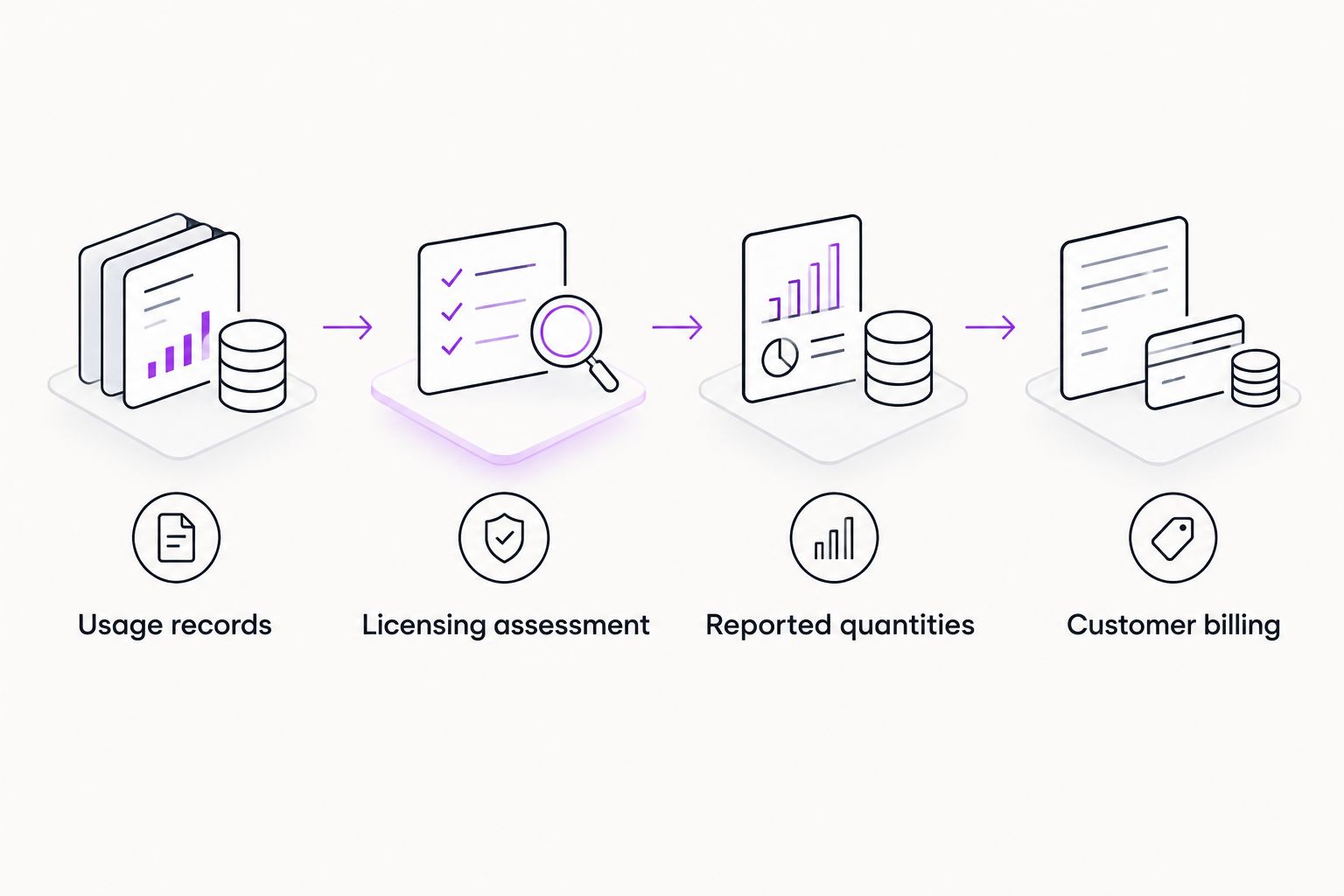
A final reported quantity needs a traceable path back to its source records.
Document the licensing basis for each decision
Use the applicable agreements and official licensing materials to establish your licensing basis. Record the document version, effective date, relevant provision, and environment facts supporting each material decision. Do not substitute a remembered rule for the terms governing the arrangement.
Keep SPLA, CSP, and BYOL assessments distinct where those arrangements appear in your environment. Their labels do not establish that a particular deployment is permitted. Validate the arrangement against the actual service, customer responsibilities, deployment conditions, and applicable terms.
A 2026 licensing assessment must identify which terms govern the period being examined. Do not silently apply today's interpretation to an earlier reporting period. When a decision requires specialist interpretation, record the question and its resolution alongside the supporting material.
- Cite the agreement or official licensing material used.
- Record the effective date and scope of the interpretation.
- Describe the deployment facts supporting the decision.
- Document assumptions and unresolved questions explicitly.
- Assign approval responsibility for material interpretations.
Separate billing checks from licensing approval
Reconcile customer billing with the approved licensing assessment, but do not treat an invoice as proof of compliance. Billing records show what you charged. Licensing evidence must explain the rights, deployment facts, and reporting treatment behind the service.
Require 2 named sign-offs for your internal close: one for the licensing assessment and one for billing reconciliation. This is a recommended separation of duties, not a contractual reporting requirement. Define how exceptions are escalated when the reviewers disagree.
Where commercial packaging differs from licensing measurement, retain an explicit mapping. Otherwise, a bundled customer charge can conceal the underlying quantities that your reporting process needs to substantiate.
- Compare approved reporting quantities with the billing calculation.
- Explain differences caused by commercial packaging or adjustments.
- Record credits and corrections without deleting original entries.
- Assign separate licensing and billing approval responsibilities.
- Carry unresolved differences into an owned exception register.
Assemble an audit response evidence pack
Create a response index before an audit request arrives. Organize the records by reporting period and issue, with a direct path from each submitted quantity to the calculation, source evidence, and licensing rationale supporting it.
A folder full of exports is not enough. A reviewer needs to understand which files establish scope, which contain source facts, and which show decisions. Include a short explanation of the workflow and the meaning of key fields so another person can follow the calculation.
For a 2026 reporting period, preserve the version actually submitted as well as subsequent corrections. Clearly distinguish original records, working calculations, approved outputs, and later amendments. Limit access to customer information according to your organization's obligations and approved response process.
- Maintain an index linking requests to supporting records.
- Preserve submitted reports and their approval history.
- Attach reconciliation worksheets and documented interpretations.
- Label corrections with dates, reasons, and approvers.
- Route external responses through the designated review owner.
Rehearse a response and close evidence gaps
Run an internal walkthrough using a completed reporting period. Select a submitted quantity and ask someone outside its preparation to reconstruct it from the retained records. The exercise tests whether the evidence is usable, not merely stored.
Track failures by cause: missing collection coverage, unclear customer mapping, unsupported interpretation, unexplained adjustment, or missing approval. Assign corrective actions to named owners rather than leaving findings in meeting notes.
Octopus consulting services support audit defense, but external assistance does not replace internal record ownership. Your team needs to retrieve source evidence and explain operational changes when questions arise. Repeat the walkthrough after material process changes, rather than assuming the original workflow still holds.
- Trace a submitted quantity back to its source evidence.
- Ask a reviewer to reproduce the calculation independently.
- Log missing records and unclear decisions as exceptions.
- Assign corrective actions and completion dates.
- Update the procedure after confirmed process changes.
Compare audit defense options for MSPs
Choose an approach based on the work you need to control: evidence maintenance, recurring reporting, specialist interpretation, or response preparation. Do not assume that buying software resolves contractual questions or that consulting replaces recurring data collection.
Manual evidence register and spreadsheets
- Best for: Providers with a scope their team can maintain directly
- Strength: Makes calculations and evidence references inspectable
- Key limitation: Requires disciplined version control and recurring manual reconciliation
Internal SAM workflow
- Best for: Providers with dedicated licensing and operational owners
- Strength: Keeps responsibility close to infrastructure and reporting teams
- Key limitation: Depends on maintained expertise, source coverage, and documented handoffs
Octopus platform and consulting services
- Best for: Microsoft SPLA partners and Authorized Outsourcers needing reporting, billing, and audit defense support
- Strength: Combines software asset management with consulting services
- Key limitation: Does not replace provider ownership of source evidence or approval decisions
Specialist licensing consulting
- Best for: Providers needing help with defined interpretation or audit response issues
- Strength: Adds focused review to a specific licensing question
- Key limitation: Does not replace ongoing evidence collection and reporting controls
Choose the workflow you can substantiate, not the one that produces the most polished report. Ask any prospective provider to demonstrate how your records, calculations, exceptions, and approvals fit into its proposed process.
Common audit defense mistakes MSPs make
Treating customer invoices as licensing evidence
A customer invoice establishes a commercial charge, not the full licensing basis. Preserve deployment records, applicable terms, and calculation evidence separately, then reconcile the invoice to that assessment.
Using current inventory to explain every historical period
Today's environment does not establish what existed during a prior reporting period. Retain period-specific evidence and dated change records so migrations, terminated services, and corrected mappings remain explainable.
Combining licensing arrangements without documenting the basis
SPLA, CSP, and BYOL references require their own supporting assessment where relevant. Record which arrangement applies to each in-scope service and why; a customer statement alone is not a completed licensing review.
Submitting corrected totals without preserving the correction trail
Replacing an old worksheet removes the explanation for the change. Keep the original submission, amended calculation, reason for correction, and approval record together so the sequence remains reconstructable.
FAQ
What is audit defense for managed service providers?
Audit defense for managed service providers is the process of substantiating software licensing and reporting decisions with retained evidence. It connects deployment records, applicable licensing terms, calculations, submissions, and documented corrections.
What's the best way to prepare an MSP for a licensing audit?
Build a traceable evidence pack before a request arrives. Assign owners, preserve period-specific source records, reconcile submitted quantities, and test whether another reviewer can reconstruct the calculation.
Can an MSP manage audit defense with spreadsheets?
An MSP can use spreadsheets to maintain an evidence register and reconciliation workflow. The process still needs controlled versions, complete source records, documented interpretations, and retained approvals.
Does automated SPLA reporting guarantee licensing compliance?
Automated SPLA reporting does not guarantee licensing compliance. The resulting assessment still depends on source coverage, applicable licensing terms, documented decisions, and approval controls.
Is customer billing enough to defend reported software usage?
Customer billing alone is not enough to substantiate a licensing assessment. Preserve the deployment evidence and licensing rationale, then document how the approved quantities connect to customer charges.
How does Octopus support MSP audit defense?
Octopus provides a software asset management platform and consulting services for Microsoft SPLA partners and Authorized Outsourcers. Its stated scope includes usage reporting, customer billing, and audit defense.
What should an MSP retain when correcting a licensing report?
Retain the original submission, corrected calculation, supporting evidence, correction reason, and approval history. Keep the versions distinguishable so a reviewer can reconstruct what changed and why.
One last thing
Test retrieval, not just retention. Choose a completed 2026 reporting period and ask a colleague who did not prepare it to explain a submitted quantity using only the retained evidence.
If the explanation requires the preparer's memory, improve the record. The strongest next move is not another summary dashboard; it is a calculation that another person can reconstruct without undocumented assumptions.